Applied Chemistry (CE) II
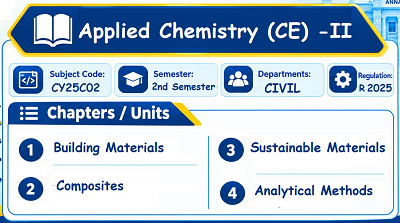
CY25C02 2nd Semester Civil Dept | 2025 Regulation
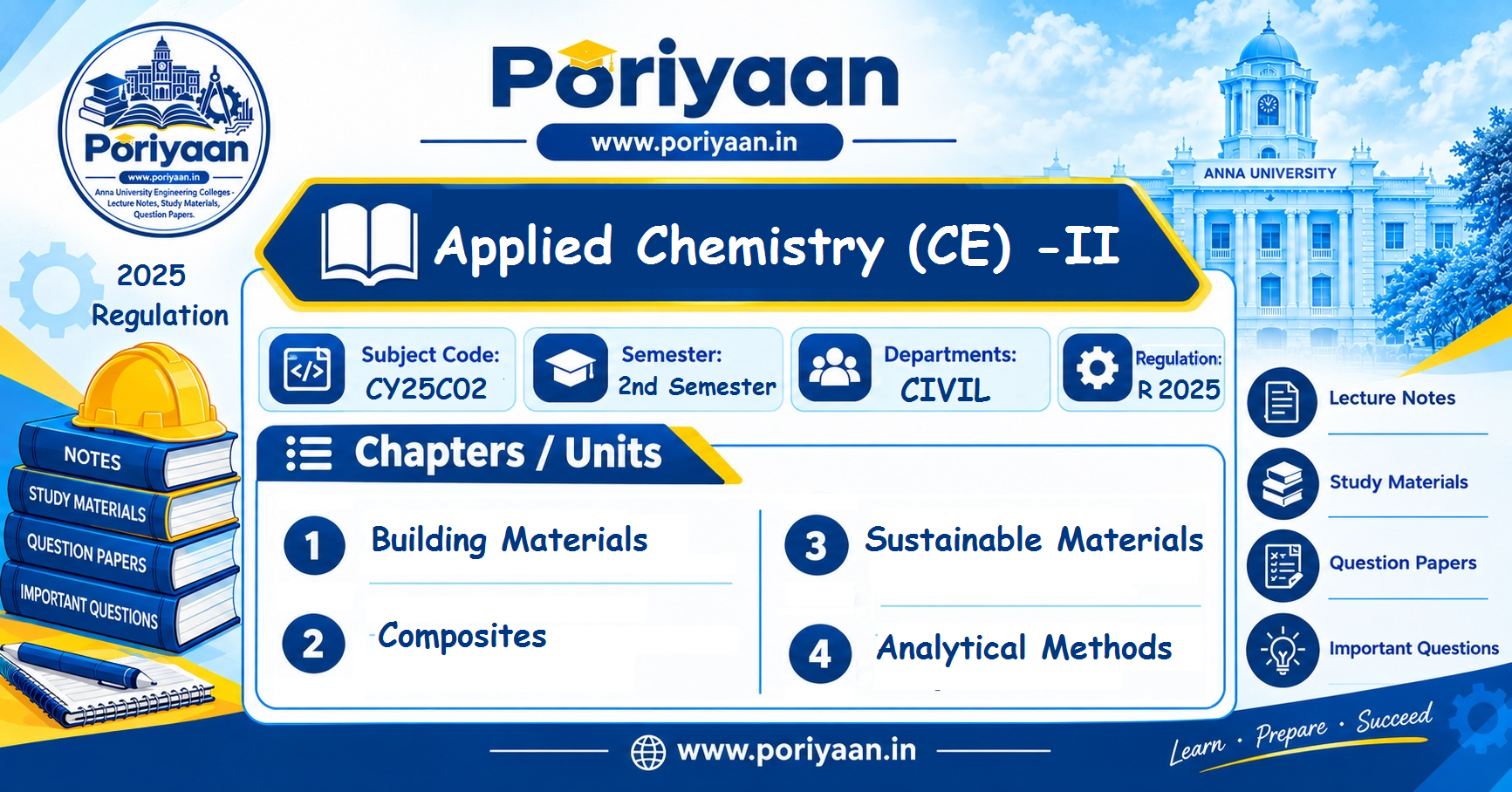
2025 regulation - 2nd semester for Civil Department. Subject Code: CY25C02, Subject Name: Applied Chemistry (CE) II, Batch: 2025, 2026, 2027, 2028. Institute: Anna University Affiliated Engineering College, TamilNadu. This page has Applied Chemistry (CE) II (CY25C02) study material, notes, semester question paper pdf download, important questions, lecture notes.
PDF Download Links
Applied Chemistry (CE) II
PDF Download Links
Applied Chemistry (CE) II
PDF Download Links
Bricks:
• Bricks
• Manufacture of bricks
• Classification of bricks
• Testing of bricks
• Uses of bricks
Stones:
• Rocks
• Qualities / properties of good building stones
• Testing of building stones
• Types of building stones and their uses
Sand:
• Sand
Cement:
• Ordinary Portland Cement
• Constituents, Ingredients of Cement Concrete
• Characteristics or properties of cement concrete
• Advantages & disadvantages of cement concrete
• Uses of cement concrete
• Preparation of cement concrete
• Types of cement concrete
• Cement concrete types according to the purpose
• SLUMP TEST - Measurement of Workability of Concrete
Mortar:
• Mortar and its Types
• Properties, Uses of cement mortar
Cement concrete:
• Constituents, Ingredients of Cement Concrete
• Characteristics or properties of cement concrete
• Advantages & disadvantages of cement concrete
• Uses of cement concrete
• Preparation of cement concrete
• Types of cement concrete
• Cement concrete types according to the purpose
• SLUMP TEST - Measurement of Workability of Concrete

CY25C02:
Applied Chemistry (CE) – II
Course
Objectives
•
To provide comprehensive understanding of chemistry concepts in building
materials.
Building
Materials: Introduction, Bricks, Glass, Cement,
Special Cement, Concrete, Reinforcement.
Activities:
Virtual demonstration of properties of building materials.
Composites:
Types, Matrix materials, Hybrids, Fiber Reinforcement, Characteristics, PMC,
MMC, CM Applications.
Activities:
Virtual demonstration of fabrication of composite materials.
Sustainable
Materials: Bio-based materials, Product &
Technology development, Admixtures, Environmental aspects, energy efficiency.
Activities:
Calculation of carbon footprint in buildings.
Analytical
Methods: Thermal conductivity, porosity, absorption
and emission characteristics of building materials.
Activities:
Analytical methods with virtual experiments, Hands-on demonstration of any one
of the methods.
Weightage:
Continuous Assessment: 40%, End Semester Examinations: 60%
Methodology for
Continuous Assessment: Quiz (5%), Assignments (20%),
Flipped Class (5%), Virtual Practice (20%), Internal Examinations (50%)
References:
1.
Jain, P. C., & Jain, M. (2022). Engineering chemistry. Dhanpat Rai
Publishing Company (P) Ltd.
2.
Eckold, G. (1994). Design and manufacture of composite structures. Woodhead
Publishing Ltd.
3.
Skoog, D. A., West, D. M., Holler, F. J., & Crouch, S. R. (2022).
Fundamentals of analytical chemistry. Cengage Learning India Pvt. Ltd.
4.
Spitzer, W. G., & Simonson, K. (2011). Green building materials: A guide to
product selection and specification. Wiley
E- resources:
1.
https://archive.nptel.ac.in/courses/112/104/112104229/
2.
https://nptel.ac.in/courses/103108100
2nd Semester 2025 Regulation : CY25C02 2nd Semester Civil Dept | 2025 Regulation Applied Chemistry (CE) II