Embedded Systems
EC25C17 3rd Semester MECH Dept | 2025 Regulation
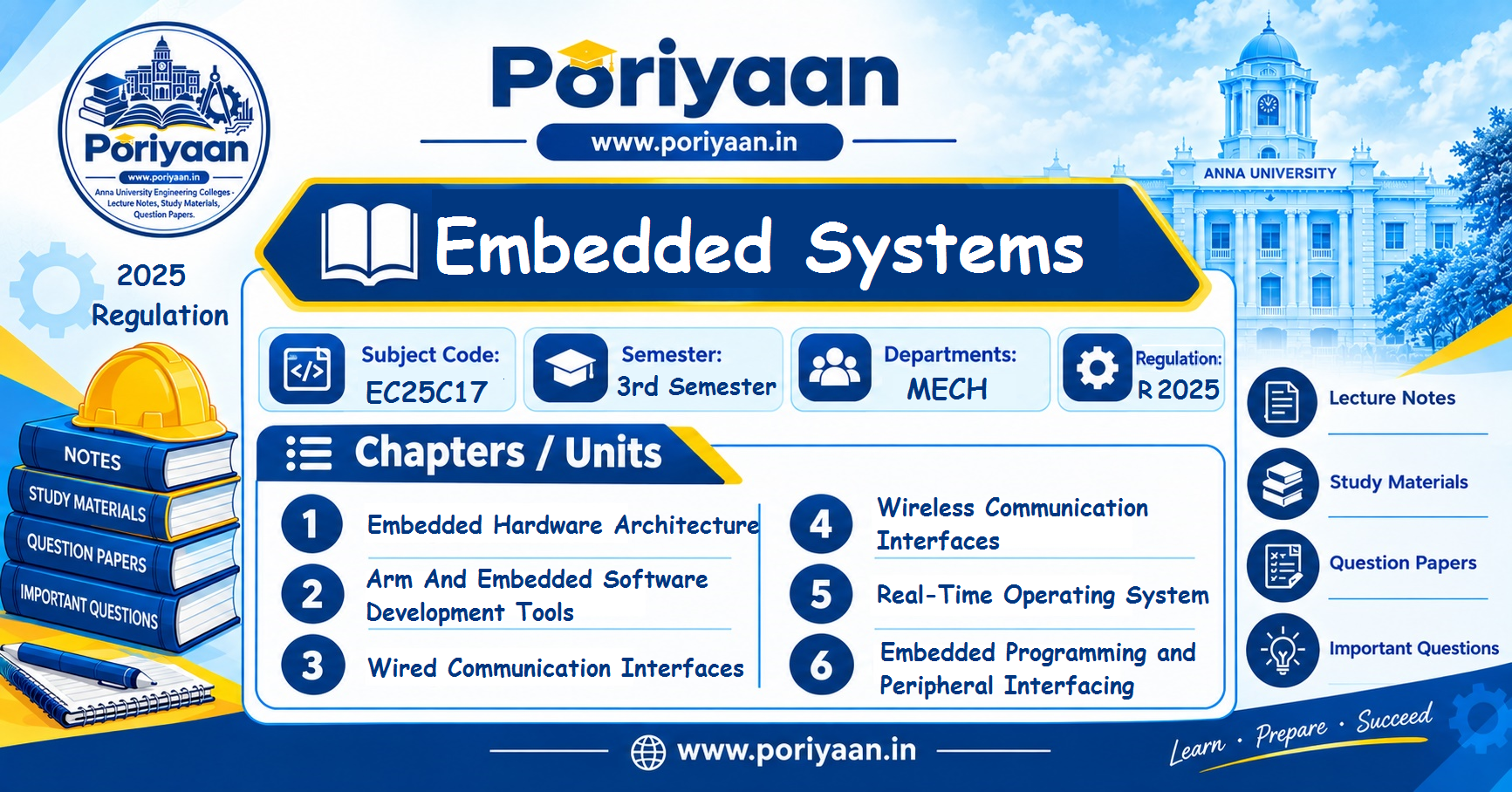
2025 regulation - 3rd semester for Mechanical Engineering Department. Subject Code: EC25C17, Subject Name: Embedded Systems, Batch: 2025, 2026, 2027, 2028. Department: Mechanical Engineering Department. Institute: Anna University Affiliated Engineering College, TamilNadu. This page has Embedded Systems (EC25C17) study material, notes, semester question paper pdf download, important questions, lecture notes.
PDF Download Links
Embedded Systems
PDF Download Links
Embedded Systems
PDF Download Links
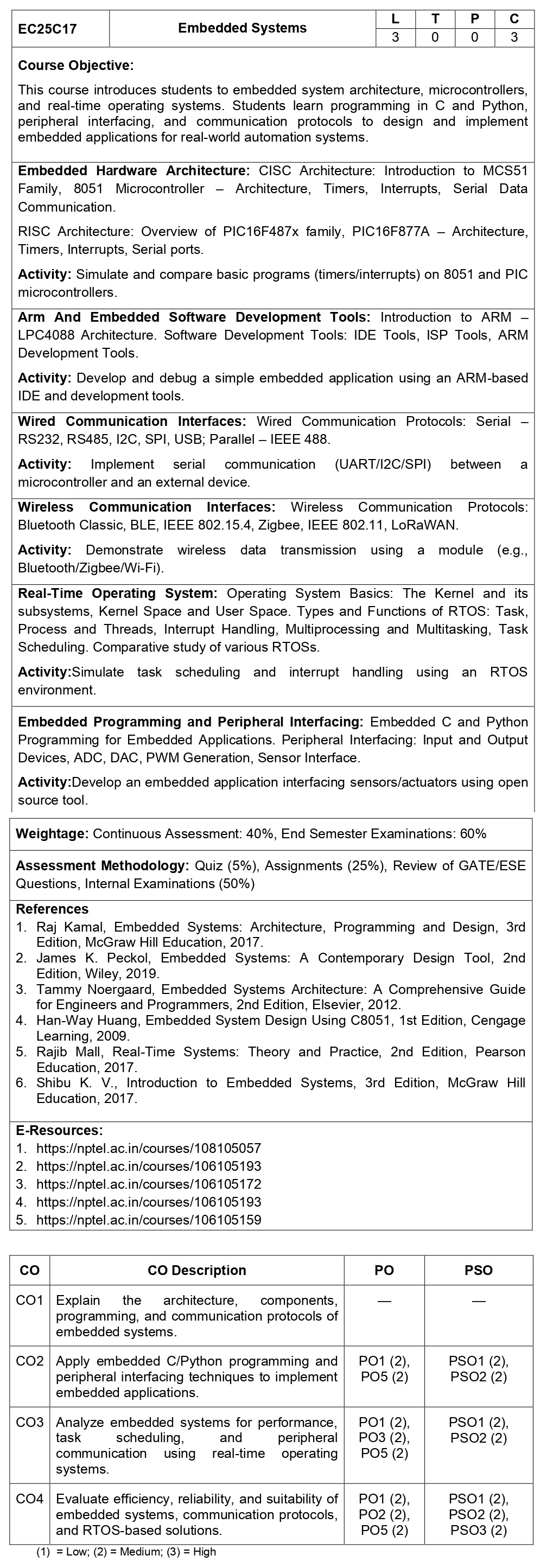
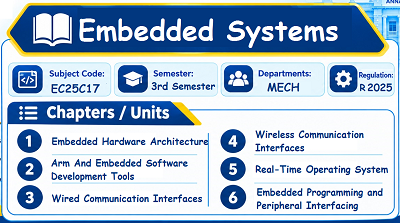
EC25C17
Embedded
Systems
Course
Objective:
This
course introduces students to embedded system architecture, microcontrollers,
and real-time operating systems. Students learn programming in C and Python,
peripheral interfacing, and communication protocols to design and implement
embedded applications for real-world automation systems.
Embedded
Hardware Architecture: CISC Architecture: Introduction
to MCS51 Family, 8051 Microcontroller – Architecture, Timers, Interrupts,
Serial Data Communication.
RISC
Architecture: Overview of PIC16F487x family, PIC16F877A – Architecture, Timers,
Interrupts, Serial ports.
Activity:
Simulate and compare basic programs (timers/interrupts) on 8051 and PIC
microcontrollers.
Arm And
Embedded Software Development Tools: Introduction to ARM –
LPC4088 Architecture. Software Development Tools: IDE Tools, ISP Tools, ARM
Development Tools.
Activity:
Develop and debug a simple embedded application using an ARM-based IDE and
development tools.
Wired
Communication Interfaces: Wired Communication
Protocols: Serial – RS232, RS485, I2C, SPI, USB; Parallel – IEEE 488.
Activity:
Implement serial communication (UART/I2C/SPI) between a microcontroller and an
external device.
Wireless
Communication Interfaces: Wireless Communication
Protocols: Bluetooth Classic, BLE, IEEE 802.15.4, Zigbee, IEEE 802.11, LoRaWAN.
Activity:
Demonstrate wireless data transmission using a module(e.g.,
Bluetooth/Zigbee/Wi-Fi).
Real-Time
Operating System: Operating System Basics: The Kernel and
its subsystems, Kernel Space and User Space. Types and Functions of RTOS: Task,
Process and Threads, Interrupt Handling, Multiprocessing and Multitasking, Task
Scheduling. Comparative study of various RTOSs.
Activity:Simulate
task scheduling and interrupt handling using an RTOS environment.
Embedded
Programming and Peripheral Interfacing: Embedded C and
Python Programming for Embedded Applications. Peripheral Interfacing: Input and
Output Devices, ADC, DAC, PWM Generation, Sensor Interface.
Activity:
Develop an embedded application interfacing sensors/actuators using open source
tool.
Weightage:
Continuous Assessment: 40%, End Semester Examinations: 60%
Assessment Methodology:
Quiz (5%), Assignments (25%), Review of GATE/ESE Questions, Internal
Examinations (50%)
References
1.
Raj Kamal, Embedded Systems: Architecture, Programming and Design, 3rd Edition,
McGraw Hill Education, 2017.
2.
James K. Peckol, Embedded Systems: A Contemporary Design Tool, 2nd Edition,
Wiley, 2019.
3.
Tammy Noergaard, Embedded Systems Architecture: A Comprehensive Guide for
Engineers and Programmers, 2nd Edition, Elsevier, 2012.
4.
Han-Way Huang, Embedded System Design Using C8051, 1st Edition, Cengage
Learning, 2009.
5.
Rajib Mall, Real-Time Systems: Theory and Practice, 2nd Edition, Pearson
Education, 2017.
6.
Shibu K. V., Introduction to Embedded Systems, 3rd Edition, McGraw Hill
Education, 2017.
3rd Semester 2025 Regulation : EC25C17 3rd Semester MECH Dept | 2025 Regulation Embedded Systems