Fundamentals of Electrical and Electronics Engineering
EE25C03 1st Semester | 2025 Regulation
2025 regulation - 1st semester paper for EEE, E&I Departments. Subject Code: EE25C03, Subject Name: Fundamentals of Electrical and Electronics Engineering, Batch: 2025, 2026, 2027, 2028. Institute: Anna University Affiliated Engineering College, TamilNadu. This page has Fundamentals of Electrical and Electronics Engineering study material, notes, semester question paper pdf download, important questions, lecture notes.
PDF Download Links
Fundamentals of Electrical and Electronics Engineering
PDF Download Links
Fundamentals of Electrical and Electronics Engineering
PDF Download Links
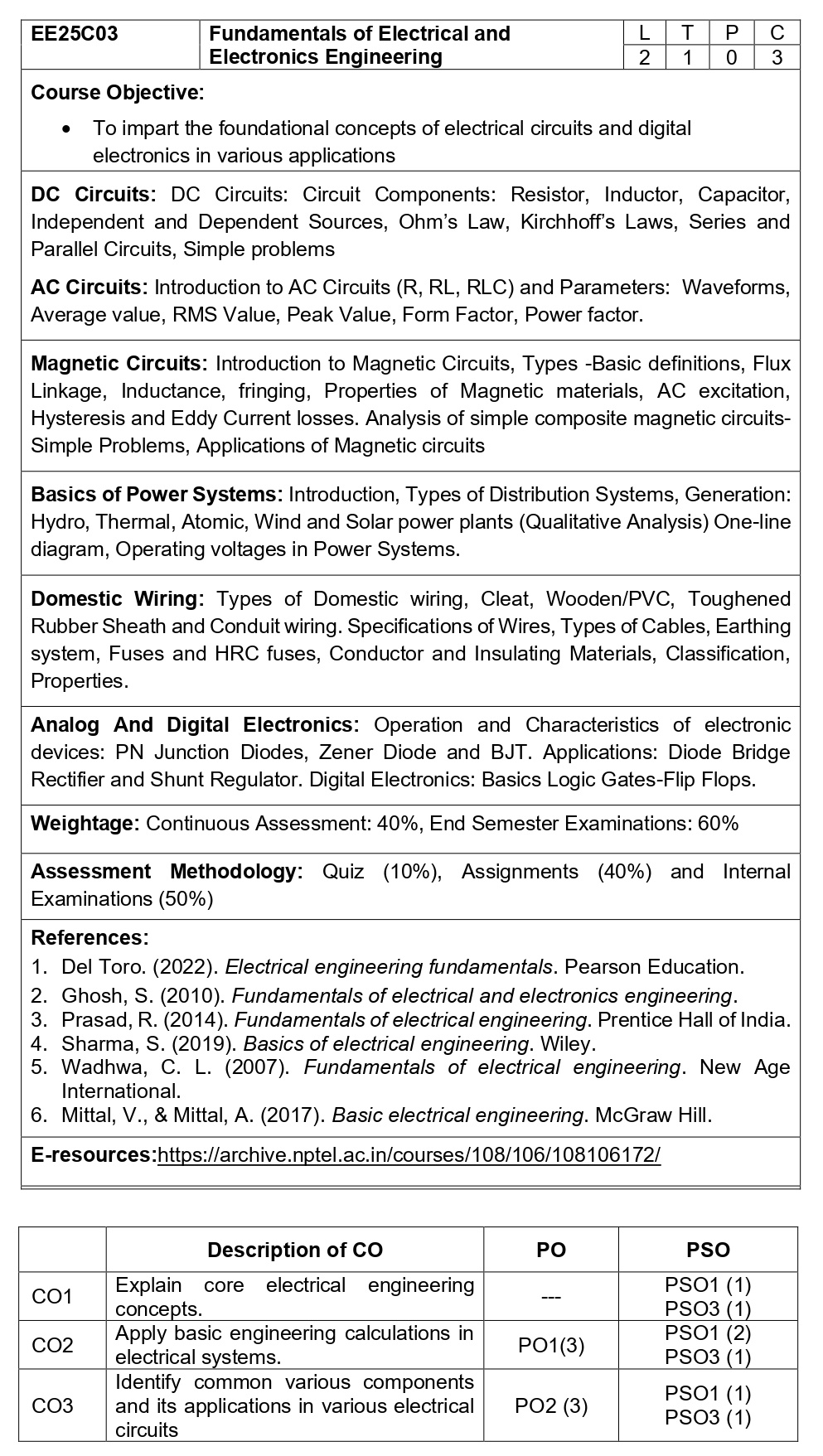
EE25C03
Fundamentals
of Electrical and Electronics Engineering
Course Objective:
•
To impart the foundational concepts of electrical circuits and digital
electronics in various applications
DC
Circuits: DC Circuits: Circuit Components:
Resistor, Inductor, Capacitor, Independent and Dependent Sources, Ohm’s Law,
Kirchhoff’s Laws, Series and Parallel Circuits, Simple problems
AC
Circuits: Introduction to AC Circuits (R, RL,
RLC) and Parameters: Waveforms, Average value, RMS Value, Peak Value, Form
Factor, Power factor.
Magnetic
Circuits: Introduction to Magnetic Circuits,
Types -Basic definitions, Flux Linkage, Inductance, fringing, Properties of
Magnetic materials, AC excitation, Hysteresis and Eddy Current losses. Analysis
of simple composite magnetic circuits- Simple Problems, Applications of
Magnetic circuits
Basics of
Power Systems: Introduction, Types of Distribution
Systems, Generation: Hydro, Thermal, Atomic, Wind and Solar power plants
(Qualitative Analysis) One-line diagram, Operating voltages in Power Systems.
Domestic
Wiring: Types of Domestic wiring, Cleat,
Wooden/PVC, Toughened Rubber Sheath and Conduit wiring. Specifications of
Wires, Types of Cables, Earthing system, Fuses and HRC fuses, Conductor and
Insulating Materials, Classification, Properties.
Analog
And Digital Electronics: Operation and
Characteristics of electronic devices: PN Junction Diodes, Zener Diode and BJT.
Applications: Diode Bridge Rectifier and Shunt Regulator. Digital Electronics:
Basics Logic Gates-Flip Flops.
Weightage:
Continuous Assessment: 40%, End Semester Examinations: 60%
Assessment Methodology:
Quiz (10%), Assignments (40%) and Internal Examinations (50%)
References:
1.
Del Toro. (2022). Electrical engineering fundamentals. Pearson Education.
2.
Ghosh, S. (2010). Fundamentals of electrical and electronics engineering.
3.
Prasad, R. (2014). Fundamentals of electrical engineering. Prentice Hall of
India.
4.
Sharma, S. (2019). Basics of electrical engineering. Wiley.
5.
Wadhwa, C. L. (2007). Fundamentals of electrical engineering. New Age
International.
6.
Mittal, V., & Mittal, A. (2017). Basic electrical engineering. McGraw Hill.
E-resources:
https://archive.nptel.ac.in/courses/108/106/108106172/
1st Semester 2025 Regulation : EE25C03 1st Semester | 2025 Regulation Fundamentals of Electrical and Electronics Engineering