Computer Programming Python
CS25C02 1st Semester | 2025 Regulation

2025 regulation - 1st semester paper for MECH, Civil Department, etc. Subject Code: CS25C02, Subject Name: Computer Programming Python, Batch: 2025, 2026, 2027, 2028. Institute: Anna University Affiliated Engineering College, TamilNadu. This page has Computer Programming Python (CS25C02) study material, notes, semester question paper pdf download, important questions, lecture notes.
PDF Download Links
Computer Programming Python
PDF Download Links
Computer Programming Python
PDF Download Links
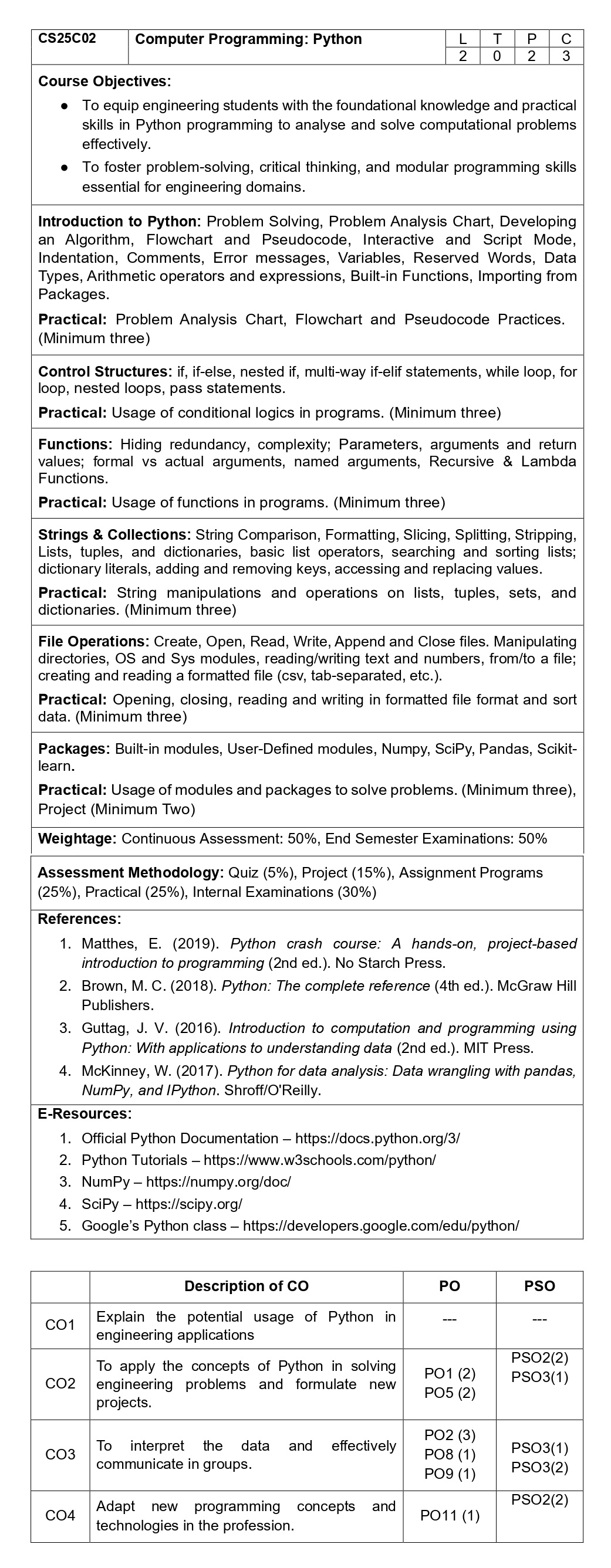
CS25C02
Computer Programming: Python
Course Objectives:
●
To equip engineering students with the foundational knowledge and practical
skills in Python programming to analyse and solve computational problems
effectively.
●
To foster problem-solving, critical thinking, and modular programming skills
essential for engineering domains.
Introduction
to Python: Problem Solving, Problem Analysis
Chart, Developing an Algorithm, Flowchart and Pseudocode, Interactive and
Script Mode, Indentation, Comments, Error messages, Variables, Reserved Words,
Data Types, Arithmetic operators and expressions, Built-in Functions, Importing
from Packages.
Practical:
Problem Analysis Chart, Flowchart and Pseudocode Practices. (Minimum three)
Control
Structures: if, if-else, nested if, multi-way
if-elif statements, while loop, for loop, nested loops, pass statements.
Practical:
Usage of conditional logics in programs. (Minimum three)
Functions:
Hiding redundancy, complexity; Parameters, arguments and return values; formal
vs actual arguments, named arguments, Recursive & Lambda Functions.
Practical:
Usage of functions in programs. (Minimum three)
Strings
& Collections: String Comparison, Formatting,
Slicing, Splitting, Stripping, Lists, tuples, and dictionaries, basic list
operators, searching and sorting lists; dictionary literals, adding and
removing keys, accessing and replacing values.
Practical:
String manipulations and operations on lists, tuples, sets, and dictionaries.
(Minimum three)
File
Operations: Create, Open, Read, Write, Append and
Close files. Manipulating directories, OS and Sys modules, reading/writing text
and numbers, from/to a file; creating and reading a formatted file (csv,
tab-separated, etc.).
Practical:
Opening, closing, reading and writing in formatted file format and sort data.
(Minimum three)
Packages:
Built-in modules, User-Defined modules, Numpy, SciPy, Pandas, Scikit- learn.
Practical:
Usage of modules and packages to solve problems. (Minimum three), Project (Minimum
Two)
Weightage:
Continuous Assessment: 50%, End Semester Examinations: 50%
Assessment Methodology:
Quiz (5%), Project (15%), Assignment Programs (25%), Practical (25%), Internal
Examinations (30%)
References:
1.
Matthes, E. (2019). Python crash course: A hands-on, project-based introduction
to programming (2nd ed.). No Starch Press.
2.
Brown, M. C. (2018). Python: The complete reference (4th ed.). McGraw Hill
Publishers.
3.
Guttag, J. V. (2016). Introduction to computation and programming using Python:
With applications to understanding data (2nd ed.). MIT Press.
4.
McKinney, W. (2017). Python for data analysis: Data wrangling with pandas,
NumPy, and IPython. Shroff/O'Reilly.
E-Resources:
1.
Official Python Documentation – https://docs.python.org/3/
2.
Python Tutorials – https://www.w3schools.com/python/
3.
NumPy – https://numpy.org/doc/
4.
SciPy – https://scipy.org/
5.
Google’s Python class – https://developers.google.com/edu/python/
1st Semester 2025 Regulation : CS25C02 1st Semester | 2025 Regulation Computer Programming Python