Python for Data Science: Chapter 1: Basics of Python
Basics of Python: Two Marks Important Questions and Answers
Python for Data Science
Python for Data Science: Chapter 1: Basics of Python: Anna University Part A Two Marks Important Questions and Answers
Python
for Data Science
Chapter
1: Basics of Python
Two Marks
Questions with Answers
1. What
is script mode in python ?
Answer: The
script mode in python is a mode in which the python commands are stored in a
file and the file is saved using the extension .py.
2. What
is the use of type commands in python?
Answer: The
type command is used to determine the type of the value used. For example
type(10) will return 10.
3. Explain
the precedence rules used in precedence operation.
Answer:
1. P: Parentheses have the
highest precedence and can be used to force an expression to evaluate in the
order you want. Since expressions in parentheses are evaluated first, 1 * (10‒5)
is 5.
2. E: Exponentiation has the
next highest precedence, so 2**3 is 8.
3. MDAS: Multiplication and Division
have the same precedence, which is higher than Addition and Subtraction,
which also have the same precedence. So 2+3*4 yields 14 rather than 20.
4.
Operators with the same precedence are evaluated from left to right. So in the
expression
3‒
2+1 will result 2. As subtraction is performed first and then addition will be
performed.
4. What
is tuple ?
Answer: Tuple
is a sequence of items of any type. Syntactically tuple is a comma separated
list of values.
For
example ‒ The tuple can be created as follows:
>>> student = ('AAA',96,'Std_X')
5. What
is a comment statement ? How do we use comment statements in python? Explain
with examples.
Answer: Comments
are non executing statements used for program understanding purposes. In python
we use # symbol to write the comment. For example ‒
#
This is a comment line
6. How to
define a function in python?
Answer: The
function can be defined using the def.
The syntax of function definition is as follows:
def function_name(parameters)
:
statements
Example
def my_function(a,b):
print("a=")
print(b= ")
7. Name
four types of scalar objects python has.
Ans:
The commonly used scalar types in python
are:
1.
int: Any integer.
2.
float Floating point number (64 bit precision).
3.
complex: Numbers with an optional imaginary component.
4.
Bool: True, False.
8. What
is a python?
Answer: Python
is a high‒level, interpreted, interactive and object‒oriented scripting
language. Python is designed to be highly readable. It uses english keywords
frequently where as other languages use punctuation and it has fewer
syntactical constructions than other languages.
9. What
is pass in python?
Answer: Pass
means no operation statement. It can be treated as placeholder in compound
statement, where there should be blank left.
10. What
are various control statements in python?
Ans:.
Various control statements in python are ‒ if, if...else, while, for
statements.
11. What
is the use of range in python?
Answer: The
range is used to represent the size of the list or a sequence. It is commonly
used in a for loop to denote the element from given range.
12. What
is the use of // operator in python?
Answer: Using
// operator is used for performing the division operation. The result will be
rounded and only integer value of the result will be displayed.
13. What
are the rules for global and local variables?
Answer:
Local
variables: If a variable is assigned a new value anywhere
within the function's body, it's assumed to be local.
Global
variables: Those variables that are only referenced inside a
function are implicitly global.
14. Is
python case sensitive language?
Answer: Yes
python is a case sensitive language.
15. What
will be the output of s*3 if s="Ureka".
Answer: The
output will be UrekaUrekaUreka.
16. What
is the purpose of ** operator ?
Answer: The
operator ** is an exponent operator. It calculates the power of given number.
For
example 2**3 = 8.
17. What
is purpose of break and continue statement ?
Answer:
•
The break statement is for terminating the loop statement and transfers
execution to the statement immediately following the loop.
•
The continue statement causes the loop to skip the remainder of its body and
immediately retest its condition prior to reiterating.
18. How
will you check that in a string all the characters are numeric ?
Answer: Using
the isnumeric() function we can check that in a string all the characters are
numeric.
19. If we
declare [10,20,30] then what is the output of 30. Justify.VD
Answer: True.
It indicates that 30 is a member of the given sequence.
20. What
is the difference between pop() and remove() function?
Answer: The
pop() will return remove last element of the list and remove() will remove any
desired element from the list.
21. How
to represent string in python?
Answer: The
string is represented using either double quotes or single quotes.
22. What
are the operating systems on which the python program runs ?
Answer: The
python is platform can run on Windows, Mac, Linux and so on. It is a platform
independent language. S
23. What
is a Boolean value ?
Answer: A
Boolean value is either true or false. It is named after the British
mathematician, George Boolean, who first formulated Boolean algebra ‒ some
rules for reasoning about and combining these values. This is the basis of all
modern computer logic.
24. What
are the python language supports the types of operators?
Answer:
•
Arithmetic operators
•
Comparison (Relational) operators
•
Assignment operators
•
Logical operators
•
Bitwise operators
•
Membership operators
•
Identity operators.
25. What
is the meaning of iteration?
Answer: Computers
are often used to automate repetitive tasks. Repeating identical or similar
tasks without making errors is something that computers do well and people do
poorly.
Repeated
execution of a set of statements is called iteration.
26. What
are the python supports the control statements ?
Answer:
Control
statement Description
break
statement ‒ Terminates the loop statement and transfers
execution to the statement immediately following the loop.
continue
statement ‒ Causes the loop to skip the remainder of its
body and immediately retest its condition prior to reiterating.
pass
statement ‒ The pass statement in Python is used when a
statement is required syntactically but you do not want any command or code to
execute.
27. State
about logical operators available in python language with example.
There
are three types of logical operators and or, not.
Operators
and: If both the
operands are true then the entire expression is true. Example:
a and b
or:
If either the first or second operand is true. Example: a or b
not:
If the operand is false then the entire expression is true. Example: not a
For
example
In [1]: a=True
b=False
a and b
False
In [2]: a or b
True
In [3]: not a
False
28. Define
recursive function.
Answer: Recursion
is a property in which one function calls itself repeatedly in which the values
of function parameters get changed on each call.
29.
Present the flow of execution for a while statement
The
while statement is popularly used
for representing iteration.
Syntax
while test_condition:
body of while
Flowchart
for while statement is as given below
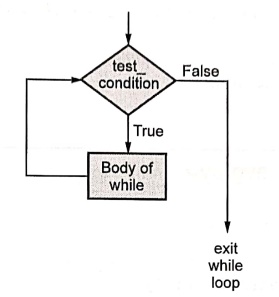
For example
while i<= 10:
i=i+1
30. What
is module ?
Answer: The
modules are basically the files having .py extension and containing some
special functionalities.
31. Write
a python script to display current date and time.
Answer:
import
datetime
now
= datetime.datetime.now()
print
("Current date and time: ")
print
(now.strftime("%Y‒%m‒%d %H:%M:%S"))
32. Write
a note on modular design.
Answer: Modular
design approach in python is a design technique which allows to keep the python
code in separate files. The executable application will be created by putting
all the modules together. It makes the application readable, reliable and
maintainable.
33 . What
are Lists in python ? Give example.
Answer: Lists
is a sequence of values enclosed within a square bracket.
For
example [10,20,30,40]
34. What
is the use of* operator in association with list in python?
Answer: The*
operator is used to repeat the list number of times. For example :
[1,2,3]*3 will give
[1,2,3,1,2,3,1,2,3]
35. What
is the purpose of extend method in python?
Answer: The
extend method takes new list as argument and append it with old list. Thus
using extend two lists can be combined.
36. Suppose
you have given a list a=[1,2,3,4], how will you iterate through this list and
print each element of it?
Answer: Following
python code is used for iterating through the list and display of the numbers
>>> a=[10,20,30,40]
>>> for i in range(len(a)):
print(a[i])
37. What
is mutability property? List is mutable or immutable.
Answer: Mutability
is a property indicating whether we can change the element of the sequence or
not.
List is mutable. That means we can change the element of list.
38. What
is aliasing ?
Answer: An
object with more than one reference has more than one name, so we say that the
object is aliased.
For
example ‒
>>> x=[10,20,30]
>>> y=x
>>> y is x
True
39. What
is tuple? How literals of type tuple are written give example.
Answer: Tuple
is a sequence of values. It is similar to list but there lies difference
between tuple and
list.
Examples of tuples
T1=(10,20,30,40)
T2=('a','b','c','d')
40. Differentiate
between tuple and list.
Answer:
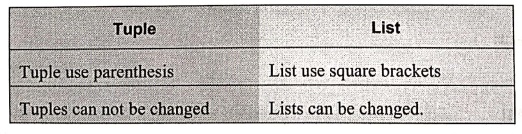
Tuple
Tuple
use parenthesis
Tuples
can not be change
List
List use square brackets
Lists can be changed.
41. How
can we pass variable number of arguments to tuple?
Answer: In
python, it is possible to have variable number of arguments. In that case the
parameter name begins with *. Then these variable number of arguments are
gathered into a tuple. For example ‒
def student Info(*args):
print(args)
42. What
is dictionary?
Answer: In
python, dictionary is unordered collection of items. These items are in the
form of key‒ value pairs.
•
The dictionary contains the collection
of indices called keys and collection of values.
•
Each key is associated with a single
value.
•
The association of keys with values is
called key‒value pair or item.
• For example
My_dictionary={1:'AAA',2: 'BBB',3:'CCC'}
43. What
is the difference between list, tuple and dictionary?
Answer: A
list can store a sequence of objects in a certain order such that we can
iterate over the list.
List
is a mutable type meaning that lists can be modified after they have been
created.
A
tuple is similar to a list except it is immutable. In tuple the elements are
enclosed with in parenthesis. Tuples have structure, lists have order.
A
dictionary is a key‒value store. It is not ordered.
44. Explain
what is range() function and how it is used in lists ?
Answer: The
range function returns an immutable sequence object of integers between the
given start integer to the stop integer.
range(start, stop,[step])
>>>for I in range(1,10,2):
print(i,end=" ")
1 3 5 7 9
45. How
lists are updated in python?
Answer: The
append() method is used to add elements to a list.
Syntax:
list.append(obj)
List=[123, 'VRB']
List.append(2017)
Print("Updated List:",List)
Output: Updated List: [123,'VRB',2017]
46. Write
a few methods that are used in python lists.
Answer:
a)
append() ‒ Add an element to end of list
b)
insert() ‒ Insert an item at the defined index
c)
remove() ‒ Removes an item from the list
d)
clear() ‒ Removes all items from the list
e)
reverse() ‒ Reverse the order of items in the list
47. What
are the advantages of tuple over list?
Answer:
•
Tuple is used for heterogeneous data types and list is used for homogeneous
data types.
•
Since tuple are immutable, iterating through tuple is faster than with list.
•
Tuples that contain immutable elements can be used as key for dictionary.
•
Implementing data that doesn't change as a tuple remains write‒protected
48. What
is indexing and negative indexing in tuple?
Answer: The
index operator is used to access an item in a tuple where index starts from 0.
Python
also allows negative indexing where the index of‒ 1 refers to the last item, ‒2
to the second last item and so on.
>>>my_tuple=('p','y','t', 'h','o','n')
>>>print(my_tuple[5] ) n
>>>print(my_tuple[‒6]) p
49. What
is the output of print tuple[1:3] if tuple = ('abcd', 786, 2.23, 'john', 70.2)
?
Answer: In
the given command, tuple[1:3] is accessing the items in tuple using indexing.
It
will print elements starting from 2nd till 3rd. Output will be (786, 2.23).
50. What
are the methods that are used in python tuple?
Answer:
Methods
that add items or remove items are not available with tuple. Only the following
two methods are available:
a)
count(x)‒ returns the number of items that is equal to x
b)
index(x)‒ returns index of first item that is equal to x
51. Is
tuple comparison possible? Explain how with example.
Answer:
The
standard comparisons ('<','">', '<=','>=','==") work
exactly the same among tuple objects. The tuple objects are compared element by
element.
>>>a=(1,2,3,4,5)
>>>b=(9,8,7,6,5)
>>>a<
b True
52. What
are the built‒in functions that are used in tuple?
Answer:
•
all() ‒ Returns true if all elements of the tuple are true or if tuple is empty
•
any() ‒ Returns true if any element of
tuple is true
•
len() ‒ Returns the length in the tuple
•
max() ‒ Returns the largest item in
tuple
•
min) ‒ Returns the smallest item in
tuple
•
sum() ‒ Returns the sum of all elements
in tuple.
53. What
is the output of print tuple + tinytuple if tuple = ('abcd',786, 2.23, 'john',
70.2) and tinytuple = (123, 'john') ?
Answer: It
will print concatenated tuples. Output will be ('abcd', 786, 2.23, 'john',
70.200000000000003, 123, 'john').
54. Explain
what is dictionary and how it is created in python ?
Answer:
Dictionaries
are similar to other compound types except that they can use any immutable type
as an index. One way to create a dictionary is to start with the empty
dictionary and add elements. The empty dictionary is denoted {}:
>>> eng2sp = {}
>>> eng2sp['one'] = 'uno'
>>> eng2sp['two'] = 'dos'
55. What
is meant by key‒value pairs in a dictionary?
Answer: The
elements of a dictionary appear in a comma‒separated list. Each entry contains
an index and a value separated by a colon. In a dictionary, the indices are
called keys, so the elements are called key‒value pairs.>>> print
eng2sp {'one': 'uno', 'two': 'dos"}
56. How
to slice list in python?
Answer:
•
The : operator used within the square bracket that it is a list slice and not
the index of the list
>>> a=[10,20,30,40,50,60]
>>> a[1:4]
[20, 30, 40]
>>> a[:5]
[10, 20, 30, 40, 50]
57. How
to create a list in python ? Illustrate the use of negative indexing of list
with example.
Answer: The
list is crated by following methods ‒
1)
Mylist = [] #creation of empty list
2)
Mylist = [10,20,30,40] #creation of the list of elements of 10,20,30,40
The
negative indexing is the act of indexing from the end of the list with indexing
starting at ‒1 i.e. ‒ 1 gives the last element of list, ‒2 gives the second
last element of list and so on.
For
example ‒
>>> mylist = [10,20,30,40,50]
>>> print(mylist[‒1])
50
>>> print(mylist[‒2])
40
>>> print(mylist[‒3])
30
>>>
58. Give
the python code to find the minimum among the list of 10 numbers.
Answer:
a=[18, 52, 23, 41, 32, 55, 7, 3, ‒1, 100]
#
minimum number
min_num = a[0] if a else None
#
find minimum number
for i in a:
if i<min_num:
min_num=i
print("Minimum element from the list is: ", min_num)
59. Demonstrate
with simple code to draw the histogram in python.
Answer:
import
matplotlib.pyplot as plt
from
numpy.random import normal
gaussian_numbers
= normal(size=1000)
#plt.hist(gaussian_numbers)
plt.hist(gaussian_numbers)
plt.title("Gaussian
Histogram")
plt.xlabel("Value")
plt.ylabel("Frequency")
plt.show()
60. Relate
strings and lists.
Answer: String
is basically a collection of characters. This collection of characters is
basically a list of characters. For example ‒
mystring = ['I','n','d','i','a']
61. Give
a function that can take a value and return the first key mapping to that value
in a dictionary.
Answer:
def myfun(d,val):
return [k for k, v in d.items() if v = = val]
d = {
'AAA': 101,
'BBB': 102,
'CCC': 103,
'DDD': 104,
'EEE': 105
}
# Get the first key in a dictionary
print('First Key of dictionary:')
print(myfun(d,101))
Output
First Key of
dictionary:
['AAA']
>>>
Python for Data Science: Chapter 1: Basics of Python : Tag: Computer Programming, Python, Data Science : Python for Data Science - Basics of Python: Two Marks Important Questions and Answers
Python for Data Science: Chapter 1: Basics of Python
Under Subject
Python for Data Science
AD25201 2nd Semester AIDS Dept | 2025 Regulation | 2nd Semester 2025 Regulation
Related Subjects
English Essentials II
EN25C02 2nd Semester | 2025 Regulation | 2nd Semester 2025 Regulation
Tamils and Technology தமிழர்களும் தொழில்நுட்பமும்
UC25H02 2nd Semester | 2025 Regulation | 2nd Semester 2025 Regulation
Linear Algebra
MA25C02 2nd Semester | 2025 Regulation
Applied Physics (CSIE) II
PH25C03 2nd Semester AIDS, CSE, IT, CSE(CY) Dept | 2025 Regulation | 2nd Semester 2025 Regulation
Digital Principles and Computer Organization
CS25C06 2nd Semester AIDS, CSE, IT, CSE(CY) Dept | 2025 Regulation | 2nd Semester 2025 Regulation

Basic Electrical and Electronics Engineering
EE25C01 2nd Semester | 2025 Regulation | 2nd Semester 2025 Regulation
Python for Data Science
AD25201 2nd Semester AIDS Dept | 2025 Regulation | 2nd Semester 2025 Regulation

Re-Engineering for Innovation
ME25C05 2nd Semester | 2025 Regulation | 2nd Semester 2025 Regulation
Python for Data Science - Laboratory
AD25201 2nd Semester AIDS Dept | 2025 Regulation | 2nd Semester 2025 Regulation