Python for Data Science: Chapter 1: Basics of Python
Python: Flow Control Statements
There are various types of conditional statements - i) if statements ii) if‒else or alternate statements iii) Nested if iv) Chained conditionals
Flow
Control Statements
There
are various types of conditional statements ‒
i)
if statements
ii)
if‒else or alternate statements
iii)
Nested if
iv)
Chained conditionals
1. if Statement
The
if statement is used to test a
particular condition. If the condition is true then it executes the block of
statements which is called as if block.
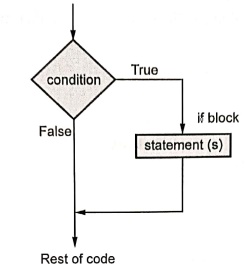
The
if statement is the simplest form of the conditional statement.
Syntax :
if condition:
statement
Example
if a<10:
print (" The number is less than 10" )
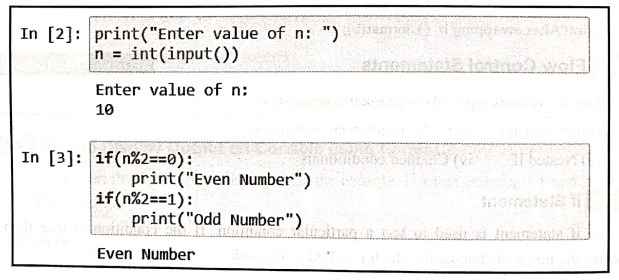
Example:1
Write a
python program to check whether a given number is even or odd.
Solution:
In [2]: print("Enter value
of n: ")
n = int(input())
Enter value of n:
10
In [3]: if(n%2==0):
print("Even Number")
if(n%2==1):
print("Odd Number")
Even Number
2. Alternative Statements
The
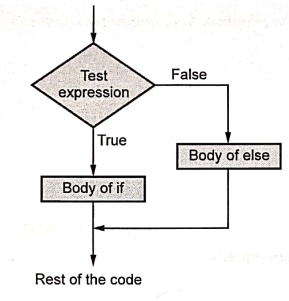
if‒else statement provides an else block combined with the if statement which
is executed in the false case of the condition. The flowchart for if‒else is –
Syntax
if condition:
statement
else:
statement
If
the condition is true, then the if‒block is executed. Otherwise, the else‒block
is executed.
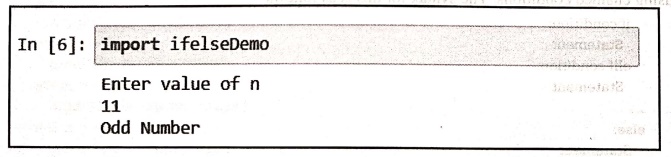
ifelseDemo.py
print("Enter value of n")
n=int(input())
if n%2==0:
print("Even Number")
else:
print("Odd Number")
Output
In [6]: import ifelseDemo
Enter value of n
11
Odd Number
3. Nested if Statements
When
one if condition is present inside another if then it is called nested if conditions. Any number of
these statements can be nested inside one another. Indentation is the only way
to figure out the level of nesting.
Example:2
Write a
python program to compare two numbers using nested conditionals.
Solution :
NestedIfDemo.py
print("Enter value of a")
a=int(input())
print("Enter value of b")
b=int(input())
if a= =b:
print("Both the
numbers are equal")
//Nested if‒else
else:
if a<b:
print("a is less than b")
else:
if a>b:
print("a is greater than
b")
Output
Enter value of a
20
Enter value of b
10
a is greater than b
4. Chained Conditionals
Sometimes
there are more than two possibilities. These possibilities can be expressed
using chained conditions. The syntax for this is as follows ‒
if condition:
Statement
elif condition:
Statement
…
else:
Statement
The
chained conditional execution will be such that each condition is checked in
order. The elif is basically an
abbreviation of else if.
There
is no limit on the number of elif statements.
If
there is else clause then it should
be at the end.
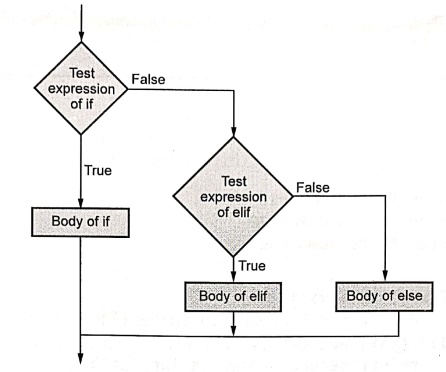
In
chained execution, each condition is checked in order and if one of the
conditions is true then corresponding branch runs and then the statement ends.
In this case if there are any remaining conditions then those conditions won't
be tested.
Example:3
Write a python
program to display the result such as distinction, first class, second class,
pass or fail based on the marks entered by the user.
Solution :
print("Enter your marks")
m=int(input())
if m >= 75:
print("Grade :
Distinction")
elif m>= 60:
print("Grade:
First Class")
elif m>= 50:
print("Grade:
Second Class")
elif m>= 40:
print("Grade:
Pass Class")
else:
print("Grade:
Fail")
Output
Enter your marks
45
Grade: Pass Class
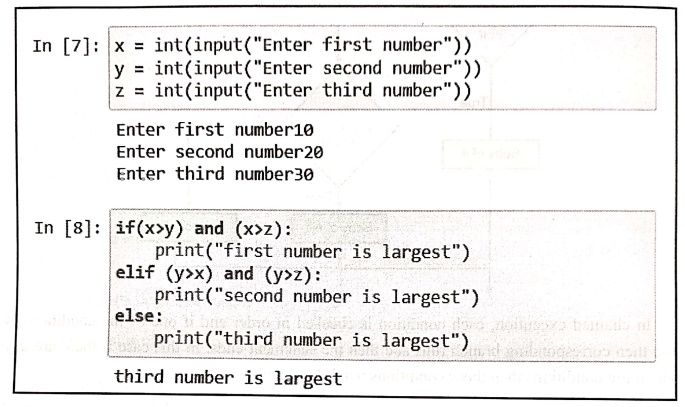
Example:4
Write a
python program to find the largest among the three numbers.
Solution :
In [7]:
x = int(input("Enter first number"))
y= int(input("Enter second number"))
z = int(input("Enter third number"))
Enter first number10
Enter second number20
Enter third number30
In [8]:
if(x>y) and (x>z):
print("first number is largest")
elif (y>x) and (y>z):
print("second number is largest")
else:
print("third number is largest")
third number is largest
Review Question
1. Explain three types
of conditional statements.
Python for Data Science: Chapter 1: Basics of Python : Tag: Computer Programming, Python, Data Science : - Python: Flow Control Statements
Python for Data Science: Chapter 1: Basics of Python
Under Subject
Python for Data Science
AD25201 2nd Semester AIDS Dept | 2025 Regulation | 2nd Semester 2025 Regulation
Related Subjects
English Essentials II
EN25C02 2nd Semester | 2025 Regulation | 2nd Semester 2025 Regulation
Tamils and Technology தமிழர்களும் தொழில்நுட்பமும்
UC25H02 2nd Semester | 2025 Regulation | 2nd Semester 2025 Regulation
Linear Algebra
MA25C02 2nd Semester | 2025 Regulation
Applied Physics (CSIE) II
PH25C03 2nd Semester AIDS, CSE, IT, CSE(CY) Dept | 2025 Regulation | 2nd Semester 2025 Regulation
Digital Principles and Computer Organization
CS25C06 2nd Semester AIDS, CSE, IT, CSE(CY) Dept | 2025 Regulation | 2nd Semester 2025 Regulation

Basic Electrical and Electronics Engineering
EE25C01 2nd Semester | 2025 Regulation | 2nd Semester 2025 Regulation
Python for Data Science
AD25201 2nd Semester AIDS Dept | 2025 Regulation | 2nd Semester 2025 Regulation

Re-Engineering for Innovation
ME25C05 2nd Semester | 2025 Regulation | 2nd Semester 2025 Regulation
Python for Data Science - Laboratory
AD25201 2nd Semester AIDS Dept | 2025 Regulation | 2nd Semester 2025 Regulation