Python for Data Science: Chapter 1: Basics of Python
Python: Tuple
Questions: 1. Enlist built in functions in tuple. 2. What is tuple? Give the difference.
Tuple
1. Introduction to Tuples
1. Definition Tuple
Tuple
is a collection of elements which are enclosed within the parenthesis, and
these elements are separated by commas.
How to
Create Tuple?
T1
= (10, 20, 30, 40)
T2
= ('a','b','c','d')
T3
= ('A',10, 20)
T4
= ('aaa','bbb',30, 40)
The
empty tuple can be created as
T1
= ()
How to write tuple?
Tuple
is written within the parenthesis. Even if the tuple contains a single value,
the comma is used as a separator. For example ‒
T1
= (10,)
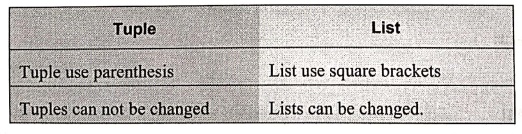
Difference between tuple and list
Tuple
1. Tuple use parenthesis
2. Tuples can not be changed
List
1. List use square brackets
2. Lists can be changed.
2. Accessing Values in Tuple
The
element in Tuple can be accessed using the index.
For example ‒
>>> t1=(10,20,'AAA', 'BBB')
>>> print(t1[0])
10
>>> print(t1[1:3])
(20, 'AAA')
>>>
3. Deleting Values in Tuple
•
We can delete a tuple using del
statement. The code for this is as given below ‒
T1=(10,20,30)
del
T1
print(T1)
•
As an output of the above program, the error message will be displayed as T1
gets deleted.
4. Updating Tuple
Tuples
are immutable. That means ‒ values in the tuple can not be changed. We can only
extract the values of one tuple to create another tuple.
For example
T1 = (10,20,30)
T2 = (40,50)
T3 = T1+T2
print(T3)
Output
(10, 20, 30, 40, 50)
2. Basic Tuple Operations
1) len:
The len function is used to find the total number of elements in the tuple.
>>> t1=(10,20,30,40)
>>> print(len(t1))
4
>>>
2)
Concatenation: The operator + is used to concatenate
two tuples. For example
>>> t1=(10,20,30)
>>>t2=(40,50,60)
>>> print(t1+t2)
(10, 20, 30, 40, 50, 60)
>>>
3)
Repetition: For repetition of the elements in the
Tuple, we use * operator. For example,
>>> t1=(10,20,30)
>>> print(t1*3)
(10, 20, 30, 10, 20, 30, 10, 20, 30)
>>>
4)
Membership:
Membership means checking if the element is
present in the tuple or not. The membership operation is performed using in
operator.
>>> t1=(10,20,30,40,50)
>>> print(3 in t1)
False
>>> print(30 in t1)
True
>>>
5)
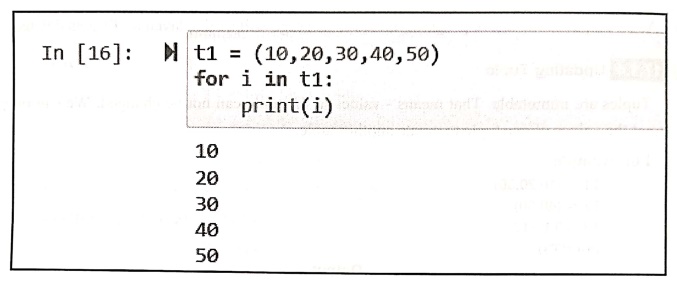
Iteration: Iteration means accessing individual element of
tuple. With the help of for loop we
can access the element of a tuple. Following screenshot illustrates this
operation
In [16]:
t1 = (10,20,30,40,50)
for i in t1:
print(i)
10
20
30
40
50
3. Built in Tuple Function
There
are some useful built in Tuple functions. These functions are enlisted in the
following table‒
Function Purpose
cmp(t1,12)
: This function compares tuple t1 with tuple t2.
It
will return either 1, 0 or ‒1, depending upon whether the two tuples being
compared are similar or not.
Here,
cmp() will return negative (‒1) if tl<t2, zero (0) if t1= t2, positive (1)
if tl>t2.
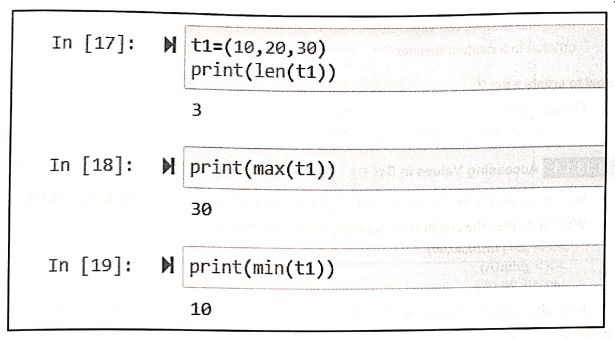
len(t1) :
This function gives the total length of the tuple.
max(tl) :
This function returns maximum value from given tuple t1.
min(tl) :
This function returns minimum value from given tuple t1.
tuple(sequence) :
This function converts the list into tuple.
The
illustration of above functions is as shown below ‒
>>>t1=(10,20)
>>>t2=(10,20,30)
>>>print(cmp(t1, t2)
>>>‒1
In [17]:
t1=(10,20,30)
print(len(t1))
3
In [18]:
print(max(t1))
30
In [19]:
print(min(t1))
10
Tuple function: There
is built in function tuple which is used to create the tuple.
For example
>>> t1=tuple()
>>> print(t1)
( )
>>>
Another example
>>> t1=tuple("hello")
>>> print(t1)
('h', 'e', '1', '1', 'o')
>>>
Review Questions
1. Enlist built in
functions in tuple.
2. What is tuple? Give
the difference.
Python for Data Science: Chapter 1: Basics of Python : Tag: Computer Programming, Python, Data Science : - Python: Tuple
Python for Data Science: Chapter 1: Basics of Python
Under Subject
Python for Data Science
AD25201 2nd Semester AIDS Dept | 2025 Regulation | 2nd Semester 2025 Regulation
Related Subjects
English Essentials II
EN25C02 2nd Semester | 2025 Regulation | 2nd Semester 2025 Regulation
Tamils and Technology தமிழர்களும் தொழில்நுட்பமும்
UC25H02 2nd Semester | 2025 Regulation | 2nd Semester 2025 Regulation
Linear Algebra
MA25C02 2nd Semester | 2025 Regulation
Applied Physics (CSIE) II
PH25C03 2nd Semester AIDS, CSE, IT, CSE(CY) Dept | 2025 Regulation | 2nd Semester 2025 Regulation
Digital Principles and Computer Organization
CS25C06 2nd Semester AIDS, CSE, IT, CSE(CY) Dept | 2025 Regulation | 2nd Semester 2025 Regulation

Basic Electrical and Electronics Engineering
EE25C01 2nd Semester | 2025 Regulation | 2nd Semester 2025 Regulation
Python for Data Science
AD25201 2nd Semester AIDS Dept | 2025 Regulation | 2nd Semester 2025 Regulation

Re-Engineering for Innovation
ME25C05 2nd Semester | 2025 Regulation | 2nd Semester 2025 Regulation
Python for Data Science - Laboratory
AD25201 2nd Semester AIDS Dept | 2025 Regulation | 2nd Semester 2025 Regulation