Theory of Computation
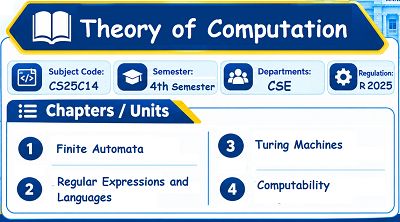
CS25C14 4th Semester CSE Department | 2025 Regulation
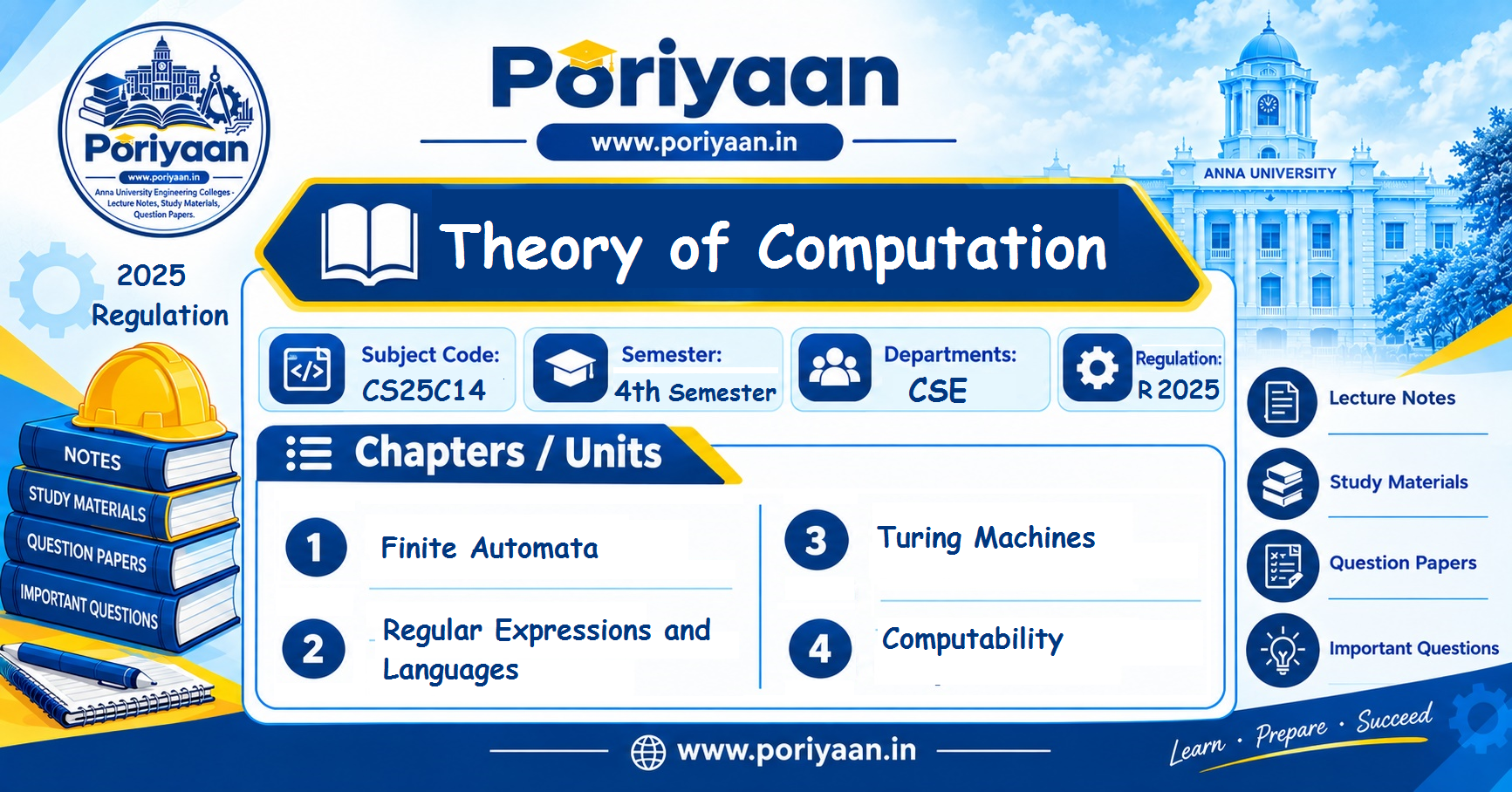
2025 regulation - 4th semester for CSE Department. Subject Code: CS25C14, Subject Name: Theory of Computation, Batch: 2025, 2026, 2027, 2028. Department: CSE Computer Science and Engineering Department. Institute: Anna University Affiliated Engineering College, TamilNadu. This page has Theory of Computation (CS25C14) study material, notes, semester question paper pdf download, important questions, lecture notes.
PDF Download Links
Theory of Computation
- Need for Automata Theory
- Introduction to Formal Proof
- Additional Forms of Proof
- Inductive Proof
- Finite Automata (FA)
- Deterministic Finite Automata (DFA)
- Non-deterministic Finite Automata (NFA)
- Finite Automata with Epsilon Transitions
- Equivalence of NFA with ε to NFA without ε
- Equivalence of NFA and DFA
- Equivalence of NFA with ε to DFA
- Minimization of DFA
- Two Marks Questions with Answers
- Regular Expression and Regular Languages
- Equivalence of Finite Automata and Regular Expressions
- Equivalence of NFA and Regular Expression
- Conversion of Finite Automata to Regular Expressions
- Equivalence of Two Regular Expressions
- Proving Languages to be not Regular (Pumping Lemma)
- Closure Properties of Regular Languages
- Two marks Questions with Answers
Notes and Question Answer of Unit IV: Normal Forms and Turing Machines will Uploaded shortly...
PDF Download Links
Theory of Computation
Unit I: Automata and Regular Expressions
- Need for Automata Theory
- Introduction to Formal Proof
- Additional Forms of Proof
- Inductive Proof
- Finite Automata (FA)
- Deterministic Finite Automata (DFA)
- Non-deterministic Finite Automata (NFA)
- Finite Automata with Epsilon Transitions
- Equivalence of NFA with ε to NFA without ε
- Equivalence of NFA and DFA
- Equivalence of NFA with ε to DFA
- Minimization of DFA
- Two Marks Questions with Answers
Unit II: Regular Expressions and Languages
- Regular Expression and Regular Languages
- Equivalence of Finite Automata and Regular Expressions
- Equivalence of NFA and Regular Expression
- Conversion of Finite Automata to Regular Expressions
- Equivalence of Two Regular Expressions
- Proving Languages to be not Regular (Pumping Lemma)
- Closure Properties of Regular Languages
- Two marks Questions with Answers
Unit III: Context Free Grammar and Push Down Automata
Unit IV: Normal Forms and Turing Machines
Notes and Question Answer of Unit IV: Normal Forms and Turing Machines will Uploaded shortly...
PDF Download Links
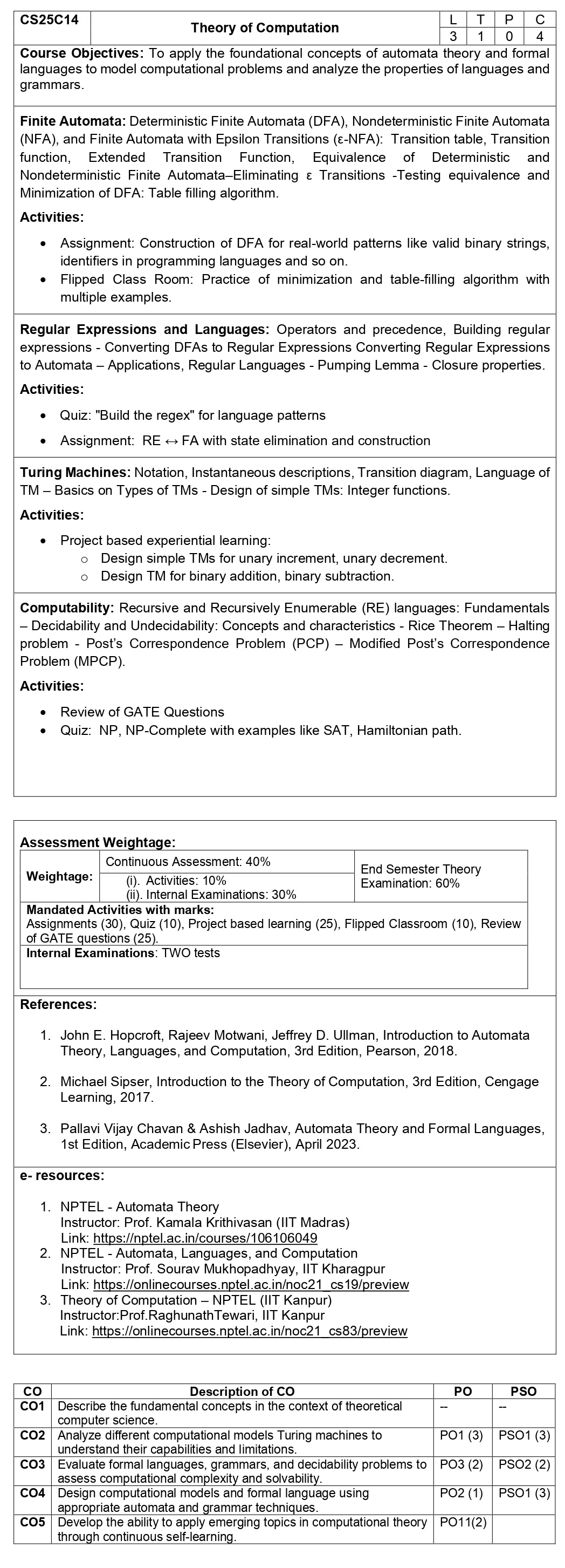
CS25C14:
Theory of
Computation
Course
Objectives: To apply the foundational concepts of automata
theory and formal languages to model computational problems and analyze the
properties of languages and grammars.
Finite
Automata: Deterministic Finite Automata (DFA),
Nondeterministic Finite Automata (NFA), and Finite Automata with Epsilon
Transitions (ε-NFA): Transition table, Transition function, Extended Transition
Function, Equivalence of Deterministic and Nondeterministic Finite
Automata–Eliminating ε Transitions -Testing equivalence and Minimization of
DFA: Table filling algorithm.
Activities:
•
Assignment: Construction of DFA for real-world patterns like valid binary
strings, identifiers in programming languages and so on.
•
Flipped Class Room: Practice of minimization and table-filling algorithm with
multiple examples.
Regular
Expressions and Languages: Operators and
precedence, Building regular expressions - Converting DFAs to Regular Expressions
Converting Regular Expressions to Automata – Applications, Regular Languages -
Pumping Lemma - Closure properties.
Activities:
•
Quiz: "Build the regex" for language patterns
•
Assignment: RE ↔ FA with state elimination and construction
Turing
Machines: Notation, Instantaneous descriptions,
Transition diagram, Language of TM – Basics on Types of TMs - Design of simple
TMs: Integer functions.
Activities:
•
Project based experiential learning:
o
Design simple TMs for unary increment, unary decrement.
o
Design TM for binary addition, binary subtraction.
Computability:
Recursive and Recursively Enumerable (RE) languages: Fundamentals –
Decidability and Undecidability: Concepts and characteristics - Rice Theorem –
Halting problem - Post’s Correspondence Problem (PCP) – Modified Post’s
Correspondence Problem (MPCP).
Activities:
•
Review of GATE Questions
•
Quiz: NP, NP-Complete with examples like SAT, Hamiltonian path.
Assessment
Weightage:
Weightage:Continuous
Assessment: 40%
(i)
. Activities: 10%
(ii)
. Internal Examination: 30%
End
Semester Theory Examination: 60%
Mandated Activities with marks: Assignments (30), Quiz (10), Project based learning (25), Flipped Classroom (10), Review of GATE questions (25).
Internal Examinations:
TWO tests
References:
1.
John E. Hopcroft, Rajeev Motwani, Jeffrey D. Ullman, Introduction to Automata
Theory, Languages, and Computation, 3rd Edition, Pearson, 2018.
2.
Michael Sipser, Introduction to the Theory of Computation, 3rd Edition, Cengage
Learning, 2017.
3.
Pallavi Vijay Chavan & Ashish Jadhav, Automata Theory and Formal Languages,
1st Edition, Academic Press (Elsevier), April 2023.
Theory of Computation: Unit I: Automata and Regular Expressions,, Theory of Computation: Unit II: Regular Expressions and Languages,, Theory of Computation: Unit III: Context Free Grammar and Push Down Automata,, Theory of Computation: Unit IV: Normal Forms and Turing Machines 4th Semester 2025 Regulation : CS25C14 4th Semester CSE Department | 2025 Regulation Theory of Computation