Object Oriented Programming: Chapter 2: Classes and Objects
Access Specifiers
C++ Programming | Object Oriented Programming
Inside the body of the class the data members and functions are declared using the keywords like private, public or protected. These are called access specifiers.
Access
Specifiers
•
Inside the body of the class the data
members and functions are declared using the keywords like private, public or protected. These are called access specifiers.
•
The access specifier specifies the
manner in which the data can be accessed.
•
By default the access specifier is of private type. When the data and
functions are declared as private then only members of same class can access
them. This achieves the data hiding property.
•
The public
access specifier allows the function declared outside the class to access the
data and functions declared under it.
•
The protected
access specifier allows the functions and data declared under it be
accessible by the belonging class and the immediate derived class. Outside the
belonging class and derived class these members are not accessible.
•
The accessibility of members of class is
as shown in 2.3.1.
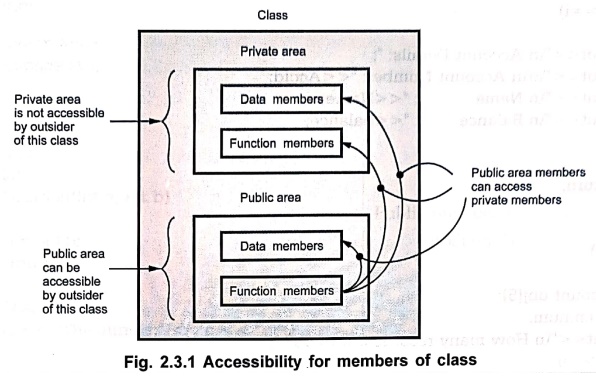
Fig. 2.3.1 Accessibility for members
of class
Example:1
Create a
class account. It has three data member account id, name and balance. Define
function to assign value and display value. Define function that search account
number given by the user. If account number exists, print detail of that
account. Write a program using array of object. Declare at least 5 account and
print details.
Solution:
#include<iostream>
using namespace std;
class Account
{
private:
int AccId;
char Name[20];
double balance;
public:
void get_data();
void search(int);
};
void Account::get_data()
{
cout<<"\n
Enter the Account Number: ";
cin>>AccId;
cout<<"\n
Enter the Name: ";
cin>>Name;
cout<<"\n
Enter the Account balance: ";
cin>>balance;
}
void Account::search(int i)
if(AccId ==i)
{
cout<<"\n
Account Details : ";
cout<<"\n\n
Account Number: "<<AccId;
cout<<"\n
Name :"<<Name;
cout<<"\n
Balance : "<<balance;
}
else
return;
}
int main()
{
Account obj[5];
int i,n,num;
cout<<"\n
How many records are there? ";
cin>>n;
cout<<<"\n
Enter the records....\n";
for(i=0;i<n;i++)
{
cout<<"\n\t\t
Record # "<<i+1;
obj[i].get_data();
}
cout<<"\n
Enter the Account Number for displaying the details: ";
cin>>num;
for(i=0;i<n;i++)
{
obj[i].search(num);
}
return 0;
}
Object Oriented Programming: Chapter 2: Classes and Objects : Tag: Oops, Computer Programming : C++ Programming | Object Oriented Programming - Access Specifiers
Object Oriented Programming: Chapter 2: Classes and Objects
Under Subject
Object Oriented Programming (OOPs)
CS25C07 2nd Semester CSE, CSE(CY) Depts | 2025 Regulation | 2nd Semester 2025 Regulation
Related Subjects

English Essentials II
EN25C02 2nd Semester | 2025 Regulation | 2nd Semester 2025 Regulation
Tamils and Technology தமிழர்களும் தொழில்நுட்பமும்
UC25H02 2nd Semester | 2025 Regulation | 2nd Semester 2025 Regulation
Linear Algebra
MA25C02 2nd Semester | 2025 Regulation
Applied Physics (CSIE) II
PH25C03 2nd Semester AIDS, CSE, IT, CSE(CY) Dept | 2025 Regulation | 2nd Semester 2025 Regulation
Digital Principles and Computer Organization
CS25C06 2nd Semester AIDS, CSE, IT, CSE(CY) Dept | 2025 Regulation | 2nd Semester 2025 Regulation

Basic Electrical and Electronics Engineering
EE25C01 2nd Semester | 2025 Regulation | 2nd Semester 2025 Regulation
Object Oriented Programming (OOPs)
CS25C07 2nd Semester CSE, CSE(CY) Depts | 2025 Regulation | 2nd Semester 2025 Regulation

Re-Engineering for Innovation
ME25C05 2nd Semester | 2025 Regulation | 2nd Semester 2025 Regulation
Object Oriented Programming (OOPs) - Laboratory
CS25C07 2nd Semester CSE, CSE(CY) Depts | 2025 Regulation | 2nd Semester 2025 Regulation