Object Oriented Programming: Chapter 6: IO Systems and File IO
Concept of Streams
C++ Object Oriented Programming
When C program begins execution three predefined streams are automatically opened and those are stdin, stdout, stderr and when C++ program begins four streams get opened ‒ cin, cout, cerr and clog.
Chapter :6
I/O
Systems and File I/O
Concept
of Streams
•
Stream is basically a channel on which data flow from sender
to receiver. Data can be sent out from the program on an output stream or
received into the program on an input stream. For example, at the start of a
program, the standard input stream "cin" is connected to the keyboard
and the standard output stream "cout" is connected to the screen. In
fact, input and output streams such as "cin" and "cout"
are examples of stream objects. In C++ the entire I/O (Input/Output) system
operates through streams. A stream is connected to a physical device by the C++
input output system (Popularly known as I/O system).
•
When C program begins execution three predefined
streams are automatically opened and those are stdin, stdout, stderr and
when C++ program begins four streams get opened ‒ cin, cout, cerr and clog.
Stream
Meaning Physical device
cin :
Standard input ‒ Connected to Keyboard
cout : Standard
output ‒ Connected to Screen
cerr : Standard
error ‒ Connected
to Screen
clog : Buffer
of error ‒ Connected to Screen
The
header file named iostream.h supports these I/O operations.
Example:1
How do
the I/O facilities in C++ differ from that of C?
Solution :
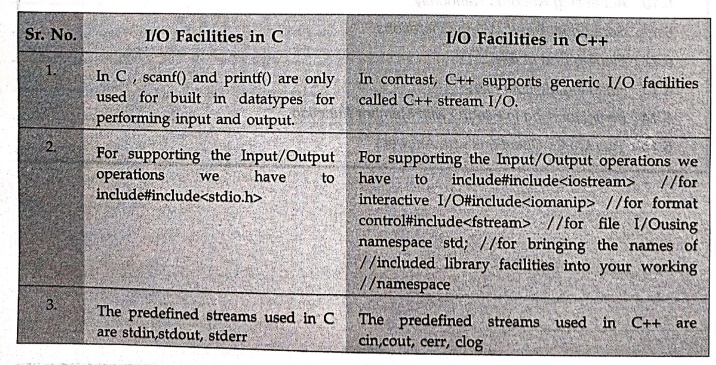
I/O Facilities in C
1.
In C, scanf() and printf() are only used for built in datatypes for performing
input and output.
2.
For supporting the Input/Output operations we have to include#include<stdio.h>
3.
The predefined streams used in C are stdin,stdout, stderr
I/O Facilities in C++
1.
In contrast, C++ supports generic I/O facilities called C++ stream I/O.
2.
For supporting the Input/Output operations we have to
include#include<iostream> //for interactive I/O#include<iomanip>
//for format control#include<fstream> //for file I/Ousing namespace std;
//for bringing the names of //included library facilities into your working
//namespace
3.The
predefined streams used in C++ are cin,cout, cerr, clog
Object Oriented Programming: Chapter 6: IO Systems and File IO : Tag: Oops, Computer Programming : C++ Object Oriented Programming - Concept of Streams
Object Oriented Programming: Chapter 6: IO Systems and File IO
Under Subject
Object Oriented Programming (OOPs)
CS25C07 2nd Semester CSE, CSE(CY) Depts | 2025 Regulation | 2nd Semester 2025 Regulation
Related Subjects

English Essentials II
EN25C02 2nd Semester | 2025 Regulation | 2nd Semester 2025 Regulation

Tamils and Technology தமிழர்களும் தொழில்நுட்பமும்
UC25H02 2nd Semester | 2025 Regulation | 2nd Semester 2025 Regulation
Linear Algebra
MA25C02 2nd Semester | 2025 Regulation
Applied Physics (CSIE) II
PH25C03 2nd Semester AIDS, CSE, IT, CSE(CY) Dept | 2025 Regulation | 2nd Semester 2025 Regulation
Digital Principles and Computer Organization
CS25C06 2nd Semester AIDS, CSE, IT, CSE(CY) Dept | 2025 Regulation | 2nd Semester 2025 Regulation

Basic Electrical and Electronics Engineering
EE25C01 2nd Semester | 2025 Regulation | 2nd Semester 2025 Regulation
Object Oriented Programming (OOPs)
CS25C07 2nd Semester CSE, CSE(CY) Depts | 2025 Regulation | 2nd Semester 2025 Regulation

Re-Engineering for Innovation
ME25C05 2nd Semester | 2025 Regulation | 2nd Semester 2025 Regulation
Object Oriented Programming (OOPs) - Laboratory
CS25C07 2nd Semester CSE, CSE(CY) Depts | 2025 Regulation | 2nd Semester 2025 Regulation