Object Oriented Programming: Chapter 3: Inheritance and Compile Time Polymorphism
Polymorphism
C++ Programming | Object Oriented Programming
What is meant by polymorphism? Explain the various types of polymorphism in C++ with suitable examples.
Polymorphism
•
Polymorphism means many forms. It is
one of the important features of OOP.
•
Polymorphism is basically an ability to create a variable, a function or an
object that has more than one form.
•
The primary goal of polymorphism is an ability of the object of different types
to respond to methods and data values by using the same name. The programmer
does not have to know the exact type of the object in advance hence exact
behavior of the object is determined at the run time.
•
Polymorphism is concerned with the application of specific implementation or
use of abstract base class.
1. Difference between Inheritance and Polymorphism
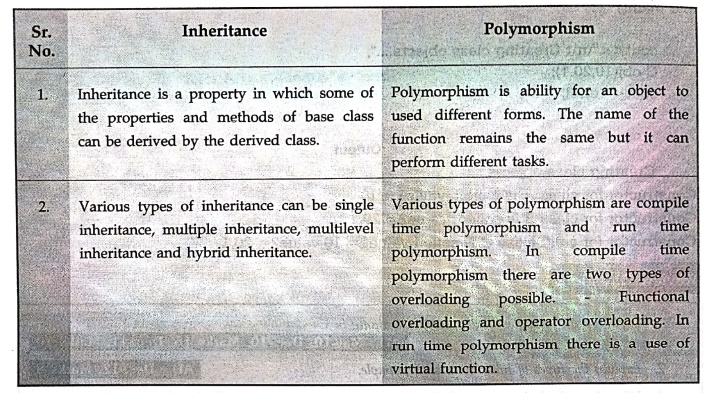
Inheritance
1.
Inheritance is a property in which some of the properties and methods of base
class can be derived by the derived class.
2.
Various types of inheritance can be single inheritance, multiple inheritance,
multilevel inheritance and hybrid inheritance.
Polymorphism
1.
Polymorphism is ability for an object to used different forms. The name of the
function remains the same but it can perform different tasks.
2.
Various types of polymorphism are compile time polymorphism and run time
polymorphism. In compile time polymorphism there are two types of overloading
possible. ‒‒‒‒Functional overloading and operator overloading. In run time
polymorphism there is a use of A virtual function.
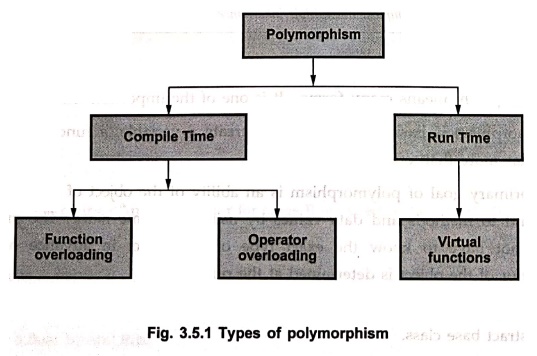
2. Implementing Polymorphism
The
polymorphism can be implemented by two types ‒ Compile time and run time.
•
Following is a simple C++ program that illustrate the concept of polymorphism.
#include <iostream>
using namespace std;
class test {
private:
int a,b,c,d;
public:
int sum(int,int); //Two forms of the
function named sum
int sum(int,int,int);
};
int test::sum(int a,int b)
{
return (a+b);
}
int test::sum(int a,int b,int c)
{
return (a+b+c);
}
int main()
{
test obj;
int a, b, c,choice;
int result=0;
cout<<"\n\t\t Main Menu";
cout<<"\n\t 1.Addition of two numbers";
cout<<"\n\t 2.Addition of three numbers";
cout<<"\n Enter Your choice: ";
cin >> choice;
switch(choice)
{
case 1: cout<<"\nEnter 2 numbers: ";
cin >> a >>
b;
result = obj.sum(a,b);
break;
case 2: cout<<"\nEnter 3 numbers: ";
cin >> a >> b >> c;
result = obj.sum(a,b,c);
break;
default: cout<<"\nWrong Choice";
break;
}
cout<<"\n\nresult: " << result <<
endl;
return 0;
}
Output
Main Menu
1.Addition of two
numbers
2. Addition of three
numbers
Enter Your choice: 1
Enter 2 numbers: 10 20
result: 30
Review Question
1.What is meant by polymorphism?
Explain the various types of polymorphism in C++ with suitable examples.
Object Oriented Programming: Chapter 3: Inheritance and Compile Time Polymorphism : Tag: Oops, Computer Programming : C++ Programming | Object Oriented Programming - Polymorphism
Object Oriented Programming: Chapter 3: Inheritance and Compile Time Polymorphism
Under Subject
Object Oriented Programming (OOPs)
CS25C07 2nd Semester CSE, CSE(CY) Depts | 2025 Regulation | 2nd Semester 2025 Regulation
Related Subjects
English Essentials II
EN25C02 2nd Semester | 2025 Regulation | 2nd Semester 2025 Regulation
Tamils and Technology தமிழர்களும் தொழில்நுட்பமும்
UC25H02 2nd Semester | 2025 Regulation | 2nd Semester 2025 Regulation
Linear Algebra
MA25C02 2nd Semester | 2025 Regulation
Applied Physics (CSIE) II
PH25C03 2nd Semester AIDS, CSE, IT, CSE(CY) Dept | 2025 Regulation | 2nd Semester 2025 Regulation
Digital Principles and Computer Organization
CS25C06 2nd Semester AIDS, CSE, IT, CSE(CY) Dept | 2025 Regulation | 2nd Semester 2025 Regulation

Basic Electrical and Electronics Engineering
EE25C01 2nd Semester | 2025 Regulation | 2nd Semester 2025 Regulation
Object Oriented Programming (OOPs)
CS25C07 2nd Semester CSE, CSE(CY) Depts | 2025 Regulation | 2nd Semester 2025 Regulation

Re-Engineering for Innovation
ME25C05 2nd Semester | 2025 Regulation | 2nd Semester 2025 Regulation
Object Oriented Programming (OOPs) - Laboratory
CS25C07 2nd Semester CSE, CSE(CY) Depts | 2025 Regulation | 2nd Semester 2025 Regulation