Circuits and Network Analysis
EC25C02 2nd Semester ECE Dept | 2025 Regulation
2025 regulation - 2nd semester for ECE Department. Subject Code: EC25C02, Subject Name: Circuits and Network Analysis, Batch: 2025, 2026, 2027, 2028. Institute: Anna University Affiliated Engineering College, TamilNadu. This page has Circuits and Network Analysis (EC25C02) study material, notes, semester question paper pdf download, important questions, lecture notes.
PDF Download Links
Circuits and Network Analysis
PDF Download Links
Circuits and Network Analysis
PDF Download Links
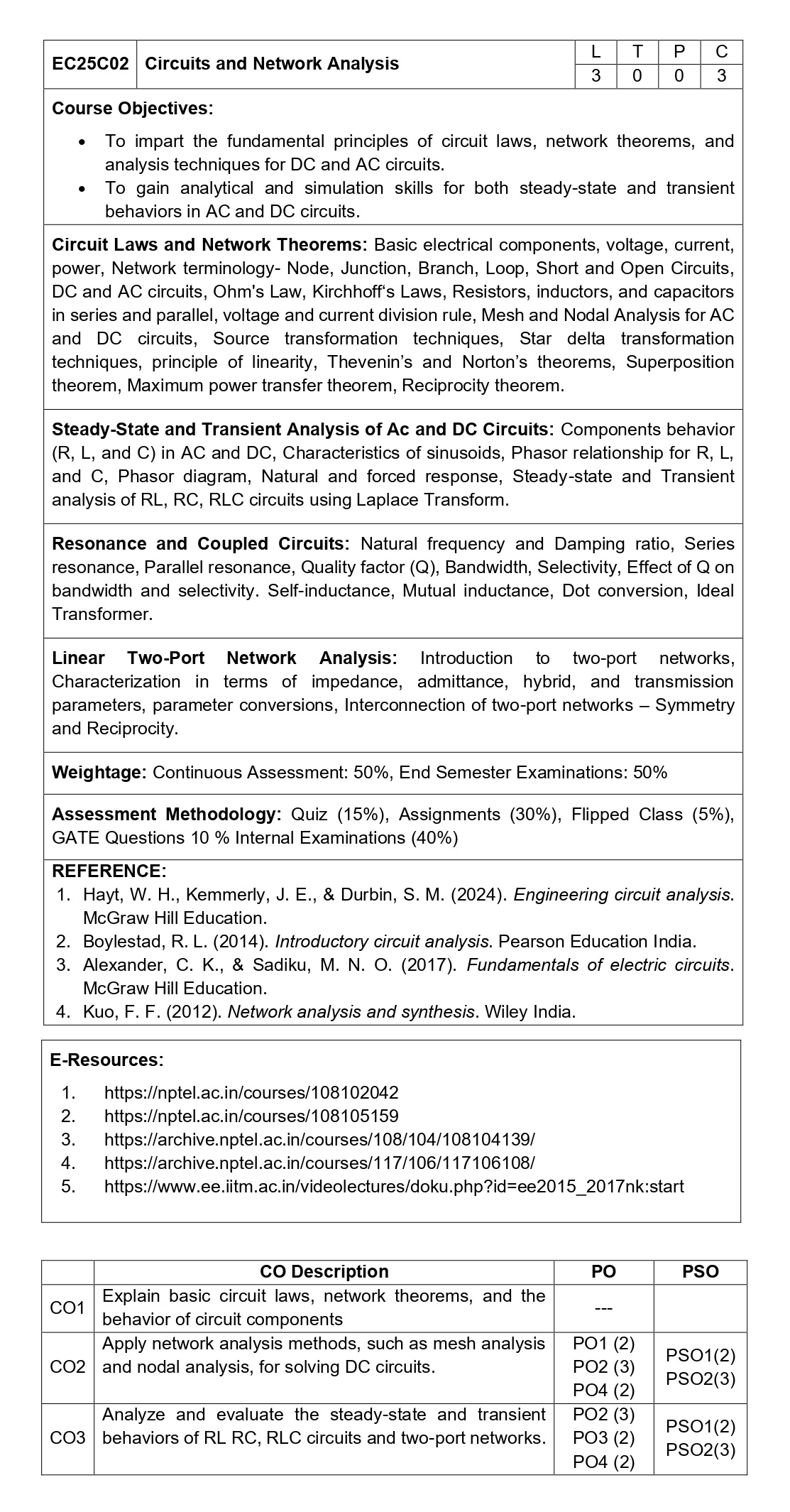
EC25C02
Circuits
and Network Analysis
Course Objectives:
•
To impart the fundamental principles of circuit laws, network theorems, and
analysis techniques for DC and AC circuits.
•
To gain analytical and simulation skills for both steady-state and transient behaviors
in AC and DC circuits.
Circuit
Laws and Network Theorems: Basic electrical
components, voltage, current, power, Network terminology- Node, Junction,
Branch, Loop, Short and Open Circuits, DC and AC circuits, Ohm's Law,
Kirchhoff‘s Laws, Resistors, inductors, and capacitors in series and parallel,
voltage and current division rule, Mesh and Nodal Analysis for AC and DC
circuits, Source transformation techniques, Star delta transformation
techniques, principle of linearity, Thevenin’s and Norton’s theorems,
Superposition theorem, Maximum power transfer theorem, Reciprocity theorem.
Steady-State
and Transient Analysis of Ac and DC Circuits:
Components behavior (R, L, and C) in AC and DC, Characteristics of sinusoids,
Phasor relationship for R, L, and C, Phasor diagram, Natural and forced
response, Steady-state and Transient analysis of RL, RC, RLC circuits using
Laplace Transform.
Resonance
and Coupled Circuits: Natural frequency and Damping
ratio, Series resonance, Parallel resonance, Quality factor (Q), Bandwidth,
Selectivity, Effect of Q on bandwidth and selectivity. Self-inductance, Mutual
inductance, Dot conversion, Ideal Transformer.
Linear
Two-Port Network Analysis: Introduction to
two-port networks, Characterization in terms of impedance, admittance, hybrid,
and transmission parameters, parameter conversions, Interconnection of two-port
networks – Symmetry and Reciprocity.
Weightage:
Continuous Assessment: 50%, End Semester Examinations: 50%
Assessment Methodology:
Quiz (15%), Assignments (30%), Flipped Class (5%), GATE Questions 10 % Internal
Examinations (40%)
REFERENCE:
1.
Hayt, W. H., Kemmerly, J. E., & Durbin, S. M. (2024). Engineering circuit
analysis. McGraw Hill Education.
2.
Boylestad, R. L. (2014). Introductory circuit analysis. Pearson Education
India.
3.
Alexander, C. K., & Sadiku, M. N. O. (2017). Fundamentals of electric
circuits. McGraw Hill Education.
4.
Kuo, F. F. (2012). Network analysis and synthesis. Wiley India.
E-Resources:
1.
https://nptel.ac.in/courses/108102042
2.
https://nptel.ac.in/courses/108105159
3.
https://archive.nptel.ac.in/courses/108/104/108104139/
4.
https://archive.nptel.ac.in/courses/117/106/117106108/
5.
https://www.ee.iitm.ac.in/videolectures/doku.php?id=ee2015_2017nk:start
2nd Semester 2025 Regulation : EC25C02 2nd Semester ECE Dept | 2025 Regulation Circuits and Network Analysis