Electron Devices
EC25C01 2nd Semester ECE Dept | 2025 Regulation
2025 regulation - 2nd semester for ECE Department. Subject Code: EC25C01, Subject Name: Electron Devices, Batch: 2025, 2026, 2027, 2028. Institute: Anna University Affiliated Engineering College, TamilNadu. This page has Electron Devices (EC25C01) study material, notes, semester question paper pdf download, important questions, lecture notes.
PDF Download Links
Electron Devices
PDF Download Links
Electron Devices
PDF Download Links
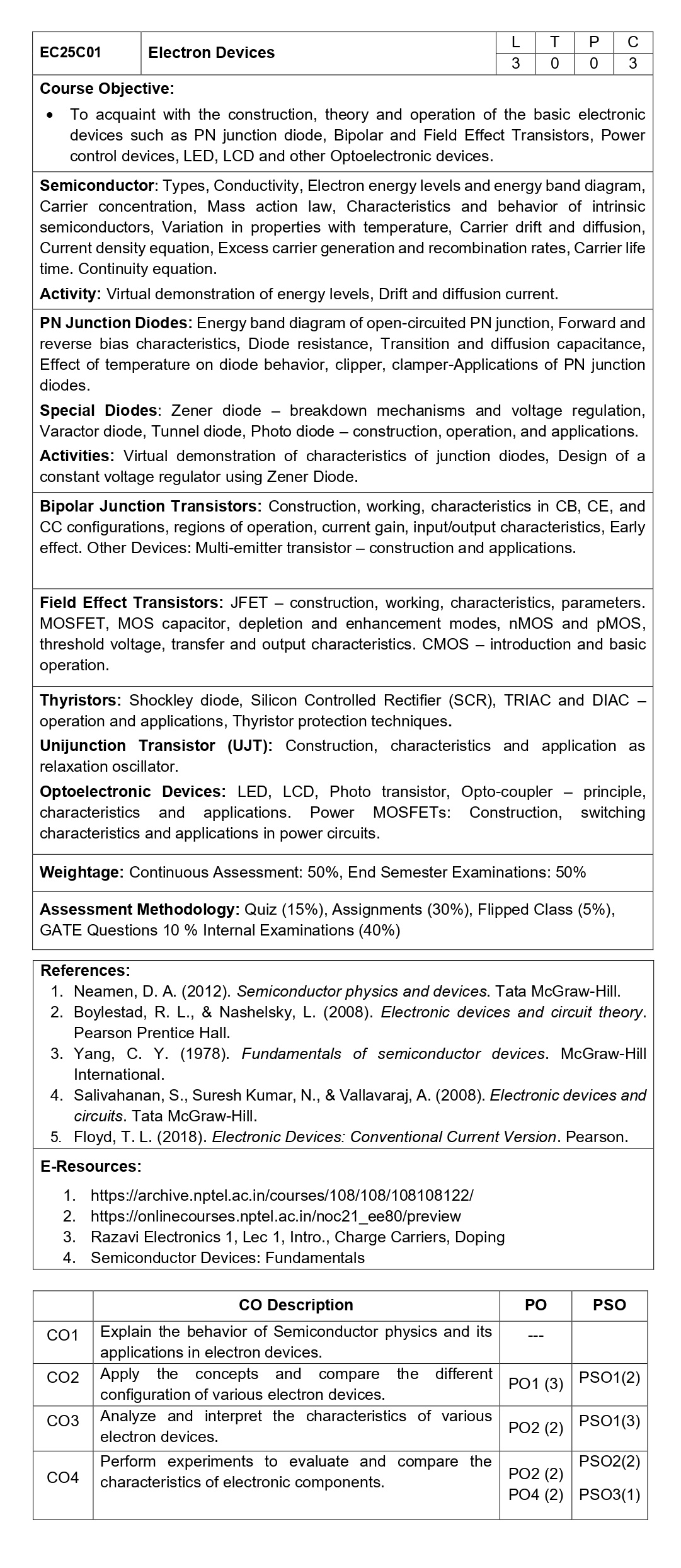
EC25C01
Electron
Devices
Course Objective:
•
To acquaint with the construction, theory and operation of the basic electronic
devices such as PN junction diode, Bipolar and Field Effect Transistors, Power
control devices, LED, LCD and other Optoelectronic devices.
Semiconductor:
Types, Conductivity, Electron energy levels and energy band diagram, Carrier
concentration, Mass action law, Characteristics and behavior of intrinsic
semiconductors, Variation in properties with temperature, Carrier drift and
diffusion, Current density equation, Excess carrier generation and
recombination rates, Carrier life time. Continuity equation.
Activity: Virtual
demonstration of energy levels, Drift and diffusion current.
PN
Junction Diodes: Energy band diagram of open-circuited
PN junction, Forward and reverse bias characteristics, Diode resistance,
Transition and diffusion capacitance, Effect of temperature on diode behavior,
clipper, clamper-Applications of PN junction diodes.
Special
Diodes: Zener diode – breakdown mechanisms and
voltage regulation, Varactor diode, Tunnel diode, Photo diode – construction,
operation, and applications.
Activities:
Virtual demonstration of characteristics of junction diodes, Design of a
constant voltage regulator using Zener Diode.
Bipolar
Junction Transistors: Construction, working,
characteristics in CB, CE, and CC configurations, regions of operation, current
gain, input/output characteristics, Early effect. Other Devices: Multi-emitter
transistor – construction and applications.
Field
Effect Transistors: JFET – construction, working,
characteristics, parameters. MOSFET, MOS capacitor, depletion and enhancement
modes, nMOS and pMOS, threshold voltage, transfer and output characteristics.
CMOS – introduction and basic operation.
Thyristors:
Shockley
diode, Silicon Controlled Rectifier (SCR), TRIAC and DIAC – operation and
applications, Thyristor protection techniques.
Unijunction
Transistor (UJT): Construction, characteristics and
application as relaxation oscillator.
Optoelectronic
Devices: LED, LCD, Photo transistor,
Opto-coupler – principle, characteristics and applications. Power MOSFETs:
Construction, switching characteristics and applications in power circuits.
Weightage:
Continuous Assessment: 50%, End Semester Examinations: 50%
Assessment Methodology:
Quiz (15%), Assignments (30%), Flipped Class (5%), GATE Questions 10 % Internal
Examinations (40%)
References:
1.
Neamen, D. A. (2012). Semiconductor physics and devices. Tata McGraw-Hill.
2.
Boylestad, R. L., & Nashelsky, L. (2008). Electronic devices and circuit
theory. Pearson Prentice Hall.
3.
Yang, C. Y. (1978). Fundamentals of semiconductor devices. McGraw-Hill
International.
4.
Salivahanan, S., Suresh Kumar, N., & Vallavaraj, A. (2008). Electronic
devices and circuits. Tata McGraw-Hill.
5.
Floyd, T. L. (2018). Electronic Devices: Conventional Current Version. Pearson.
E-Resources:
1.
https://archive.nptel.ac.in/courses/108/108/108108122/
2.
https://onlinecourses.nptel.ac.in/noc21_ee80/preview
3.
Razavi Electronics 1, Lec 1, Intro., Charge Carriers, Doping
4.
Semiconductor Devices: Fundamentals
2nd Semester 2025 Regulation : EC25C01 2nd Semester ECE Dept | 2025 Regulation Electron Devices