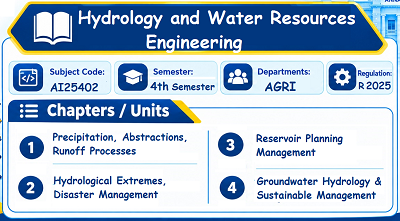
Hydrology and Water Resources Engineering
AI25402 4th Semester Agriculture Department | 2025 Regulation
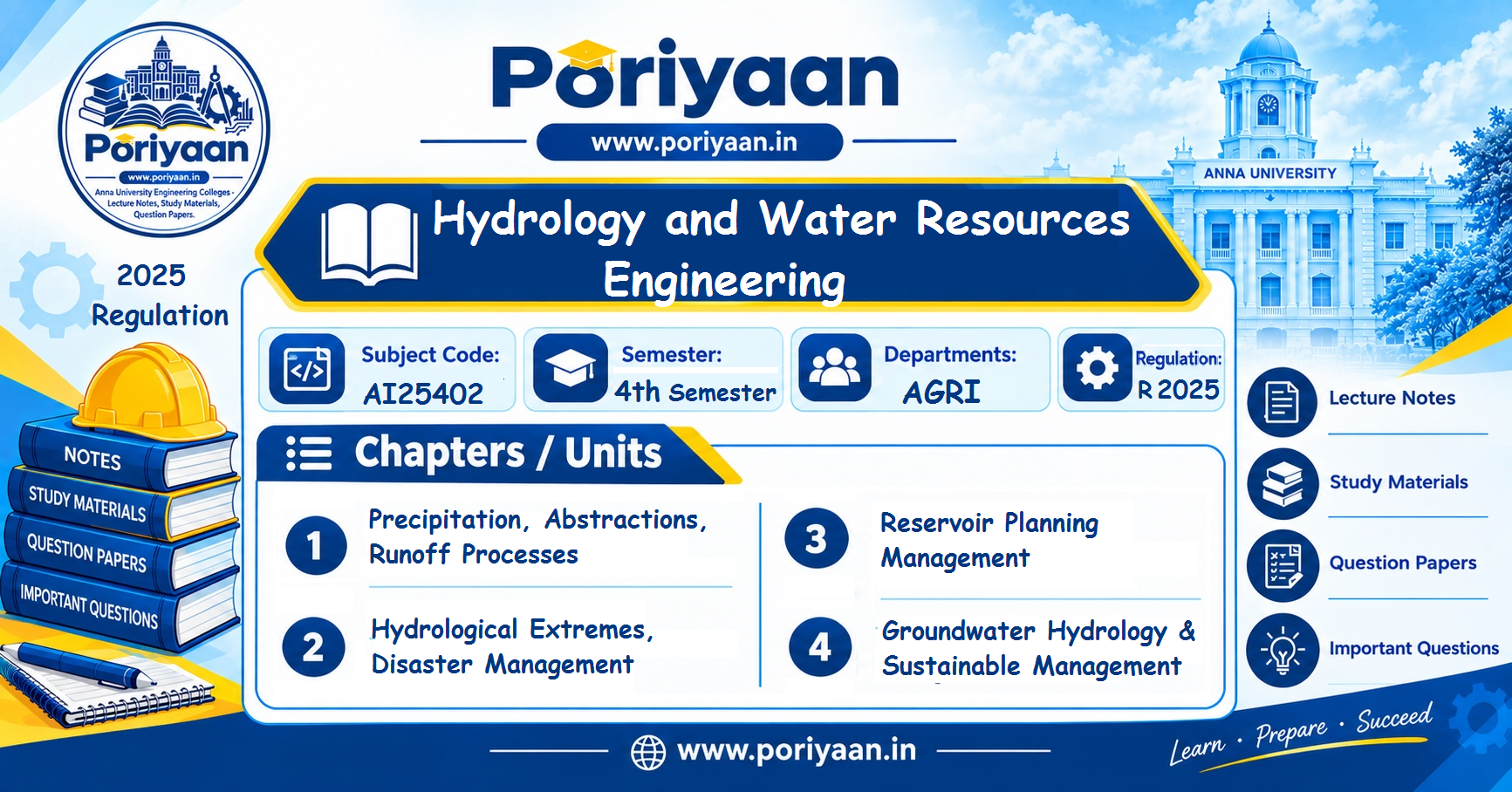
2025 regulation - 4th semester for Agriculture Department. Subject Code: AI25402, Subject Name: Hydrology and Water Resources Engineering, Batch: 2025, 2026, 2027, 2028. Department: Agriculture Engineering Department. Institute: Anna University Affiliated Engineering College, TamilNadu. This page has Hydrology and Water Resources Engineering (AI25402) study material, notes, semester question paper pdf download, important questions, lecture notes.
PDF Download Links
Hydrology and Water Resources Engineering
PDF Download Links
Hydrology and Water Resources Engineering
PDF Download Links
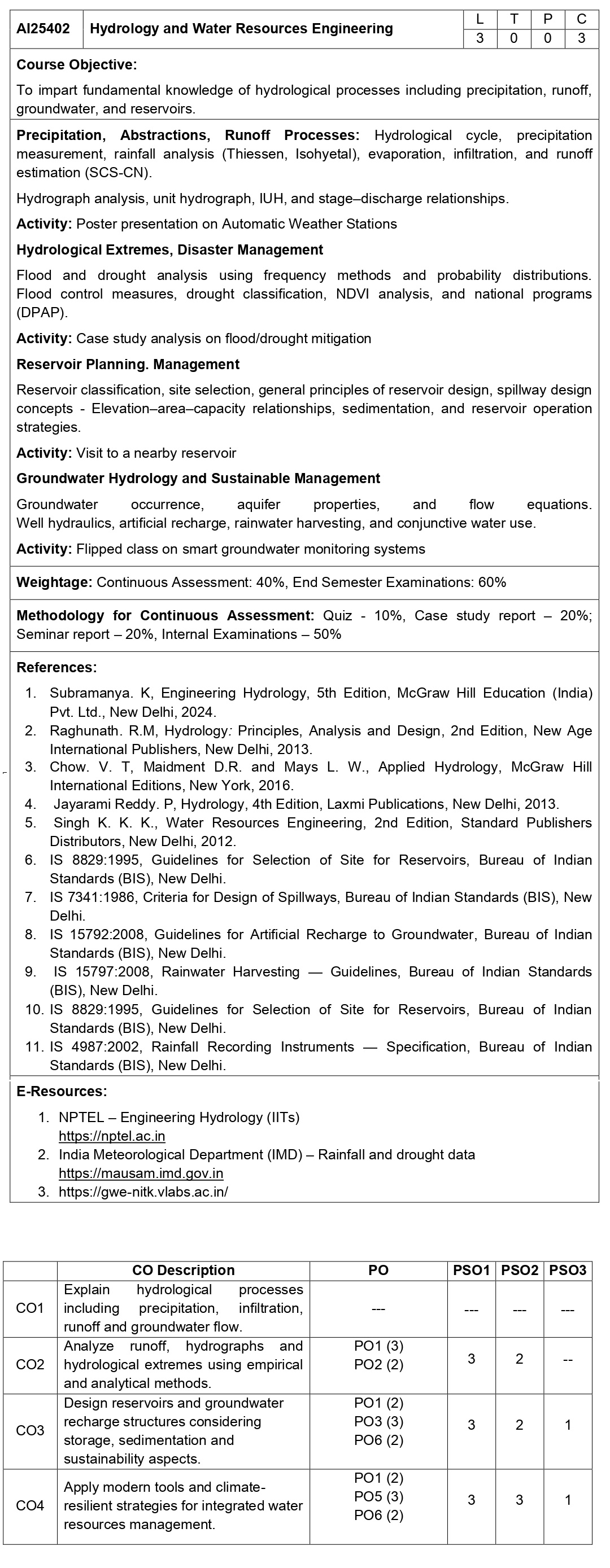
AI25402:
Hydrology
and Water Resources Engineering
Course
Objective:
To
impart fundamental knowledge of hydrological processes including precipitation,
runoff, groundwater, and reservoirs.
Precipitation, Abstractions, Runoff Processes: Hydrological cycle, precipitation measurement, rainfall analysis (Thiessen, Isohyetal), evaporation, infiltration, and runoff estimation (SCS-CN).
Hydrograph analysis, unit hydrograph, IUH, and stage–discharge relationships.
Activity:
Poster presentation on Automatic Weather Stations
Hydrological
Extremes, Disaster Management
Flood
and drought analysis using frequency methods and probability distributions.
Flood control measures, drought classification, NDVI analysis, and national programs
(DPAP).
Activity:
Case study analysis on flood/drought mitigation
Reservoir
Planning. Management
Reservoir
classification, site selection, general principles of reservoir design,
spillway design concepts - Elevation–area–capacity relationships, sedimentation,
and reservoir operation strategies.
Activity:
Visit to a nearby reservoir
Groundwater
Hydrology and Sustainable Management
Groundwater
occurrence, aquifer properties, and flow equations. Well hydraulics, artificial
recharge, rainwater harvesting, and conjunctive water use.
Activity:
Flipped class on smart groundwater monitoring systems
Weightage:
Continuous Assessment: 40%, End Semester Examinations: 60%
Methodology for
Continuous Assessment: Quiz - 10%, Case study report –
20%; Seminar report – 20%, Internal Examinations – 50%
References:
1.
Subramanya. K, Engineering Hydrology, 5th Edition, McGraw Hill Education
(India) Pvt. Ltd., New Delhi, 2024.
2. Raghunath. R.M, Hydrology: Principles, Analysis and Design, 2nd Edition, New Age International Publishers, New Delhi, 2013.
3.
Chow. V. T, Maidment D.R. and Mays L. W., Applied Hydrology, McGraw Hill
International Editions, New York, 2016.
4.
Jayarami Reddy. P, Hydrology, 4th Edition, Laxmi Publications, New Delhi, 2013.
5.
Singh K. K. K., Water Resources Engineering, 2nd Edition, Standard Publishers
Distributors, New Delhi, 2012.
6.
IS 8829:1995, Guidelines for Selection of Site for Reservoirs, Bureau of Indian
Standards (BIS), New Delhi.
7.
IS 7341:1986, Criteria for Design of Spillways, Bureau of Indian Standards
(BIS), New Delhi.
8.
IS 15792:2008, Guidelines for Artificial Recharge to Groundwater, Bureau of
Indian Standards (BIS), New Delhi.
9.
IS 15797:2008, Rainwater Harvesting — Guidelines, Bureau of Indian Standards
(BIS), New Delhi.
10.
IS 8829:1995, Guidelines for Selection of Site for Reservoirs, Bureau of Indian
Standards (BIS), New Delhi.
11. IS 4987:2002, Rainfall Recording Instruments — Specification, Bureau of Indian Standards (BIS), New Delhi.
4th Semester 2025 Regulation : AI25402 4th Semester Agriculture Department | 2025 Regulation Hydrology and Water Resources Engineering