Transforms and its Applications: UNIT 4: Fourier Transform
Simple applications to solve partial differential equations using Fourier transform
Fourier Transform: Example Important Solved Problems with formula, steps, derivation, answer and Exercise Problems based on Applications using Fourier Transform.
Applications using Fourier Transform
APPLICATIONS:
Simple applications to solve partial differential equations
using Fourier transform :
Problem 1:
Solve
the one‒dimensional wave equation

Subject
to the initial conditions
y
(x, 0) = 0, ∂u/∂x(x, 0) = e−x2
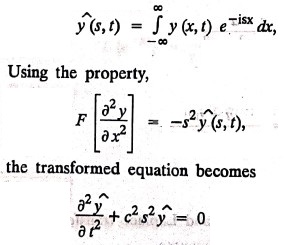
Step 1: Fourier
transform with respect to x
Define
the Fourier transform
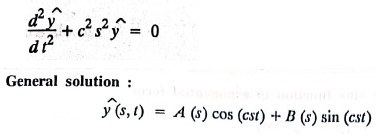
Step 2. Solution of the
transformed ODE
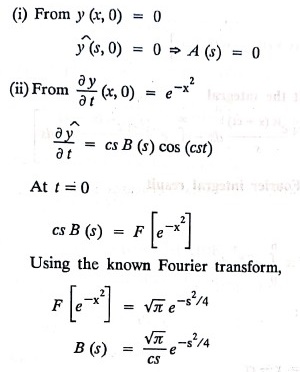
Step 3: Apply initial
conditions
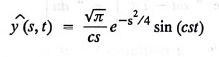
Step 4: Transformed
solution
Step 5. Inverse Fourier
Transform (Detailed steps)
The
transformed solution is
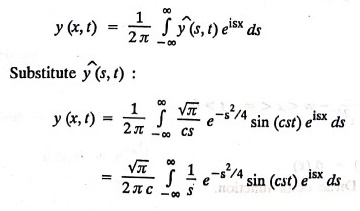
Step 5(a): Write the
inverse Fourier transform
Step 5(b) Express the
sine function in exponential form
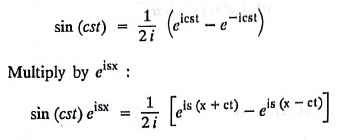
Step 5(c) Substitute
and split the integral

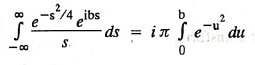
Step 5(d): Use the
standard Fourier integral result
The
known identity is
Step 5(e): Apply the
identity :
Let
b
= x + ct and b = x ‒ ct
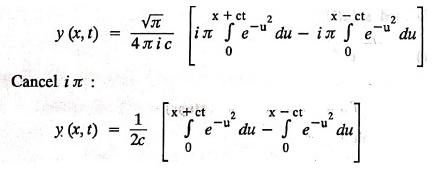
Step 5(f): Combine the
integrals
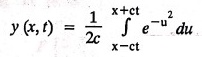
Problem 2:
We
solve the diffusion (heat) equation

Subject
to the initial condition
u(x, 0) = δ(x)
where
δ(x) is the Dirac delta function.
Solution:
Step 1: Take Fourier
transform with respect to x
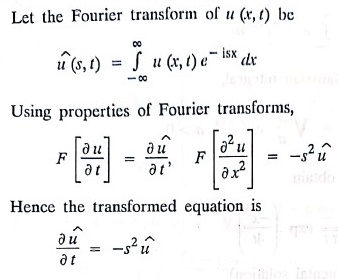
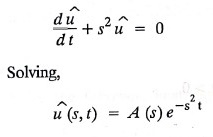
Step 2: Solve the
transformed ODE
This
is a first‒order linear ODE :
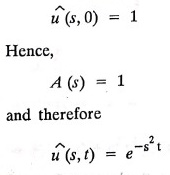
Step 3: Apply the
initial condition :
Taking
Fourier transform of the initial condition:
u(x, 0) = δ(x)
Using
the property
F
[δ(x)] = 1
we
get
Step 4: Inverse Fourier Transform :
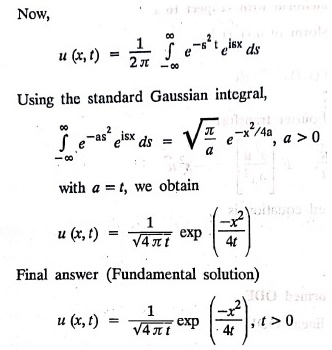
Problem 3:
Solve
the equation ∂u/∂t = ∂2u/∂x2, x > 0, t> 0
subject
to the conditions
(i)
u = 0, when x = 0, t> 0
(ii)
u = 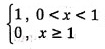 , when t = 0
and
(iii) u (x, t) is bounded.
Solution:
Since
(u)x=0 is given, taking Fourier sine transform of both sides of the given
equation, we have
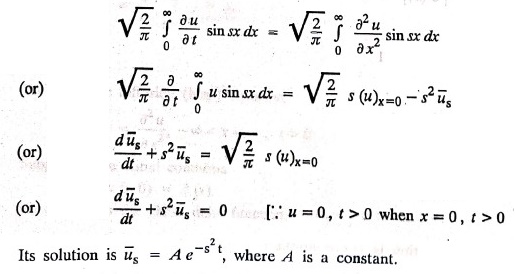
Now,
when t= 0, Fourier sine transform of u (x, t)... (1)
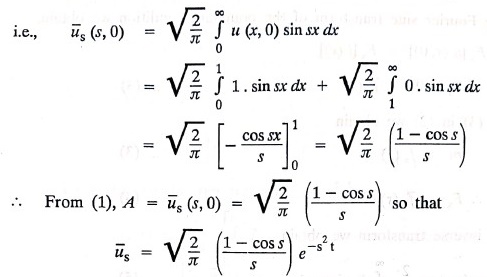
Applying
the inverse Fourier sine transform, we have
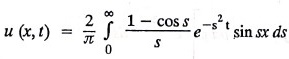
which is required solution.
Problem 4:
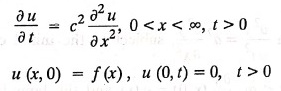
Solve
the following heat equation
Solution:
Here
the problem is given in 0 < x < ∞. Hence Fourier transform can not be
applied. Also the application of Fourier cosine transform requires a derivative
value. So let us apply Fourier sine transform on both sides.
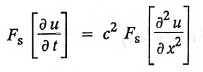
d/dt
Fs(s, t) = c2 [‒s2 FS (s, t) + su(0, t)]
Fs' (s, t) = ‒c2s2Fs (s,
t) ['.' u (0,t) = 0]
Fs' (s,
t) + c2s2FS(s, t) = 0
which
is a linear equation
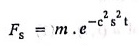
The
solution is
 ……….(2)
Taking
Fourier sine transform of the boundary condition we obtain,
Fs
[u (x, 0)] = Fs f(x)]
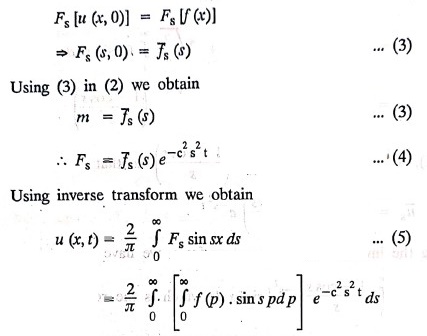
which
is the required solution.
Problem 5:
Solve the wave equation 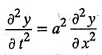 subject to the initial conditions y(x, 0) = f(x), ‒∞<x< ∞, ∂y/∂t
(x, 0) = g(x) and the boundary conditions y (x, t) → 0, as x → ± ∞.
subject to the initial conditions y(x, 0) = f(x), ‒∞<x< ∞, ∂y/∂t
(x, 0) = g(x) and the boundary conditions y (x, t) → 0, as x → ± ∞.
Solution:
Taking
Fourier transforms of the equation with respect to x, we get,
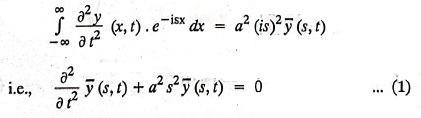
Taking
Fourier transforms of the initial conditions, we have
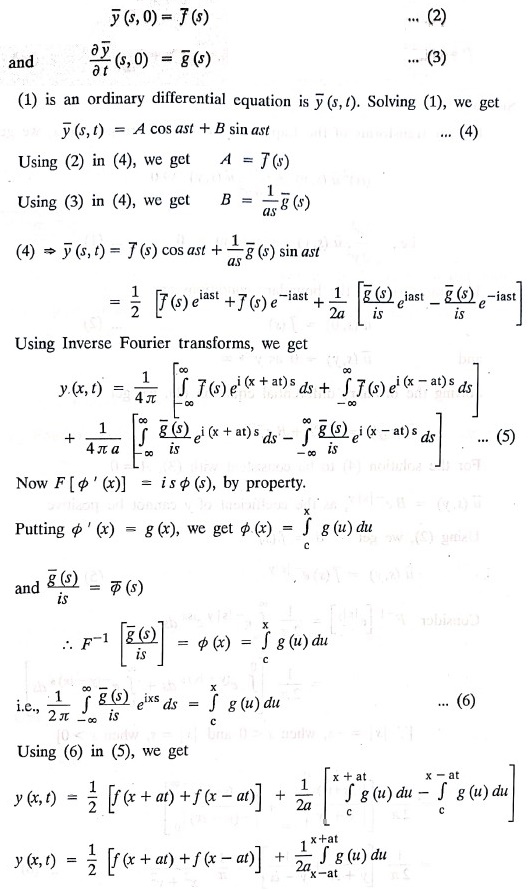
Problem 6:
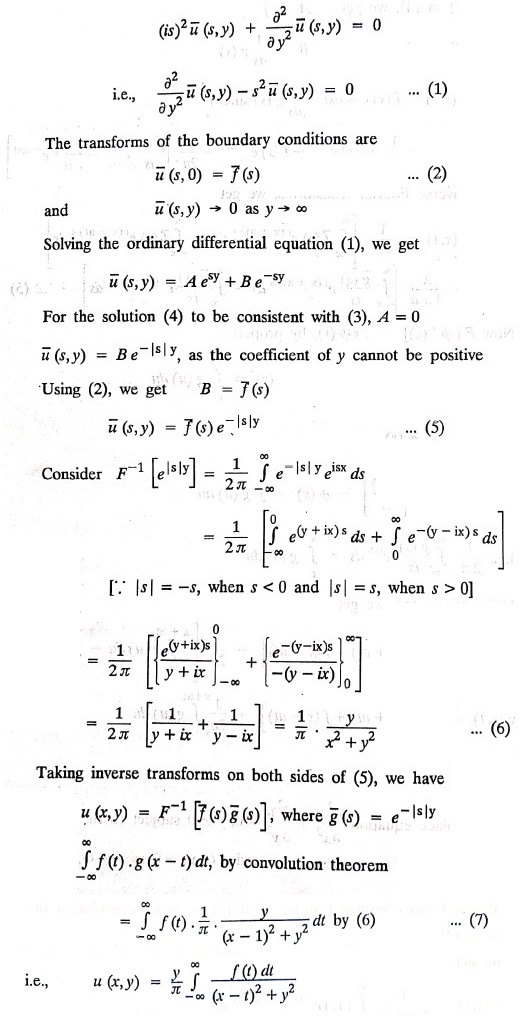
Solve the Laplace
equation  = 0, y ≥ 0 subject to the boundary conditions u (x, 0) =
f(x), ‒∞<x<∞ and u (x, y)→ 0 as
y→ ∞.
= 0, y ≥ 0 subject to the boundary conditions u (x, 0) =
f(x), ‒∞<x<∞ and u (x, y)→ 0 as
y→ ∞.
Solution:
Fourier
transforms of the Laplace equation with respect to x, we get
Problem 7:
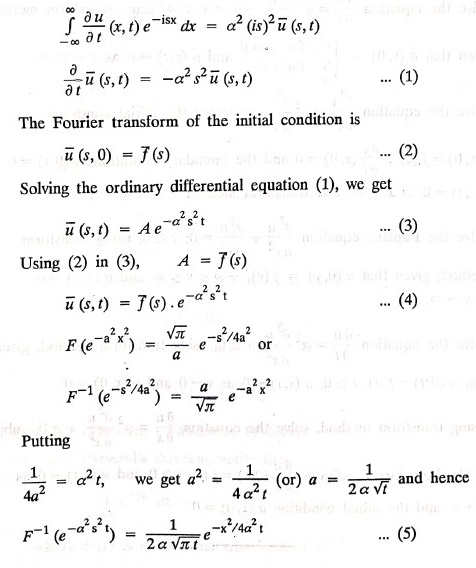
Solve the one‒dimensional
heat flow equation ∂u/∂t = a2
∂2u/∂x2 for a rod with insulated sides extending from ‒∞
to ∞ and with initial temperature distribution given by u(x, 0) = f(x)
Solution:
Assume
that u (x, t) → 0 as x → ± ∞
Taking
Fourier transforms of the given equation with respect to x, we get
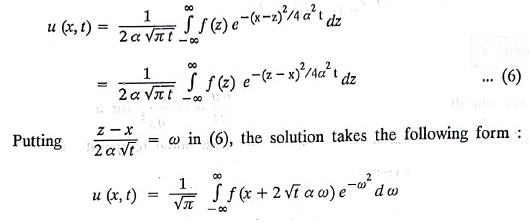
Taking
Fourier inverse transforms of (4) by using convolution theorem and using (5)
we
get
EXERCISES
1.
Solve the equation ∂u/∂t = a2
∂2u/∂x2 , −∞ < x < ∞ using transform method,
given that u(x,0) = 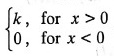 and u (x, t) → 0 as x → ± ∞.
2.
Solve the equations ∂2y/∂t2 = c2 ∂2y/∂x2, satisfying the initial
conditions y (x, 0) = f(x). ∂u/∂t (x,
0) = 0 and the boundary conditions y(0,t) = 0, y (x, t) → 0 as x → ∞. Use
transform method.
3.
Solve the Laplace equation ∂2u/∂x2 + ∂2u/∂y2
= 0; x≥0, using transform method, given that u(0,y) = f(y), −∞ < y < ∞ and u(x, y) → 0 as x → ∞.
4.
Solve the equation ∂u/∂t = a2
∂2u/∂x2, x≥0, using transform method, given that u (0,t)
= f(t), t ≥ 0, u (x, t) → 0 as x → 0
and u (x, 0) = 0
5.
Using transform method, solve the equation ∂u/∂x = a2 ∂2u/∂x2, x ≥ 0, subject to the
boundary conditions ∂u/∂x (0,t) = f(t),
t≥ 0 and u (x, t) → 0 as x → ∞ and the initial condition u (x, 0) = 0
Transforms and its Applications: UNIT 4: Fourier Transform : Tag: Engineering mathematics, Maths : - Simple applications to solve partial differential equations using Fourier transform
Transforms and its Applications: UNIT 4: Fourier Transform
Under Subject
Transforms and its Applications
MA25C03 2nd Semester EEE Dept | 2025 Regulation | 2nd Semester 2025 Regulation
Related Subjects

English Essentials II
EN25C02 2nd Semester | 2025 Regulation | 2nd Semester 2025 Regulation

Tamils and Technology தமிழர்களும் தொழில்நுட்பமும்
UC25H02 2nd Semester | 2025 Regulation | 2nd Semester 2025 Regulation
Transforms and its Applications
MA25C03 2nd Semester EEE Dept | 2025 Regulation | 2nd Semester 2025 Regulation
Applied Physics (EE) II
PH25C04 2nd Semester EEE Dept | 2025 Regulation | 2nd Semester 2025 Regulation

Basic Civil and Mechanical Engineering
GE25C01 2nd Semester EEE Dept | 2025 Regulation | 2nd Semester 2025 Regulation
Engineering Drawing
ME25C01 EEE, Mech, Agri, EEE Depts | 2025 Regulation | 2nd Semester 2025 Regulation
Data Structures and Algorithms
CS25C04 2nd Semester EEE Dept | 2025 Regulation

Re-Engineering for Innovation
ME25C05 2nd Semester | 2025 Regulation | 2nd Semester 2025 Regulation
Engineering Drawing - Laboratory
ME25C01 2nd Semester | 2025 Regulation | 2nd Semester 2025 Regulation

Data Structures and Algorithms - Laboratory
CS25C04 2nd Semester EEE Dept | 2025 Regulation | 2nd Semester 2025 Regulation