Digital Principles and Computer Organization: Chapter 9: Pipelining
Arithmetic Pipeline
Question: What is arithmetic pipeline? Explain arithmetic pipeline for floating point adder/subtractor with the help of one example.
Arithmetic
Pipeline
•
A digital computer performs fixed–point or integer arithmetic and floating
point arithmetic. In modern computers, these two functions (integer arithmetic
and floating point arithmetic) are performed by two separate units to introduce
parallelism. These arithmetic units perform scalar operations involving one
pair of operands at a time.
•
Let us consider a floating point adder / subtractor with two normalized
floating–point binary inputs A and B.
A
= mA × 2e A
B
= mB × 2 e B
where
mA
and mB are the two fractions those represent the mantissas
eA
and eB are the two exponents.
•
We know that, to perform floating point addition / subtraction we have to
perform following suboperations.
■
Exponent comparison
■
Equalize or align the mantissas and choose larger exponent.
■
Add / subtract Mantissas
■
Normalize the result
•
These four sub operations are divided into four different stages. In the first
stage exponent comparison is carried out by subtracting them. In the second
stage the w larger exponent is chosen as the exponent of the result.
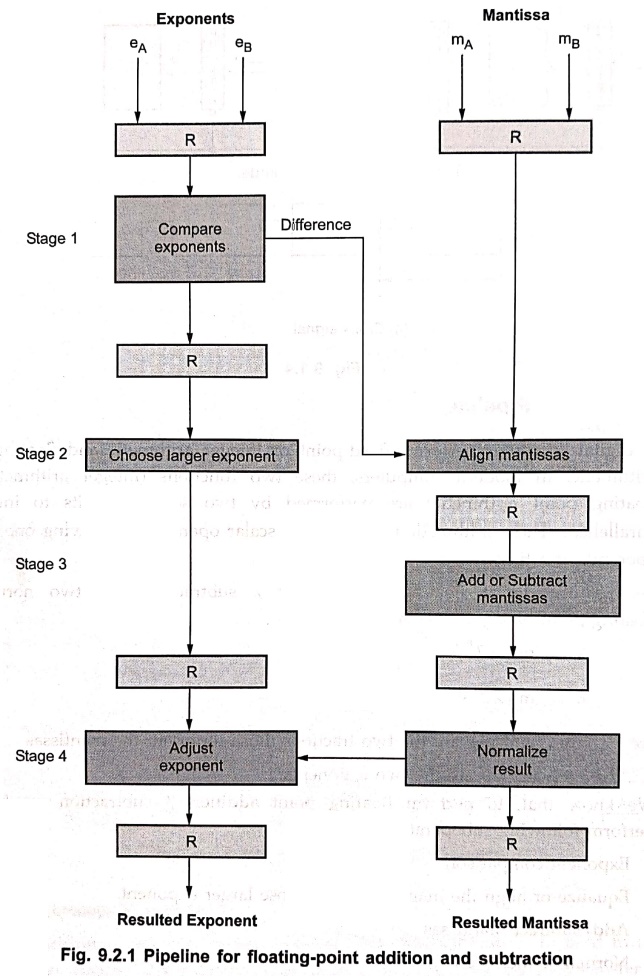
The
result of the comparison, i.e. difference in the first stage determines how
many times the mantissa associated with the smaller exponent must be shifted
right to align the mantissas. This subtask is also performed in second stage.
In the third stage, two mantissas are added or subtracted. Finally, the result
is normalized in the stage four. If an overflow occurs, the mantissa of the
result is shifted right and the exponent is incremented by one. If an underflow
occurs, the mantissa is shifted left and exponent is decremented by a number
equal to the number of leading zeros in the mantissa. The flow chart in Fig.
9.2.1 illustrates above discussed pipelined stages. Registers shown in the
flowchart stores the result of the suboperations.
Example: 1
Let us consider that we
have to add number A and number B.
where
A = mA x 2 e A = 0.10110 × 23
and
B = mB x 2 e
B = 0.11010 × 24
Now we see how
suboperations are performed in different stages.
Solution :
Stage 1 :
Exponent comparison
|
еA – еB | = | 3 – 4 | = 1
Stage 2 :
Align the mantissas and choose larger exponent
1.
Exponent of the result is = eB = 4.
2.
Mantissa mA = 0.01011
A = 0.01011 × 24 and
B = 0.11010 × 24
Stage 3 :
Add mantissas
Mantissa
of result mR = 0.01011 + 0.11010 = 1.00101
R = 1.10101 × 24
Stage 4 :
Normalize the result
R
= 0.100101 × 25
Mantissa
is shifted right by one digit so that it has a fraction with a nonzero first
digit, and exponent is incremented by one.
We
know that, the comparator, shifter, incrementer, decrementer and add /
subtractor used in implementation of floating point addition / subtraction
pipeline are the combinational circuits. They introduce time delays to produce
output. Suppose that due to these delays we have time delays in the four stages
of pipeline. These are : t1 = 50 ns, t2 = 80 ns, t3
= 90 ns and t4 = 80 ns. In addition to this there is an interstage
delay d = 10 ns. The time period for clock cycle is given by
t
= 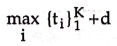 = 90 ns + 10 ns = 100 ns
The
amount of time required to perform floating point addition / subtraction using
a non–pipeline floating point adder / subtractor will be
T1
= t1 + t2 + t3 + t4 + d = 50 + 80 +
90 + 80 + 10 = 310 ns
Therefore,
the speed up factor for this particular pipeline is
S4
= 310 ns / 100 ns = 3.1
Example: 2
The time delay of the
four segment (fetch instruction, decode and calculate effective address, fetch
operand, and execute instruction segment) are as follows :
t1 = 40 ns,
t2 = 25 ns, t3 = 85 ns, t4 = 55 ns
The interface registers
delay time tr = 5 ns
i) How long would it
take to add 75 pairs of numbers in the pipeline?
ii) How can we reduce
the total time to about one half of the time calculated in part (i)?
Solution:
i)
Minimum clock cycle for pipeline
=
Maximum delay through a stage + Delay time for interface register
=
85 + 5 = 90 ns
Number
of cycles required to add 75 pairs of numbers
=
k + n − 1 = 4 + 75 – 1 = 78
Time
required to execute 75 pairs of numbers
=
78 × 90 = 7020 ns
ii)
One–half time of part (i) = 7020 / 2 = 3510
ns
Minimum
clock cycle of pipeline = 3510 / 78 = 45
ns
Maximum
delay through stage = 45 – 5 = 40 ns
Thus
keeping maximum delay through stage equal to 40 ns we can reduce the total time
to 3510 ns.
Example: 3
How would you use the
floating point pipeline address to add 50 floating point nt pipeline address numbers.
Solution :
In
this section we have seen the pipeline for floating–point addition. By using
the same pipeline we can add 50 floating point numbers. In each clock cycle
stage 1 gets two fractions and two mantissas of two numbers. As explained
earlier, the entire floating point addition operation is carried out in 4
stages. Thus to add 50 floating point numbers total 4 + (50 − 1) = 53 cycles
are required.
Review Question
1. What is arithmetic
pipeline? Explain arithmetic pipeline for floating point adder/subtractor with
the help of one example.
Digital Principles and Computer Organization: Chapter 9: Pipelining : Tag: : - Arithmetic Pipeline
Digital Principles and Computer Organization: Chapter 9: Pipelining
Under Subject
Digital Principles and Computer Organization
CS25C06 2nd Semester AIDS, CSE, IT, CSE(CY) Dept | 2025 Regulation | 2nd Semester 2025 Regulation
Related Subjects

English Essentials II
EN25C02 2nd Semester | 2025 Regulation | 2nd Semester 2025 Regulation

Tamils and Technology தமிழர்களும் தொழில்நுட்பமும்
UC25H02 2nd Semester | 2025 Regulation | 2nd Semester 2025 Regulation
Linear Algebra
MA25C02 2nd Semester | 2025 Regulation
Applied Physics (CSIE) II
PH25C03 2nd Semester AIDS, CSE, IT, CSE(CY) Dept | 2025 Regulation | 2nd Semester 2025 Regulation
Digital Principles and Computer Organization
CS25C06 2nd Semester AIDS, CSE, IT, CSE(CY) Dept | 2025 Regulation | 2nd Semester 2025 Regulation

Basic Electrical and Electronics Engineering
EE25C01 2nd Semester | 2025 Regulation | 2nd Semester 2025 Regulation
Python for Data Science
AD25201 2nd Semester AIDS Dept | 2025 Regulation | 2nd Semester 2025 Regulation

Re-Engineering for Innovation
ME25C05 2nd Semester | 2025 Regulation | 2nd Semester 2025 Regulation
Python for Data Science - Laboratory
AD25201 2nd Semester AIDS Dept | 2025 Regulation | 2nd Semester 2025 Regulation