Digital Principles and Computer Organization: Chapter 9: Pipelining
Pipelining: Two Marks Important Questions and Answers
Digital Principles and Computer Organization
Digital Principles and Computer Organization: Chapter 9: Pipelining: Anna University Part A Two Marks Important Questions and Answers
Digital
Principles and Computer Organization:
Chapter 9: Pipelining
Two
Marks Questions with Answers
1. Define
pipelining.
Answer: Pipelining is a technique of decomposing a
sequential process into sub operations with each sub process being executed in
a special dedicated segment that operates concurrently with all other segments.
2. What
is stage delay ?
Answer: The processing time in
each pipeline stage is called stage delay.
3. What
is interstage delay ?
Answer: The delays are also
introduced due to interstage transfer data. These time delays are known as interstage delay and it is denoted as
d.
4. What
is clock skewing?
Answer: Ideally, we expect the
clock pulse to arrive at all stage registers at the same time. In practice, the
same clock pulse may arrive at different stages with a time offset of s. This
problem is known as clock skewing.
5. What
is speed–up factor ?
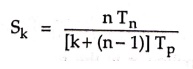
Answer: The speedup factor of
a k–stage pipeline over an equivalent non–pipelined processor is defined as
Sk = nTn
/ [k+ (n–1)]Tp
6. What
is instruction pipelining?
Answer: Performing fetch,
decode and execute cycles for several simultaneously to reduce overall
processing time is referred to referred to as instruction pipelining.
7. List
the four stages in the instruction pipelining.
Answer: The four stages in the
instruction pipelining are :
S1
– Fetch (F) : Read instruction from the memory.
S2
– Decode (D) : Decode the opcode and fetch source operand (s) if necessary.
S3
– Execute (E) : Perform the operation specified by the instruction.
S4
– Store (S) : Store the result in the destination.
8. What
is the ideal speed–up expected in a pipelined architecture with 'n' stages?
Justify your answer.
Answer: The pipelined
processor ideally completes the processing of one instruction in each clock
cycle, which means that the rate of instruction processing with n stage
pipeline is n times that of sequential operation. Therefore, ideal speed–up
factor is n. However, such ideal performance of the pipeline is achieved only
when pipeline stages must complete their processing tasks for a given
instruction in the time allotted. Unfortunately, this is not the case; pipeline
operations could not sustained without interruption throughout the program
execution.
9. What
is meant by hazard in pipelining ?
Answer: Any reason that causes
the pipeline to stall is called a hazard.
10. List
the different types of hazards.
Answer: The different types of instruction hazards are
:
1.
Structural hazards.
2.
Data or Data dependent hazards.
3.
Instruction or Control hazards.
11. What
is structural hazard ?
Answer: The hazard that exist
because of conflicts due to insufficient resources when even with all possible
combination, it may not be possible to overlap the operation is called
structural hazard.
12. What
is instruction or control hazard ?
Answer: The hazard due to
pipelining branch and other instructions that change the contents of program
counter is called instruction or control hazard.
13. What
is pipeline scheduling ?
Answer: Rather than allowing
the pipeline to stall, the compiler can rearrange instructions to avoid data
hazard. It is called pipeline
scheduling.
14. What
is delayed load and delayed slot ?
Answer: A load which requires
that the following instruction do not use its result is said : to be delayed
load and the pipeline slot after load instruction is called delayed slot.
15. How
addressing modes affect the instruction pipelining ?
Answer: Degradation of
performance is an instruction pipeline may be due to address dependency where
operand address cannot be calculated without available information needed by
addressing mode for e.g. an instructions with register indirect mode cannot
proceed to fetch the operand if the previous instructions is loading the
address into the register. Hence operand access is delayed degrading the
performance of pipeline.
16. How
compiler is used in pipelining ?
Answer: A compiler translates
a high level language program into a sequence of machine instructions. The
number of cycles required to execute program is dependent not only on the
choice of instruction, but also on the order in which they appear in the
program. The compiler may rearrange program instruction to achieve better
performance of course, such changes must not affect of the result of the
computation.
17. What
is loop buffer?
Answer:
A
loop buffer is a small very high speed memory. It is used to store recently
prefetched instructions in sequence. If conditional branch is valid, the
hardware first checks whether the branch target is within the loop buffer. If
so, the next instructions are fetched from the buffer, instead of memory
avoiding memory access.
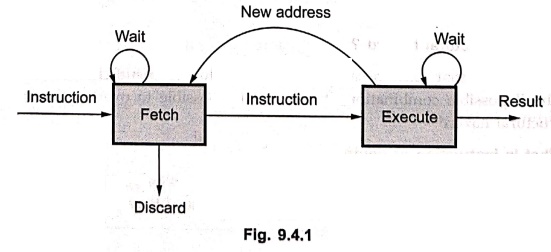
18. Draw
the structure of two stage instruction pipe line.
Answer:
Fig.
9.4.1 shows the structure of two stage instruction pipe line.
19. What
would be the effect, if we increase the number of pipelining stages?
Answer: As the number of
pipeline stages increases, the probability of the pipeline being stalled also
increases because more instructions are being executed concurrently. Thus,
dependancies between instructions that are far apart may still cause the
pipeline to stall. As the number of pipeline stages increase, the branch
penalties may become more significant.
20. What
is data hazard in pipelining? What are the solutions ?
Answer: When either the source
or the destination operands of an instruction are not available at the time
expected in the pipeline and as a result pipeline is stalled, we say such a
situation is a data hazard.
1.
The easiest way to handle data hazards is to stall the pipeline.
2.
The second simple hardware technique which can handle data hazard is called forwarding or register by passing.
21. What
are the classification of data hazards ?
Answer: The data hazard can be
classified as,
1.
RAW (read after write) hazard
2.
WAW (write after write) hazard
3.
WAR (write after read) hazard
22. What
is the use of condition code register ?
Answer: The conditional branch
instruction checks the condition code flags to decide the flow of program
execution.
23. What
do you mean by out–of order execution ?
Answer:
The dispatch unit dispatches the instructions in the order in which they appear
in the program. But their execution may be completed in the different order
because of data dependency among the instructions. Such situation is called out–of
order execution.
24. What is
instruction throughput ?
Answer: The instruction
throughput is the number of instructions executed per second. For sequential
execution, it is given by,
Ps
= R / S.
where
R is a clock rate measured in clocks per second and S is the average number of
steps needed to execute one machine instruction.
25. Why
is branch prediction algorithm needed ?
Answer: Branch prediction
algorithm is needed to reduce the branch penalty.
26. List
commonly used branch prediction techniques.
Answer: The commonly used
branch prediction techniques are :
•
Predict Never Taken
•
Predict Always Taken
•
Predict By Opcode
•
Taken/Not Taken Switch
•
Branch History Table.
27. Name
the two types of branch prediction strategies.
Answer: The two types of
branch prediction strategies are :
•
Static branch strategy
•
Dynamic branch strategy.
28. What
is branch target / prediction buffer?
Answer: The buffer in which
the recent branch information is stored is called branch target buffer.
29. What
is branch folding ?
Answer: The instruction fetch
unit has executed the branch instruction concurrently with the execution of
other instructions. This technique is referred to as branch folding.
30. What
is delayed branching ?
Answer: A technique called
delayed branching can minimize the penalty incurred as a result of conditional
branch instructions. The idea is simple. The instructions in the delay slots
are always fetched. Therefore, we would like to arrange for them to be fully executed
whether or not the branch is taken. The objective is to be able to place useful
instructions in these slots. If no useful instructions can be placed in the
delay slots, these slots must be filled with NOP instructions.
31. What
is meant by speculative execution?
Answer: Speculative execution
means that instructions are executed before the processor is certain that they
are in the correct execution sequence. Hence, care must be taken that no
processor registers or memory locations are updated until it is confirmed that
these instructions should indeed be executed. If the branch decision indicates
otherwise, the instructions and all their associated data in the execution
units must be purged, and the correct instructions fetched and executed.
32. What
is called static and dynamic branch prediction ?
OR
Differentiate
between the static and dynamic techniques.
Answer: The branch prediction
decision is always the same every time a given instruction is executed. Any
approach that has this characteristic is called static branch prediction.
Another approach in which the prediction decision may change depending on
execution history is called dynamic branch prediction.
33. What
is the role of cache in pipelining?
Answer: Each pipeline stage is
expected to complete in one clock cycle. The clock period should be long enough
to let the slowest pipeline stage to complete. Faster stages have to wait for
the slowest one to complete. Since main memory is very slow compared to the
execution, if each instruction needs to be fetched from main memory, pipeline
is almost useless. The cache memory reduces the memory access time and makes
pipelining useful.
Digital Principles and Computer Organization: Chapter 9: Pipelining : Tag: : Digital Principles and Computer Organization - Pipelining: Two Marks Important Questions and Answers
Digital Principles and Computer Organization: Chapter 9: Pipelining
Under Subject
Digital Principles and Computer Organization
CS25C06 2nd Semester AIDS, CSE, IT, CSE(CY) Dept | 2025 Regulation | 2nd Semester 2025 Regulation
Related Subjects

English Essentials II
EN25C02 2nd Semester | 2025 Regulation | 2nd Semester 2025 Regulation

Tamils and Technology தமிழர்களும் தொழில்நுட்பமும்
UC25H02 2nd Semester | 2025 Regulation | 2nd Semester 2025 Regulation
Linear Algebra
MA25C02 2nd Semester | 2025 Regulation
Applied Physics (CSIE) II
PH25C03 2nd Semester AIDS, CSE, IT, CSE(CY) Dept | 2025 Regulation | 2nd Semester 2025 Regulation
Digital Principles and Computer Organization
CS25C06 2nd Semester AIDS, CSE, IT, CSE(CY) Dept | 2025 Regulation | 2nd Semester 2025 Regulation

Basic Electrical and Electronics Engineering
EE25C01 2nd Semester | 2025 Regulation | 2nd Semester 2025 Regulation
Python for Data Science
AD25201 2nd Semester AIDS Dept | 2025 Regulation | 2nd Semester 2025 Regulation

Re-Engineering for Innovation
ME25C05 2nd Semester | 2025 Regulation | 2nd Semester 2025 Regulation
Python for Data Science - Laboratory
AD25201 2nd Semester AIDS Dept | 2025 Regulation | 2nd Semester 2025 Regulation