Data Structures using C PlusPlus: Chapter 7: Graphs
Graphs (Data Structure): Two Marks Important Questions and Answers
Data Structures using C++ Program
Data Structures using C++ Program: Chapter 7: Graphs: Anna University Part A Two Marks Important Questions and Answers
Data Structures using C ++
Chapter 7: Graphs
Two Marks Questions with Answers
1. Define
graph.
Answer:
A
graph is a collection of two sets of V and E where V is finite non empty set of
vertices and E is a finite non empty set of edges.
Vertices
are nothing but the nodes in the graph and two adjacent vertices are joined by
edges.
The
graph is denoted by G = {V,E}
2. What
are the storage representation of the graph?
Answer:
The
graph can be represented by using arrays or linked list.
1.
The adjacency matrix is a storage representation of the graph by which the
graph is stored in two dimensional arrays.
2.
The adjacency list is a storage representation of a graph by which the graph is
stored in linked list.
3. What
are the applications of graph?
Answer:
The
graph theory is used widely in the computer science very widely. The
applications of graph theory are ‒
1.
In computer networking such as Local Area Network (LAN), Wide Area Networking
(WAN) internetworking the graph is used.
2.
In telephone cabling graph theory is effectively used.
3.
In job scheduling algorithms the graph is used.
4. Prove
that the number of odd degeree vertices in a connected graph should be even.
Answer:
To
prove this, consider connected graphs with odd degree vertices.
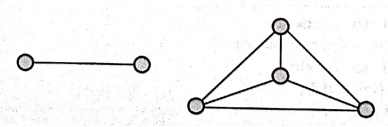
degree
= 1
number
of vertices = 2
degree
= 2
number
of vertices = 3
degree
= 3
number of vertices = 4
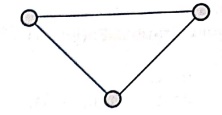
This
figures show clearly that in a connected graph there are even number of
vertices with odd degree.
5. Differentiate
between trees and graphs.
Answer:
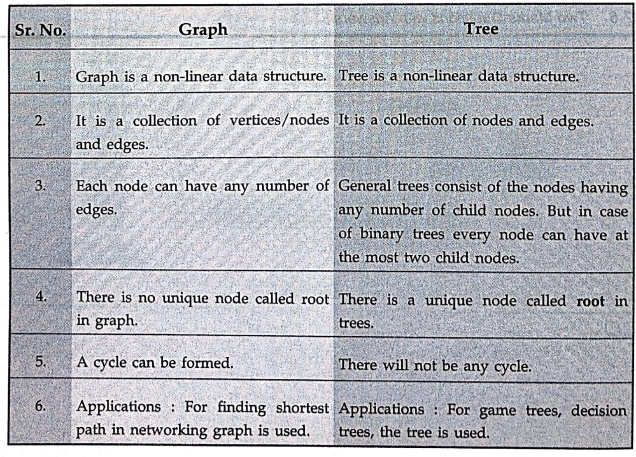
Graph
1.
Graph is a non‒linear data structure.
2.
It is a collection of vertices/nodes and edges.
3.
Each node can have any number of edges.
4.
There is no unique node called root in graph.
5.
A cycle can be formed.
6.
Applications : For finding shortest path in networking graph is used
Tree
1.
Tree is a non‒linear data structure.
2.
It is a collection of nodes and edges.
3.
General trees consist of the nodes having any number of child nodes. But in
case of binary trees every node can have at the most two child nodes.
4.
There is a unique node called root in trees.
5. There will not be any cycle.
6.
Applications : For game trees, decision trees, the tree is used.
6. When
does a graph becomes a tree?
Answer:
A
graph becomes a tree when
•
It contains an unique node which has no incoming(incident) edge but have all
the outgoing edges. This node will become the root of the tree.
•
Remaining nodes of the graph have at the most one incoming edges (these will become the internal nodes).
•
There must be some nodes in the graph having no outgoing edge at all(these will then become the leaf nodes).
•
The graph should be connected.
7. What
is meant by adjacency matrix ?
Answer:
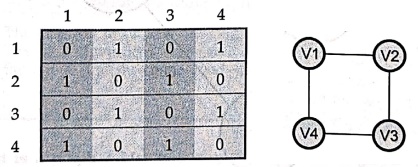
Adjacency
matrix is a method of representation of a graph using two dimensional matrix.
For example ‒ If the edge is present between two vertices then the value in
adjacency matrix is set to 1 otherwise 0.
8. What
is strongly connected components? Explain.
Answer:
A
directed graph is said to be strongly connected if for every pair of vertex
there exists a path.
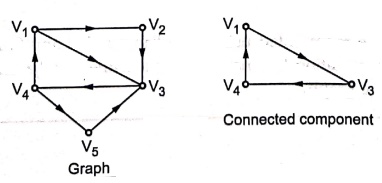
There
exists a path from V1 to V3 as well as from V3
to V1.
9. Write
the template for depth first search ?
Answer:
void Graph::DFS(int v1)
{
int v2;
cout<<endl;<<v1;
v[v1]=TRUE;
for(v2=0;v2<n;v2++)
if(g[v1][v2] = =TRUE
&& v[v2]= =FALSE)
DFS(v2);
}
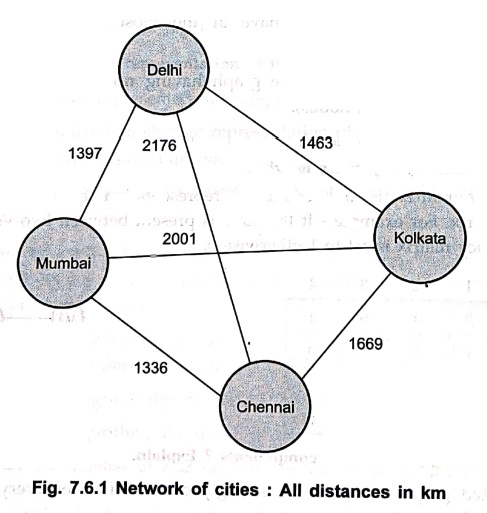
10. Give
the representation of network of cities (Chennai, Delhi, Kolkata and Mumbai) as
weighted graph.
Answer:
11. How a
graph is represented?
Answer:
A
graph can be represented using 1. Adjacency list and 2. Adjacency list. In the
adjacency matrix representation the matrix is used while in adjacency list the
linked list is used to represent the graph.
12. When
a graph is said to be connected?
Answer:
An
undirected graph is said to be connected if for every pair of distinct vertices
Vi and Vj in V(G) there is an edge Vi to Vj
in G.
Note
that there is path from any two vertices.
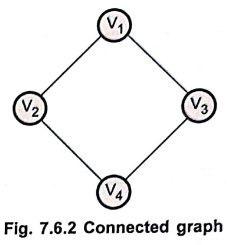
For example:
•
V1 ‒ V2
•
V2 ‒ V1
•
V3 ‒ V1
•
V4 ‒ V3 ‒ V1
•
V1 ‒ V3
•
V2 ‒ V1 ‒ V3
•
V3 ‒ V1 ‒ V2
•
V4
‒ V2
•
V1 ‒ V4
•
V2 ‒ V4
•
V3 ‒ V4
•
V4 ‒ V3
13. Differentiate
between breadth first and depth first
Answer:
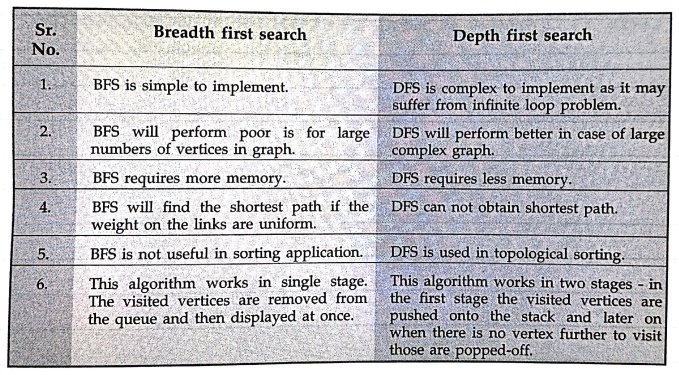
Breadth first search
1.
BFS is simple to implement.
2.
BFS will perform poor is for large numbers of vertices in graph.
3.
BFS requires more memory.
4.
BFS will find the shortest path if the weight on the links are uniform.
5.
BFS is not useful in sorting application.
6.
This algorithm works in single stage. The visited vertices are removed from the
queue and then displayed at once.
Depth first search
1.
DFS is complex to implement as it may suffer from infinite loop problem.
2.
DFS will perform better in case of large complex graph.
3.
DFS requires less memory.
4.
DFS can not obtain shortest path.
5.
DFS is used in topological sorting.
6.
This algorithm works in two stages ‒ in the first stage the visited vertices
are pushed onto the stack and later on when there is no vertex further to visit
those are popped‒off.
14. What
is a graph? List two ways to represent a graph.
A
graph is a collection of two sets V and E where V is a finite non‒empty set of
vertices and E is a finite non‒empty set of edges.
• Vertices are nothing but the nodes in
the graph.
•
Two adjacent vertices are joined by edges.
•
Any graph is denoted as G = (V, E}.
•
There are several representations of graphs, but we will discuss the two
commonly used representations called
■
Adjacency Matrix
■
Adjacency Lists
Let
us see each one by one.
Data Structures using C PlusPlus: Chapter 7: Graphs : Tag: Data Structure, C++ Programing : Data Structures using C++ Program - Graphs (Data Structure): Two Marks Important Questions and Answers
Data Structures using C PlusPlus: Chapter 7: Graphs
Under Subject
Data Structures using CPlusPlus
CS25C05 2nd Semester ECE Dept | 2025 Regulation | 2nd Semester 2025 Regulation
Related Subjects
English Essentials II
EN25C02 2nd Semester | 2025 Regulation | 2nd Semester 2025 Regulation
Tamils and Technology தமிழர்களும் தொழில்நுட்பமும்
UC25H02 2nd Semester | 2025 Regulation | 2nd Semester 2025 Regulation
Linear Algebra
MA25C02 2nd Semester | 2025 Regulation

Electron Devices
EC25C01 2nd Semester ECE Dept | 2025 Regulation | 2nd Semester 2025 Regulation
Data Structures using CPlusPlus
CS25C05 2nd Semester ECE Dept | 2025 Regulation | 2nd Semester 2025 Regulation

Circuits and Network Analysis
EC25C02 2nd Semester ECE Dept | 2025 Regulation | 2nd Semester 2025 Regulation

Re-Engineering for Innovation
ME25C05 2nd Semester | 2025 Regulation | 2nd Semester 2025 Regulation
Engineering Drawing - Laboratory
ME25C01 2nd Semester | 2025 Regulation | 2nd Semester 2025 Regulation
Data Structures using CPlusPlus - Laboratory
CS25C05 2nd Semester ECE Dept | 2025 Regulation | 2nd Semester 2025 Regulation
Devices and Circuits Laboratory
EC25C03 2nd Semester ECE Dept | 2025 Regulation | 2nd Semester 2025 Regulation