Data Structures using C PlusPlus: Chapter 7: Graphs
Representation of Graphs: Adjacency Matrix
Data Structures using C++ Program
Questions: 1. Explain BFS and DFS in detail. Write the algorithm. 2. Explain breadth first search algorithm for traversal of any graph with suitable examples. Define time complexity of the algorithm. 3. What is graph? Explain the depth first search tree. 4. Explain DFS and BFS with suitable example. 5. Illustrate the depth first search algorithm with a graph and explain. 6. Describe in detail about breadth‒first search and depth‒first search in a graph. 7. Discuss types of graph traversal and explain each with suitable examples.
Representation of
Graphs
•
There are several representations of graphs, but we will discuss the two
commonly used representations called
■
Adjacency Matrix
■
Adjacency Lists
Let
us see each one by one.
Adjacency
Matrix
•
Consider a graph G of n vertices and the matrix M. If there is an edge present
between vertices Vi and Vj then M[i][j] = 1 else M[i][j]
= 0. Note that for an undirected graph if M[i][j] = 1 then for M[j][i] is also
1. Here are some graphs shown by adjacency matrix.
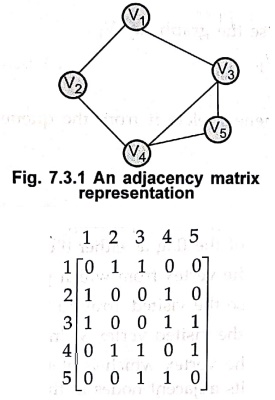
1. Creating a Graph using Adjacency Matrix
•
Creation of graph using adjacency matrix is quite simple task. The adjacency
matrix is nothing but a two dimensional array. The algorithm for creation of
graph using adjacency matix will be as follows:
1)
Declare an array of M[size] [size] which will store the graph.
2)
Enter how many nodes you want in a graph.
3)
Enter the edges of the graph by two vertices each, say Vi, Vj
indicates some edge.
4)
If the graph is directed set M[i][j] = 1. If graph is undirected set M[i][j] =
1 and M[j][i] = 1 as well.
5)
When all the edges for the desired graph is entered print the graph M[i][j].
2. Breadth First Traversal of a Graph
• Basic concept :
Breadth First Search (BFS) is a graph traversal technique that visits all the
vertices level by level, starting from a given source node.
•
It explores all immediate neighbors first before moving to the next level.
•
For BFS traversal we generally use Queue data structure.
•
For the graph to traverse it by BFS we will follow the following logic ‒ Say a
vertex V1 in the graph will be visited first, then all the vertices
adjacent to V1 will be traversed suppose adjacent to V1
are (V2, V3, V4,...Vn). So V2,
V3...Vn will be printed first. Then again from V2
the adjacent vertices will be printed. This process will be continued for all
the vertices to get encounterd. To keep track of all the vertices and their
adjacent vertices we will make use of Queue
data structure. Also we will make use of an array for visited nodes. The nodes which are get visited are set to
1. Thus we can keep track of visited nodes.
•
In short in BFS traversal we follow the path in breadthwise fashion. Let us see
the algorithm for breadth first search.
Algorithm :
1.
Create a graph. Depending on the type of graph i.e. directed or undirected set
the value of the flag as either 0 or 1 respectively.
2.
Read the vertex from which you want to traverse the graph say Vi
3.
Initialise the visited array to 1 at the index of Vi.
4.
Insert the visited vertex Vi in the queue.
5.
Visit the vertex which is at the front of the queue. Delete it from the queue
and place its adjacent nodes in the queue.
6.
Repeat the step 5, till the queue is not empty.
7.
Stop.
Pseudo code
void Gbfs::bfs(int v1)
{
int v2;
visit[v1] = TRUE;
front rear = ‒1;
Q[++rear] = v1;
while (front != rear)
{
v1 = Q[++front];
cout<<"\n"<<v1;
for (v2 = 0; v2 < n;
v2++)
{
if (g[v1][v2] = =
TRUE && visit [v2] = = FALSE)
{
Q[++rear] = v2;
visit[v2] = TRUE;
}
}
}
}
Explanation of logic of BFS
•
In BFS the queue is maintained for storing the adjacent nodes and an array
'visited' is maintained for keeping the track of visited nodes. i.e. once a
particular node is visited it should not be revisited again. Let us see how our
program works:
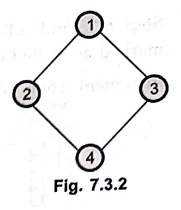
Step 1 :
Start with vertex 1
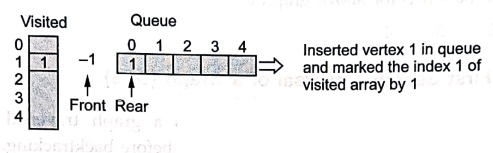
Step 2 :
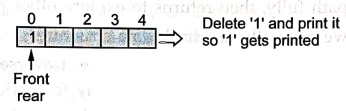
Step 3 :
Find
adjacent vertices of vertex 1 and mark them as visited, insert those in Queue
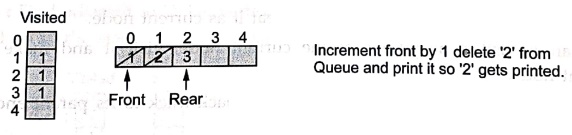
Step 4 :
Find adjacent to '2' and insert those nodes in Queue as well as mark them as
visited.
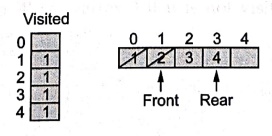
Step 5 :
Increment front and delete the node print it.
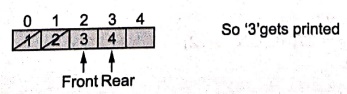
Step 6 :
Find adjacent to '3' i.e. 4 check whether it is marked as visited. If it is
marked as visited do not insert in the queue.
Increment
front, delete the node from queue and print it.
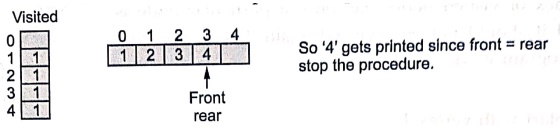
So
output will be ‒ BFS for above graph as
1
2 3
4
3. Depth First Search Traversal of a Graph (DFS)
•
Basic concept : Depth First Search
(DFS) is a graph traversal technique that explores as deep as possible along
each branch before backtracking.
•
It goes down one path fully, then returns to explore other paths.
•
For DFS traversal we generally use stack data structure.
•
When there is no adjacent vertex present we traverse back and search for
unvisited vertex. We will maintain a visited array to mark all the visited
vertices. In case of DFS the depth of a graph should be known. Let see one
example of a graph to traverse it by DFS.
Algorithm
1.
Select an unvisited node v, visit it and treat it as current node.
2.
Find an unvisited neighbour of the current node, visit it and make it as new
current node.
3.
If current node has no unvisited neighbours back track to its parent and make
it a new current node.
4.
Repeat the steps 2 and 3 until no more nodes can be visited.
5.
Repeat from step 1 for the remaining nodes.
Pseudo code
void Gdfs::Dfs (int v1)
{
int v2;
cout<<endl<<v1;
v[v1] = TRUE;
for ( v2 = 0; v2 <
n; v2++)
if (g[v1][v2] = = TRUE && v[v2] = =
FALSE)
Dfs(v2);
}
Explanation of logic for depth first traversal
•
In DFS the basic data structure for storing the adjacent nodes is stack. In our
program we have used a recursive call to DFS function. When a recursive call is
invoked actually push operation gets performed. When we exit from the loop pop
operation will be performed. Let us see how our program works.
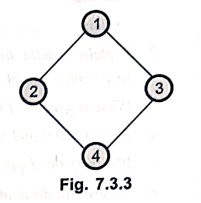
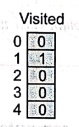
Step 1 :
Start with vertex 1, print it so '1' gets printed. Mark 1 as visited.
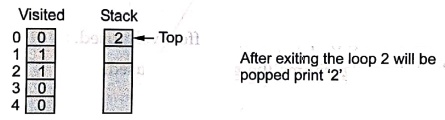
Step 2 :
Find
adjacent vertex to 1, say i.e. 2 if it is not visited, call DFS(2) i.e. 2 will
get inserted in the stack, mark is as visited.
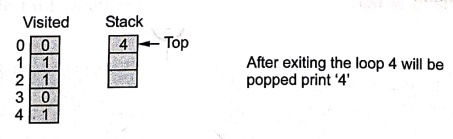
Step 3 :
Find
adjacent to '2' i.e. vertex 4 if it is not visited call DFS(4) i.e., 4 will get
pushed on to the stack mark it as visited.
Step 4 :
Find
adjacent to '4' i.e. vertex 3 if it is not visited call DFS(3) i.e. 3 will be
pushed onto the stack mark it visited.
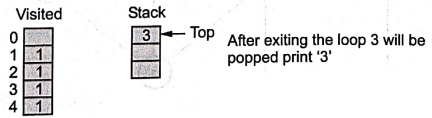
Since
all the nodes are covered stop the procedure.
So
output of DFS is
1 2
4 3
Review Questions
1. Explain BFS and DFS
in detail. Write the algorithm.
2. Explain breadth
first search algorithm for traversal of any graph with suitable examples.
Define time complexity of the algorithm.
3. What is graph?
Explain the depth first search tree.
4. Explain DFS and BFS
with suitable example.
5. Illustrate the
depth first search algorithm with a graph and explain.
6. Describe in detail
about breadth‒first search and depth‒first search in a graph.
7. Discuss types of
graph traversal and explain each with suitable examples.
Data Structures using C PlusPlus: Chapter 7: Graphs : Tag: Data Structure, C++ Programing : Data Structures using C++ Program - Representation of Graphs: Adjacency Matrix
Data Structures using C PlusPlus: Chapter 7: Graphs
Under Subject
Data Structures using CPlusPlus
CS25C05 2nd Semester ECE Dept | 2025 Regulation | 2nd Semester 2025 Regulation
Related Subjects
English Essentials II
EN25C02 2nd Semester | 2025 Regulation | 2nd Semester 2025 Regulation

Tamils and Technology தமிழர்களும் தொழில்நுட்பமும்
UC25H02 2nd Semester | 2025 Regulation | 2nd Semester 2025 Regulation
Linear Algebra
MA25C02 2nd Semester | 2025 Regulation

Electron Devices
EC25C01 2nd Semester ECE Dept | 2025 Regulation | 2nd Semester 2025 Regulation
Data Structures using CPlusPlus
CS25C05 2nd Semester ECE Dept | 2025 Regulation | 2nd Semester 2025 Regulation

Circuits and Network Analysis
EC25C02 2nd Semester ECE Dept | 2025 Regulation | 2nd Semester 2025 Regulation

Re-Engineering for Innovation
ME25C05 2nd Semester | 2025 Regulation | 2nd Semester 2025 Regulation
Engineering Drawing - Laboratory
ME25C01 2nd Semester | 2025 Regulation | 2nd Semester 2025 Regulation
Data Structures using CPlusPlus - Laboratory
CS25C05 2nd Semester ECE Dept | 2025 Regulation | 2nd Semester 2025 Regulation
Devices and Circuits Laboratory
EC25C03 2nd Semester ECE Dept | 2025 Regulation | 2nd Semester 2025 Regulation