Applied Physics I: Chapter 1: Properties of Matter - Elasticity
I-Shape Girders
Definition, Explanation, Applications, Advantages
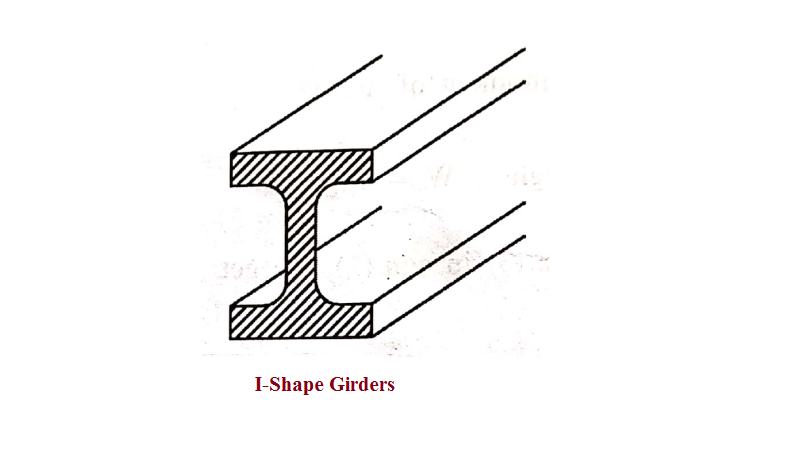
The girders with upper and lower section broadened and the middle section tapered, so that it can withstand heavy loads over it is called as I shape girders.
I‒SHAPE
GIRDERS
Definition:
The
girders with upper and lower section broadened and the middle section tapered,
so that it can withstand heavy loads over it is called as I shape girders. Since the girder look like letter I as shown in
Fig.1.16 they are named as I shape girder.

Explanation:
In
general, any girder supported at its two ends as on the opposite walls of a
room, bends under its own weight and a small depression is produced at the
middle portion. This may also be caused when loads are applied to the beams.
Due
to the depression produced, the upper parts of the girder above the neutral
axis contracts, while the lower parts below the neutral axis expands. (i.e) the
stresses have a maximum value at the top and bottom. The stresses progressively
decreases as it approaches towards the neutral axis. Therefore the upper and
lower surfaces of the girder must be stronger than the intervening part. Thus
the girders are made of I shape and are called as I‒shape girders.
Minimisation of the
depression:
We
know the depression produced in the case of a rectangular section
y = 4Wl3
/ Ybd3
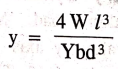
Here,
the depression can be minimised by either decreasing the load (W) (or) the
length of the girder (l) (or) by
increasing the youngs modulus (or) the breadth (b) (or) the thickness of the
girder.
Since
the length of the beam 'l' is the
fixed quantity, it cannot be decreased. Therefore the breadth and thickness may
be adjusted by making the girder of large depth and small breadth (since
thickness increases by b3). Thus the volume of the girder is
increased and hence the depression produced is reduced.
Therefore
for stability, the upper part and the lower part is made broader than the
centre part and hence forming an I shape called as I shape girders. The
depression can also be reduced by properly choosing the materials of high
youngs modulus.
APPLICATIONS OF I‒SHAPE GIRDERS
(i)
They are used in the construction of bridges over the rivers.
(ii)
They are very much useful in the production of iron rails which are employed in
railway tracks.
(iii)
They are used as supporting beams for the ceilings in the construction of
buildings.
(iv)
They are used in the construction of iron beams to support the bridges for the
heavy vehicles and also in the construction of dams.
Advantages of I shape girders
(i)
More stability
(ii)
More stronger
(iii)
High durability
Applied Physics I: Chapter 1: Properties of Matter - Elasticity : Tag: Applied Physics : Definition, Explanation, Applications, Advantages - I-Shape Girders
Applied Physics I: Chapter 1: Properties of Matter - Elasticity
Under Subject

Applied Physics I
PH25C01 1st Semester | 2025 Regulation | 1st Semester 2025 Regulation
Related Subjects

English Essentials I
EN25C01 1st Semester | 2025 Regulation | 1st Semester 2025 Regulation

தமிழர் மரபு - Heritage of Tamils
UC25H01 1st Semester | 2025 Regulation | 1st Semester 2025 Regulation

Applied Calculus
MA25C01 Maths 1 M1 - 1st Semester | 2025 Regulation | 1st Semester 2025 Regulation
Applied Physics I
PH25C01 1st Semester | 2025 Regulation | 1st Semester 2025 Regulation

Applied Chemistry I
CY25C01 1st Semester | 2025 Regulation | 1st Semester 2025 Regulation

Makerspace
ME25C04 1st Semester | 2025 Regulation | 1st Semester 2025 Regulation
Computer Programming C
CS25C01 1st Semester | 2025 Regulation | 1st Semester 2025 Regulation

Computer Programming Python
CS25C02 1st Semester | 2025 Regulation | 1st Semester 2025 Regulation

Fundamentals of Electrical and Electronics Engineering
EE25C03 1st Semester | 2025 Regulation | 1st Semester 2025 Regulation
Introduction to Mechanical Engineering
ME25C03 1st Semester | 2025 Regulation | 1st Semester 2025 Regulation

Introduction to Civil Engineering
CE25C01 1st Semester Civil Department | 2025 Regulation | 1st Semester 2025 Regulation
Essentials of Computing
CS25C03 1st Semester - AID CSE IT Department | 2025 Regulation | 1st Semester 2025 Regulation

Applied Physics I Laboratory
PH25C01 1st Semester practical Laboratory Manual | 2025 Regulation | 1st Semester Laboratory 2025 Regulation

Applied Chemistry I Laboratory
CY25C01 1st Semester practical Laboratory Manual | 2025 Regulation | 1st Semester Laboratory 2025 Regulation

Computer Programming C Laboratory
CS25C01 1st Semester practical Laboratory Manual | 2025 Regulation | 1st Semester Laboratory 2025 Regulation

Computer Programming Python Laboratory
CS25C02 1st Semester practical Laboratory Manual | 2025 Regulation | 1st Semester Laboratory 2025 Regulation
Engineering Drawing
ME25C01 EEE Mech Dept | 2025 Regulation | 2nd Semester 2025 Regulation

Basic Electronics and Electrical Engineering
EE25C04 1st Semester ECE Dept | 2025 Regulation | 2nd Semester 2025 Regulation