Applied Calculus: UNIT II: Functions of Several Variables
Partial derivatives
Explanation, Formula, Equation, Example and Solved Problems - Partial derivatives
PARTIAL DERIVATIVES
A partial derivative of
a function of several variables is the ordinary derivative w.r.to one of the
variables when all the remaining variables are kept constant. Partial
derivatives of higher order are obtained by partial differentiation of first
order partial derivative.
FIRST ORDER PARTIAL DERIVATIVES
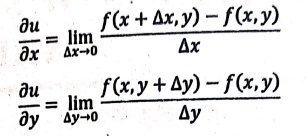
Let u = f(x, y) be a function of two independent variables. Differentiating u with respect to x keeping y as a constant is known as the partial differential coefficient of 'u' with respect to 'x'. It is denoted by ∂u/ ∂x.
Similarly, if we
differentiate u with respect to 'y' keeping 'x' constant is known as
the partial
differential coefficient of 'u' with
respect to 'y'. It is denoted by
HIGHER ORDER PARTIAL DERIVATIVES
Let u= f(x,y)
be a function of two variables x and
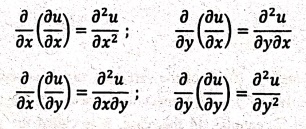
y. Then ∂u/∂x and ∂u/∂y represent the first partial derivative of u with respect to x and y. Here both ∂u/∂x and ∂u/∂y again a function of x and y. Here each of these partial
derivatives may again be differentiated with respect to x and y and it is
denoted by
Note: ∂2u/∂x∂y
means first we have to differentiate 'u'
partially with respect to 'y' and
then differentiate partially with respect to x.
1. If u = f(x,
y) and its partial derivatives are continuous, then ∂2u/∂x∂y = ∂2u/∂y∂x.
2. If z = f(x),
a function of independent variable x, then
and ∂z/∂x and dx/dz represent the same.
3. If z is a function of two variables u and v, where u = ϕ(x,y) and v = ψ(x, y) then z is a
function of x and y.

Example
1.
Find the first order
partial derivative of u = tan‒1[ x2+y2 / x+y]
Solution:
We have to find ∂u/∂x and ∂u/∂y.

Since u remains same if
we interchange x and y in (1),
u
is symmetrical w.r.to x and y.
Interchanging x and y in (2), we have
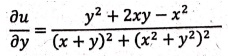
Similarly
Example
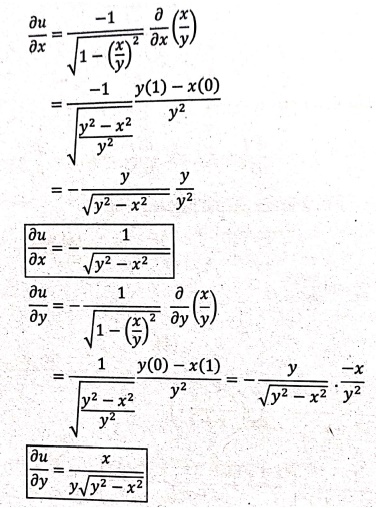
2. Find the first order partial derivatives of u = cos‒1(x/y)
Solution:
We have to find ∂u/∂x and ∂u/∂y.
Example
3. Find the first and second partial derivatives of z = x3+ y3
‒ 3axy.
Solution:
We have z = x3 + y3
‒ 3axy
∂z/∂x = 3x2‒0‒3ay(1) = 3x2 ‒
3ay
and ∂z/∂y
= 0+3y2 ‒ 3ax(1) = 3y2
– 3ax
∂2z/∂x2
= ∂/∂x(3x2‒3ay) = 6x,
∂2z/∂y∂x = ∂/∂y(3x2 ‒ 3ay) = ‒3a,
∂2z/∂y2
= ∂/∂y(3y2 ‒ 3ax) = 6y
∂2z/∂x∂y = ∂/∂x(3y2‒3ax) = ‒3a,
We observe that ∂2z/∂y∂x = ∂2z/∂x∂y
Example
4.

Example
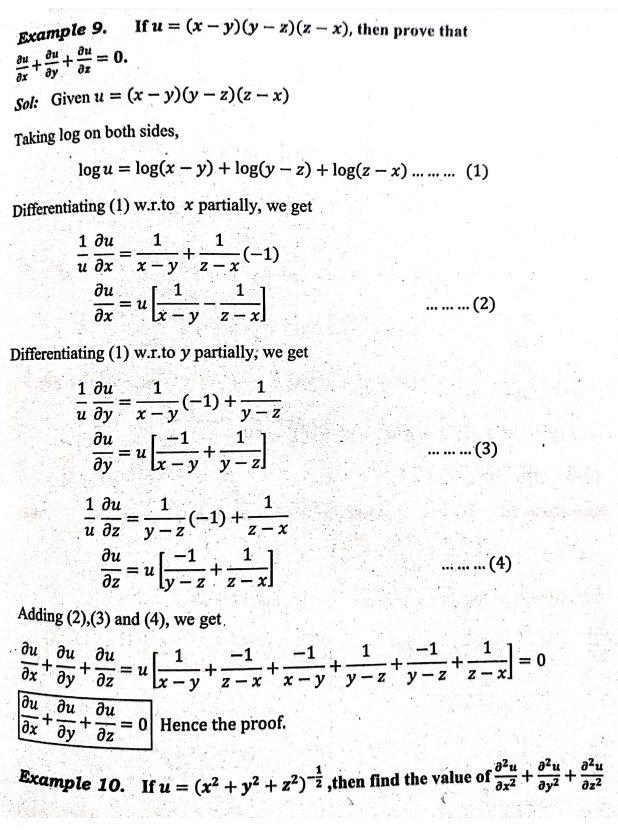
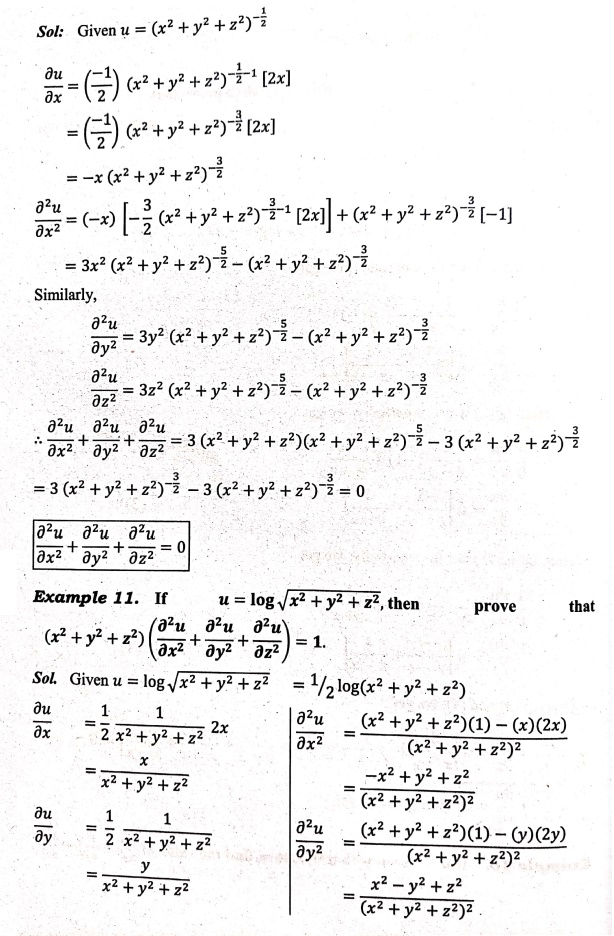
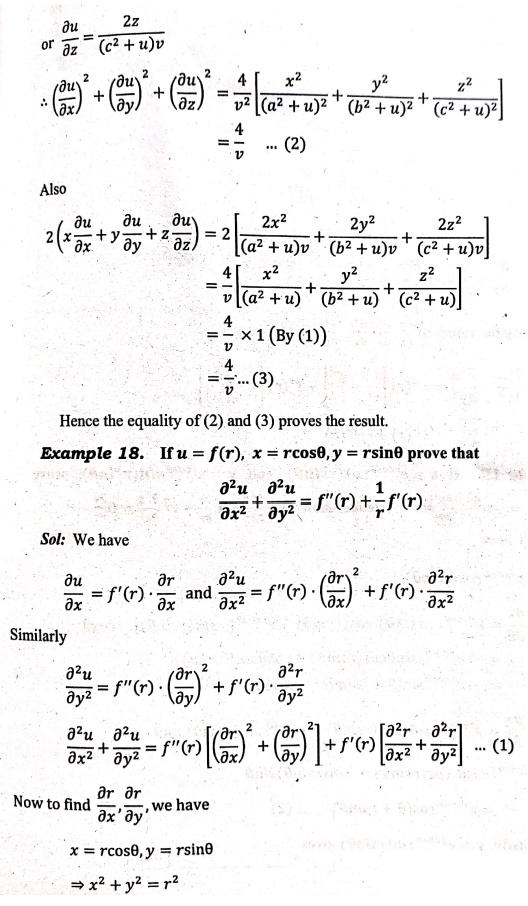
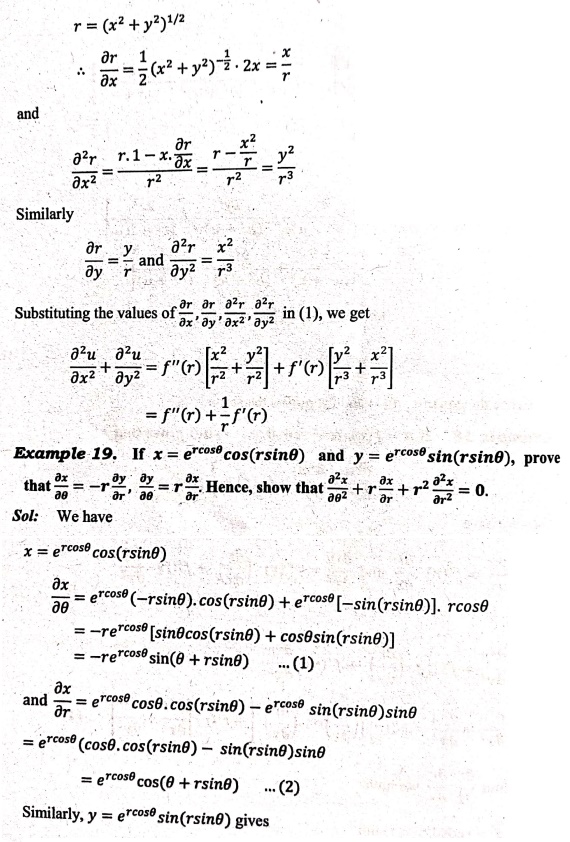
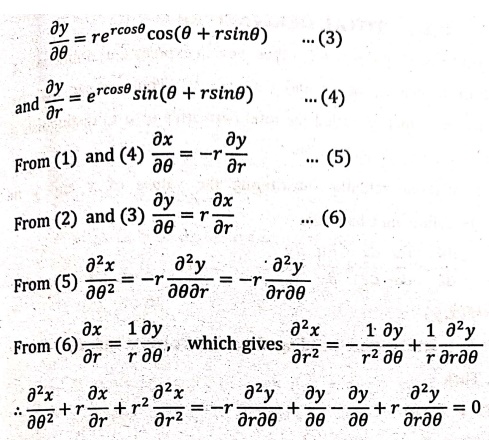
5. If u = log√[x2 + y2
+ z2], then prove that (x2
+ y2 + z2) (∂2u/∂x2
+ ∂2u/∂y2 + ∂2u/∂z2 ] = 1
Solution:




EXERCISE
39. If u = log(x2 + y2)
+ tan‒1(y/x), prove that ∂2u/∂x2 + ∂2u/∂y2
= 0.
40. Examine whether the
following functions are homogenous or not
(i) x2 + xy + y2, (ii) x3cos(y/x)
41. If z(x
+ y) = x2 + y2, then show that (∂z/∂x
‒ ∂z/∂y)2 = 4(1 ‒ ∂z/∂x ‒ ∂z/∂y)
42. If u = x2y + y2z + z2x, then prove that ∂u/∂x + ∂u/∂y
+ ∂u/∂z = (x + y + z)2
43. If x2 + y2 + z2
− 2xy ‒ 2xyz = 1, then show that dx/√[1‒x2] + dx/√[1‒x2] + dx/√[1‒x2] = 0.
44. If u = (x − y)4 + (y‒z)4
+ (z ‒ x)4, then show that ∂u/∂x + ∂u/∂y + ∂u/∂z = 0.
45. If u = log(cotx
+ coty + cotz), then prove that
sin 2x(∂u/∂x) + sin 2y(∂u/∂y) + sin 2z(∂u/∂z)
= ‒2
Applied Calculus: UNIT II: Functions of Several Variables : Tag: Applied Calculus : - Partial derivatives
Applied Calculus: UNIT II: Functions of Several Variables
Under Subject
Applied Calculus
MA25C01 Maths 1 M1 - 1st Semester | 2025 Regulation | 1st Semester 2025 Regulation
Related Subjects

English Essentials I
EN25C01 1st Semester | 2025 Regulation | 1st Semester 2025 Regulation

தமிழர் மரபு - Heritage of Tamils
UC25H01 1st Semester | 2025 Regulation | 1st Semester 2025 Regulation
Applied Calculus
MA25C01 Maths 1 M1 - 1st Semester | 2025 Regulation | 1st Semester 2025 Regulation
Applied Physics I
PH25C01 1st Semester | 2025 Regulation | 1st Semester 2025 Regulation

Applied Chemistry I
CY25C01 1st Semester | 2025 Regulation | 1st Semester 2025 Regulation

Makerspace
ME25C04 1st Semester | 2025 Regulation | 1st Semester 2025 Regulation

Computer Programming C
CS25C01 1st Semester | 2025 Regulation | 1st Semester 2025 Regulation

Computer Programming Python
CS25C02 1st Semester | 2025 Regulation | 1st Semester 2025 Regulation

Fundamentals of Electrical and Electronics Engineering
EE25C03 1st Semester | 2025 Regulation | 1st Semester 2025 Regulation
Introduction to Mechanical Engineering
ME25C03 1st Semester | 2025 Regulation | 1st Semester 2025 Regulation

Introduction to Civil Engineering
CE25C01 1st Semester Civil Department | 2025 Regulation | 1st Semester 2025 Regulation
Essentials of Computing
CS25C03 1st Semester - AID CSE IT Department | 2025 Regulation | 1st Semester 2025 Regulation

Applied Physics I Laboratory
PH25C01 1st Semester practical Laboratory Manual | 2025 Regulation | 1st Semester Laboratory 2025 Regulation

Applied Chemistry I Laboratory
CY25C01 1st Semester practical Laboratory Manual | 2025 Regulation | 1st Semester Laboratory 2025 Regulation

Computer Programming C Laboratory
CS25C01 1st Semester practical Laboratory Manual | 2025 Regulation | 1st Semester Laboratory 2025 Regulation

Computer Programming Python Laboratory
CS25C02 1st Semester practical Laboratory Manual | 2025 Regulation | 1st Semester Laboratory 2025 Regulation
Engineering Drawing
ME25C01 EEE Mech Dept | 2025 Regulation | 2nd Semester 2025 Regulation

Basic Electronics and Electrical Engineering
EE25C04 1st Semester ECE Dept | 2025 Regulation | 2nd Semester 2025 Regulation