Computer Programming C Laboratory: Practical C Programs
Summary of C Language
Summary of C Language - Computer Programming C
SUMMARY OF 'C' LANGUAGE
Variables
Syntax:
<
Variable type> <namel>, <name2>.....
Examples:
int w;
float rate;
char name[10];
Initialization
Syntax:
<variable
type> <variable name> = <value>;
Examples:
int n=10;
int n[5] = {1,2,3,4,5};
float price = 10.50;
char counter 'Y';
Assignments
Syntax:
<name>
= <value>;
Example:
n = 3977;
r = 10.50;
C = 'Y';
Constants
Syntax:
#define
<constant name> <value>
Example:
#define PI 3.141592
Type
Definition
Syntax:
typedef
<variable type> <symbolic name>;
Example:
typedef int Boolean;
Comments
Syntax: /* <body of
comment> */
Example:
/*input data */
Structures
Syntax:
struct
<identifier>
{
<type> <variable name>;
<type> <variable name>;
}
struct
<identifier> <var name>, <var name>;
Example:
struct item
{
int ic;
char iname [20];
float rate;
};
struct item pen, book;
Assignment
Syntax:
<identifier>
<member name>= <value>;
Examples:
pen.iname = 'REYNOLDS';
pen.plate = 10.50;
book.ic = 100;
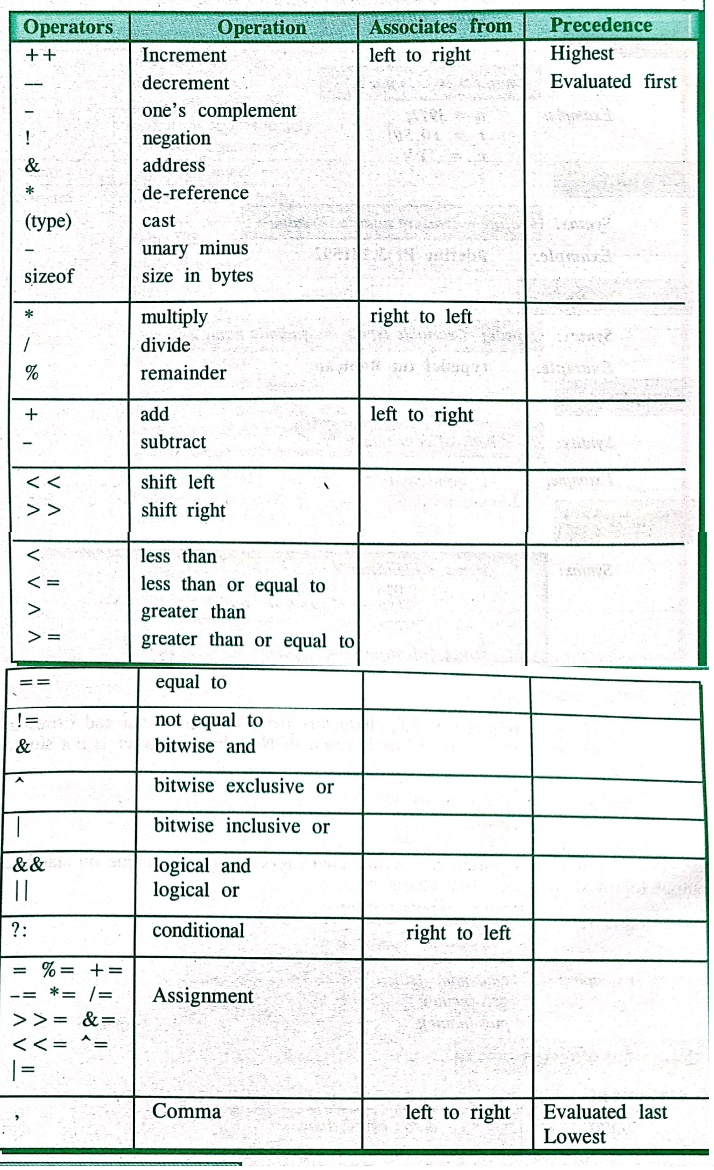
Associativity
of Operators
Input and
Output
printf:
Syntax:
printf<
"literal string>:");
printf("<literal
string>\n");
printf("conversion
specification", <variable names>);
Examples:
printf("The output in follows");
printf("Results are \n");
printf("%d %f %e \n", a,b,c);
scanf:
Syntax:
scanf("<conversion
specs >", &<variable>,&<variables>);
Examples:
scanf("%d"; & n);
scanf("%c", name);
Conversion specifications:

Primitive
input/output
gets()
and getchar(): Reads characters from standard input and stores in array name
and quits when end of line is reached. New line character is not stored in the
array.
Syntax:
c=getchar();
gets();
puts()
and putchar(): Writes characters from array name on standard output followed by
a new line character
Syntax:
putchar(c);
puts(<array
name>);
Examples:
char name [10];
gets (name);
puts (name);
Control
structures
if
statement
Syntax:
if (<condition
expression>)
{
<compound statements>;
}
Example:
if (i<n)
{
i++;
scanf("%d",
&a);
}
If else
statement
Syntax:
if (<condition
expression>)
{
<compound statements>
else
{
<compound statements>;
}
Example:
if (a>b)
printf(“A is
Big");
else
printf("B is
Big");
Instead
of compound statements a single statement alsoallowed
switch
statement
Syntax:
switch
(expression>)
{
case <value 1>:
<compound statement 1>;
break;
case <value 2>:
<compound statement 2>;
break;
…………..
…………..
default:
<compound statement for default>;
break;
}
Example:
scanf("%d",&n);
switch(n);
{
case 1: printf
("one");
break;
case 2: printf
("two");
break;
case 3:
printf("three");
break
default:
printf("no out of range");
break;
}
Loop
structures
for loop
Syntax:
for (<expression
1>; <expression 2>; <expression 3>)
{
<compound statement>;
}
Examples:
for (i=0; i<=n; i++)
{
printf("value
is %d", i);
}
while
loop
Syntax:
while (<condition
expression>)
{
<compound statement>;
}
Example:
while (i <=n)
{
printf("value of i is %d", i);
i++;
}
do while
loop
Syntax:
do
{
<compound statement>;
}
while (<conditions
expression>);
Example:
do
{
printf("value
%d", i);
i++)
}
while (i<=n);
Function
Definitions
Syntax:
<type returned>
<function name>(List of parameters)
{
<declaration of local
variables>;
<body of function> ;
}
Example:
int add (int x, int y)
{
int z;
z = x+y;
return (z);
}
Structure of a C program
#include<stdio.h>
/* /i/o library */
#include<math.h> /* math library ‒ optional */
#include
<string.h> /* string functions ‒
optional */
#include
<ctype.h> /*character class tests
‒ optional */
#include
<stdlib.h> /* utility functions ‒
optional */
#include …. /* other
library files */
#define …. /* define
constants */
/* Declare global
variables */
<variable type>
<list of variables>;
/* Function prototypes
*/
<type returned>
<function name> <parameter list>);
/* main function */
main (optional argc
and argv arguments)
{
<declaration
of local variables, arrays, structures etc>
………….
body of code
……….
} /* End of main */
<type returned>
<function name> <parameter list>)
{
<declaration of local variables>
……..
body of functions
……….
return ()
} /* End of function
*/
Other functions if
any.
File Opening Modes
r: Opens
an existing text file for reading purpose.
w: Opens
a text file for writing. If it does not exist, then a new file is created. Here
your program will start writing content from the beginning of the file.
a:
Opens a text file for writing in appending mode. If it does not exist, then a
new file is created. Here your program will start appending content in the
existing file content.
r+:
Opens a text file for both reading and writing.
w+:
Opens a text file for both reading and writing. It first truncates the file to
zero length if it exists, otherwise creates a file if it does not exist.
a+:
Opens a text file for both reading and writing. It creates the file if it does
not exist. The reading will start from the beginning but writing can only be
appended.
Preprocessor Directives
#define: Substitutes
a preprocessor macro.
#include:
Inserts a particular header from another file.
#undef:
Undefines a preprocessor macro.
#ifdef: Returns
true if this macro is defined.
#ifndef:
Returns true if this macro is not defined.
#if: Tests
if a compile time condition is true.
#else: The
alternative for #if.
#elif: #else and #if in one
statement..
#endif: Ends preprocessor conditional.
#error: Prints
error message on stderr.
#pragma:
Issues special commands to the compiler, using a standardized method.
String Functions
C
supports a wide range of functions that manipulate null‒terminated strings
Function:
Purpose
1. strcpy(s1, s2);
Copies string s2 into string s1.
2.
strcat(s1, s2); Concatenates string s2 onto the
end of string s1.
3. strlen(s1);
Returns the length of string s1.
4. strcmp(s1, s2);
Returns 0 if s1 and s2 are the same; less than 0 if s1<s2; greater than 0 if
s1>s2.
5. strchr(s1, ch);
Returns a pointer to the first occurrence of character ch in string s1.
6. strstr(s1, s2);
Returns a pointer to the first occurrence of string s2 in string s1.
Memory Management
The
C programming language provides several functions for memory allocation and
management. These functions can be found in the <stdlib.h> header file.
Function:
Description
1. void *calloc(int num, int size);
This function allocates an array of num elements each of which size in bytes
will be size.
2. void free(void *address);
This function releases a block of memory block specified by address.
3. void *malloc(int num);
This function allocates an array of num bytes and leave them uninitialized.
4. void *realloc(void *address, int
newsize); This function re‒allocates memory extending it upto
newsize.
Computer Programming C Laboratory: Practical C Programs : Tag: : - Summary of C Language
Computer Programming C Laboratory: Practical C Programs
Under Subject
Computer Programming C
CS25C01 1st Semester | 2025 Regulation | 1st Semester 2025 Regulation

Computer Programming C Laboratory
CS25C01 1st Semester EEE, ECE, CSE, CSE(CY), AIDS, IT practical Laboratory Manual | 2025 Regulation | 1st Semester Laboratory 2025 Regulation
Related Subjects

English Essentials I
EN25C01 1st Semester | 2025 Regulation | 1st Semester 2025 Regulation

தமிழர் மரபு - Heritage of Tamils
UC25H01 1st Semester | 2025 Regulation | 1st Semester 2025 Regulation
Applied Calculus
MA25C01 Maths 1 M1 - 1st Semester | 2025 Regulation | 1st Semester 2025 Regulation
Applied Physics I
PH25C01 1st Semester | 2025 Regulation | 1st Semester 2025 Regulation

Applied Chemistry I
CY25C01 1st Semester | 2025 Regulation | 1st Semester 2025 Regulation
Makerspace
ME25C04 1st Semester | 2025 Regulation | 1st Semester 2025 Regulation
Computer Programming C
CS25C01 1st Semester | 2025 Regulation | 1st Semester 2025 Regulation
Computer Programming Python
CS25C02 1st Semester | 2025 Regulation | 1st Semester 2025 Regulation
Fundamentals of Electrical and Electronics Engineering
EE25C03 1st Semester EEE Depart | 2025 Regulation | 1st Semester 2025 Regulation
Introduction to Mechanical Engineering
ME25C03 1st Semester Mechanical Dept | 2025 Regulation | 1st Semester 2025 Regulation

Introduction to Civil Engineering
CE25C01 1st Semester Civil, Agri Departments | 2025 Regulation | 1st Semester 2025 Regulation
Essentials of Computing
CS25C03 1st Semester - AIDS, CSE, CSE(CY), IT Department | 2025 Regulation | 1st Semester 2025 Regulation

Applied Physics I Laboratory
PH25C01 1st Semester practical Laboratory Manual | 2025 Regulation | 1st Semester Laboratory 2025 Regulation

Applied Chemistry I Laboratory
CY25C01 1st Semester practical Laboratory Manual | 2025 Regulation | 1st Semester Laboratory 2025 Regulation
Computer Programming C Laboratory
CS25C01 1st Semester EEE, ECE, CSE, CSE(CY), AIDS, IT practical Laboratory Manual | 2025 Regulation | 1st Semester Laboratory 2025 Regulation

Computer Programming Python Laboratory
CS25C02 1st Semester practical Laboratory Manual | 2025 Regulation | 1st Semester Laboratory 2025 Regulation
Engineering Drawing
ME25C01 EEE, Mech, Agri, EEE Depts | 2025 Regulation | 2nd Semester 2025 Regulation

Basic Electronics and Electrical Engineering
EE25C04 1st Semester ECE Dept | 2025 Regulation | 1st Semester 2025 Regulation
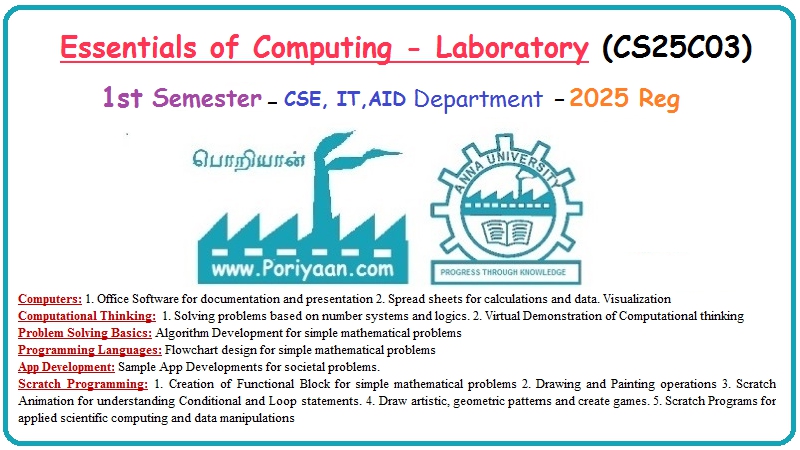
Essentials of Computing - Laboratory
CS25C03 1st Semester AIDS, CSE, CSE(CY), IT Depts | practical Laboratory Manual | 2025 Regulation | 1st Semester 2025 Regulation