Object Oriented Programming: Chapter 5: Templates and Exception Handling
Templates and Exception Handling: Two Marks Important Questions and Answers
C++ Object Oriented Programming
Object Oriented Programming C++: Chapter 5: Templates and Exception Handling : Anna University Part A Two Marks Important Questions and Answers
Object Oriented Programming
Chapter 5: Templates and Exception
Handling
Two Marks
Questions with Answers
1. What
is a difference between a function template and template function ?
Answer:
Function template is a generic programming technique in which a framework for
the desired functionality is created and using various data types the
implantation is used.
For
example ‒
void
add(T &a,T &b)
{
…
…
}
The
template function is invoking each implementation. For example –
add(10,30);
add(11.11,22.22)
2. Write
the benefits of using the template functions in C++.
Answer:
When identical operations are performed on the elements of belonging to
different data types then for each data type a separate function needs to be
written. Using function template a single function can be written to which the
appropriate data type is passed as an argument. Thus template functions brings
the reusability of the code and thus the code becomes compact.
3. Distinguish
between function overload and function templates.
Answer: :
Function overloading allows the definition of more than one function with the
same name and provides a means of choosing between the functions based on
parameter matching. Template functions tell the compiler how to create new
functions, based on the instantiation data types. Functions generated from the
template behaves like normal functions.
The
function body will differ in function overloading whereas the function body
will not differ in function template.
4.
What is a
template?
OR
What is
the use of templates ?
Answer:
Template is a tool for general programming that allows to write the code for
any data type element.
5. What
do you mean by the term 'Generic Programming'
Answer: :
•
The generic programming is a technique
that allows to write the code for any data type elements.
•
The template is used as a tool for generic programming.
6. Define
exception. Give example.
Answer:
Exceptions is a mechanism that handles any unavoidable circumstances that may
occur in the program. C++ provides built in error handling mechanism which is
known as exception handling. The exception handling is done using three
keywords try, catch and throw.
For
example following function makes use of exception handling mechanism ‒
void divide()
{
double a,b;
cout<<"\n Enter the values of a and b";
cin>>a>>b;
try
{
if(b= = 0)
throw b;
cout<<"Result:
"<<a/b<<endl;
}
catch (double b)
{
cout<<Can't
Divide by zero"<<endl;
}
}
7. What
is try‒catch block ?
Answer:
The try‒catch block is used for handling the exceptions. The try block contains
the portion of the code that is to be examined for error detection. Using catch
block the exception is caught and processed.
8. What
is the purpose of throw ?
Answer::
The throw is used to throw or raise an exception
9. In
C++, how do we handle multiple exceptions.
Answer:
By using multiple catch statements the multiple exceptions can be thrown. This
is how the multiple exceptions are handled in C++.
Object Oriented Programming: Chapter 5: Templates and Exception Handling : Tag: Oops, Computer Programming : C++ Object Oriented Programming - Templates and Exception Handling: Two Marks Important Questions and Answers
Object Oriented Programming: Chapter 5: Templates and Exception Handling
Under Subject
Object Oriented Programming (OOPs)
CS25C07 2nd Semester CSE, CSE(CY) Depts | 2025 Regulation | 2nd Semester 2025 Regulation
Related Subjects
English Essentials II
EN25C02 2nd Semester | 2025 Regulation | 2nd Semester 2025 Regulation
Tamils and Technology தமிழர்களும் தொழில்நுட்பமும்
UC25H02 2nd Semester | 2025 Regulation | 2nd Semester 2025 Regulation
Linear Algebra
MA25C02 2nd Semester | 2025 Regulation
Applied Physics (CSIE) II
PH25C03 2nd Semester AIDS, CSE, IT, CSE(CY) Dept | 2025 Regulation | 2nd Semester 2025 Regulation
Digital Principles and Computer Organization
CS25C06 2nd Semester AIDS, CSE, IT, CSE(CY) Dept | 2025 Regulation | 2nd Semester 2025 Regulation

Basic Electrical and Electronics Engineering
EE25C01 2nd Semester | 2025 Regulation | 2nd Semester 2025 Regulation
Object Oriented Programming (OOPs)
CS25C07 2nd Semester CSE, CSE(CY) Depts | 2025 Regulation | 2nd Semester 2025 Regulation

Re-Engineering for Innovation
ME25C05 2nd Semester | 2025 Regulation | 2nd Semester 2025 Regulation
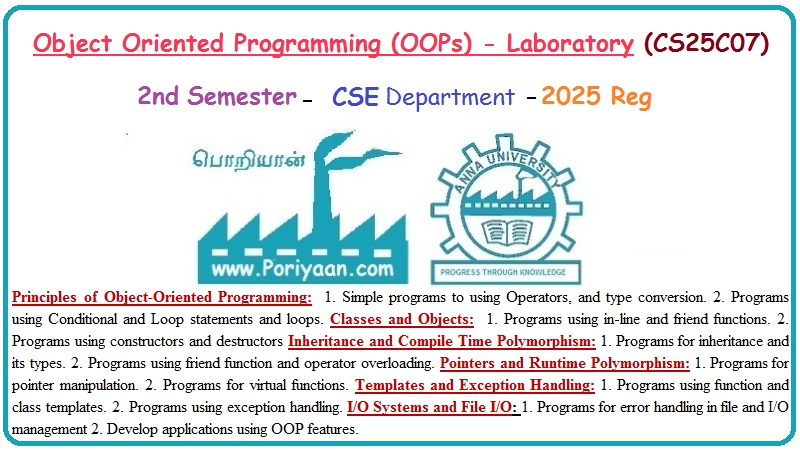
Object Oriented Programming (OOPs) - Laboratory
CS25C07 2nd Semester CSE, CSE(CY) Depts | 2025 Regulation | 2nd Semester 2025 Regulation