Applied Physics I: Chapter 3: Properties of Matter - Thermal Physics
Thermal expansion of Solids, Liquids and gases
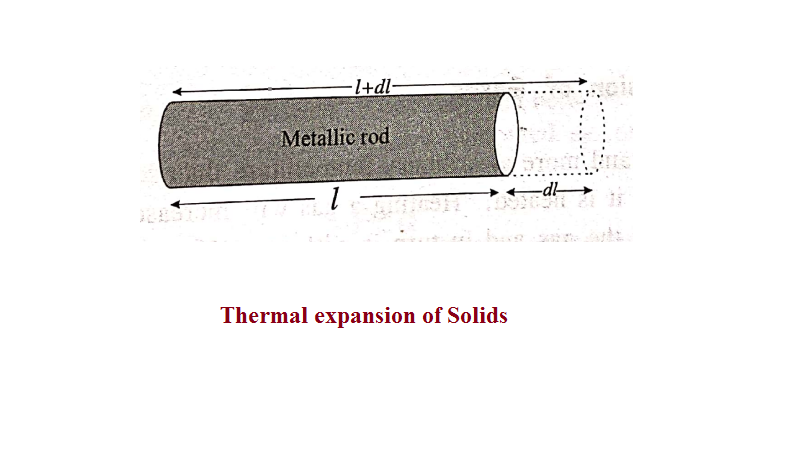
Thermal expansion: The expansion of a metal, when subjected to heat is called thermal expansion.
THERMAL
EXPANSION OF SOLIDS, LIQUIDS AND GASES
Thermal
expansion in solids
When
a metal is heated, due to increase in temperature it will expand and when it is
cooled it contracts. However, an internal force will always act so as to keep
the metal to regain its original length/position.
Definition
Thermal expansion:
The expansion of a metal, when subjected to heat is called thermal expansion.
Thermal stress:
The force (or) the stress developed inside the metal so as to regain its
original position is called thermal stress.
Explanation
Let
us consider a metal rod of length 'l'
at a temperature T. When the rod is heated to the temperature from T to T + θ,
then the length of the rod increases, linearly from l to l+dl as shown in Fig. 3.2.

The
co‒efficient of thermal expansion α = dl/lθ
If
= 1, then α = dl/l
Co‒efficient of thermal expansion (a)
Thus
the co‒efficient of thermal expansion can be defined as the ratio between the
change in length to the original length per unit rise of temperature.
Thermal expansion in liquids ‒ Volume Expansion
We
know when an ordinary alcohol‒in‒glass thermometer (or) mercury‒ in‒glass
thermometer is kept in the temperature bath, the alcohol (or) mercury rises,
due to thermal expansion.
In
this case it should be noted that the temperature rises not because of the
expansion of liquid, it is only due to the volume expansion of the liquid.
Co‒efficient of volume expansion (β)
The
co‒efficient of volume expansion 'β' is defined as the ratio between the
fractional change (ΔV) in volume to the original volume (V) per unit rise of
temperature (ΔT)
i.e.,
ΔV/V α ΔΤ
(or)
ΔV/V = βΔΤ
When
ΔT = 1
β = ΔV/V
Thermal Expansion of Gases
Gases
expand more at ordinary temperature than solid and liquid. The gas expands when
it is heated. Heating a gas will increase the kinetic energy of the particles
in the gas and in turn it will expand.
Example
For
example, when a balloon is inflated in a cool space, the inflation is partial,
but while on heating, it comes to full size. In thermal expansion, the
inflation body dimension increases due to the increase in the temperature.
Thus,
the gas expansion coefficient depends upon temperature. For an ideal gas, the
volume expansion coefficient can be found from the ideal gas equation at
constant pressure.
i.e., PV= μRT
During
the expansion of gases, it is important to be aware that both temperature and
pressure determine the change in volume of the substance. Increasing the
temperature leads to increase in the volume of the gas while the increase in
the pressure leads to decrease in volume.
Note: Increasing
the temperature of the gas without increasing the volume that is available to
accommodate the expanding gas means that the pressure builds up inside the
container and may cause it to explode.
Applied Physics I: Chapter 3: Properties of Matter - Thermal Physics : Tag: Applied Physics : - Thermal expansion of Solids, Liquids and gases
Applied Physics I: Chapter 3: Properties of Matter - Thermal Physics
Under Subject
Applied Physics I
PH25C01 1st Semester | 2025 Regulation | 1st Semester 2025 Regulation
Related Subjects

English Essentials I
EN25C01 1st Semester | 2025 Regulation | 1st Semester 2025 Regulation

தமிழர் மரபு - Heritage of Tamils
UC25H01 1st Semester | 2025 Regulation | 1st Semester 2025 Regulation
Applied Calculus
MA25C01 Maths 1 M1 - 1st Semester | 2025 Regulation | 1st Semester 2025 Regulation
Applied Physics I
PH25C01 1st Semester | 2025 Regulation | 1st Semester 2025 Regulation

Applied Chemistry I
CY25C01 1st Semester | 2025 Regulation | 1st Semester 2025 Regulation
Makerspace
ME25C04 1st Semester | 2025 Regulation | 1st Semester 2025 Regulation
Computer Programming C
CS25C01 1st Semester | 2025 Regulation | 1st Semester 2025 Regulation

Computer Programming Python
CS25C02 1st Semester | 2025 Regulation | 1st Semester 2025 Regulation
Fundamentals of Electrical and Electronics Engineering
EE25C03 1st Semester | 2025 Regulation | 1st Semester 2025 Regulation
Introduction to Mechanical Engineering
ME25C03 1st Semester | 2025 Regulation | 1st Semester 2025 Regulation

Introduction to Civil Engineering
CE25C01 1st Semester Civil Department | 2025 Regulation | 1st Semester 2025 Regulation
Essentials of Computing
CS25C03 1st Semester - AID CSE IT Department | 2025 Regulation | 1st Semester 2025 Regulation

Applied Physics I Laboratory
PH25C01 1st Semester practical Laboratory Manual | 2025 Regulation | 1st Semester Laboratory 2025 Regulation

Applied Chemistry I Laboratory
CY25C01 1st Semester practical Laboratory Manual | 2025 Regulation | 1st Semester Laboratory 2025 Regulation

Computer Programming C Laboratory
CS25C01 1st Semester practical Laboratory Manual | 2025 Regulation | 1st Semester Laboratory 2025 Regulation

Computer Programming Python Laboratory
CS25C02 1st Semester practical Laboratory Manual | 2025 Regulation | 1st Semester Laboratory 2025 Regulation
Engineering Drawing
ME25C01 EEE Mech Dept | 2025 Regulation | 2nd Semester 2025 Regulation

Basic Electronics and Electrical Engineering
EE25C04 1st Semester ECE Dept | 2025 Regulation | 2nd Semester 2025 Regulation