Applied Physics I: Chapter 3: Properties of Matter - Thermal Physics
Thermal Physics: Important part-A 2 marks Short Questions and Answers
Important part-A 2 marks Short Questions and Answers - Applied Physics I: Chapter 3: Properties of Matter - Thermal Physics
ANNA
UNIVERSITY 'PART‒A' QUESTIONS & ANSWERS
1) What are the basic
entities responsible for thermal conduction of a solid ?
(i)
Area of cross section (A)
(ii)
Temperature difference between the hot and cold layers of the solid (θ1‒
θ2)
(iii)
Time of conduction (t)
(iv)
Thickness of the solid (x)
2) Define Coefficient
of thermal conductivity.
The
Coefficient of thermal conductivity is defined as the amount of heat conducted
per second normally across the unit area of cross section, maintained at unit
temperature gradient.
(i.e.)
K = Qx / A(θ1‒ θ2)t Wm‒1K‒1
3) What is a bimetallic
strip? Give its applications.
Definition:
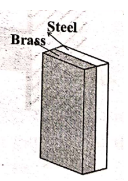
Bimetallic
strips are made up of two thin metal strips as shown in Fig. with
different co‒efficient of thermal expansion.
Applications
1.
Bimettalic strips are commonly used in water heaters as temperature controller.
2.
They are used as a switch to maintain the temperature of the liquid.
4. Distinguish between
conduction and convection.
Conduction
1.
It is the process in which the heat is transferred from hot end to cold end
without the actual movement of the particles.
2.
This process take place in solids
Convection
1.
It is the process in which the heat is transmitted from hot end to cold end by
the actual movement of the particles.
2.
This process take place in liquids
ADDITIONAL
PART A QUESTIONS & ANSWERS
1. What are modes by
which transfer of heat energy takes place.
Normally
there are three modes by which transfer of heat take from one place to another
viz., conduction, convection and radiation.
Conduction:
It is the process in which heat is transferred from hotter end to colder end
without the actual motion of the particles.
Convection:
It is the process in which heat is transmitted from hotter end to colder end by
the actual movement of heated particles.
Radiation:
It is the process in which heat is transmitted from one place to another
without the necessity of the intervening medium.
2) Define radiation and
give an example.
It
is the process in which heat is transmitted from one place to another without
the necessity of the intervening medium.
Example:
The says from the Sun reacting the Earth.
3) What is meant by
thermal expansion in solids?
When
a metal is heated, due to increase in temperature it will expand and when it is
cooled it contracts. However, an internal force will always act so as to keep
the metal to regain its original length/position.
Thermal
expansion: The expansion of a metal, when subjected to heat is
called thermal expansion.
4) Define Co‒efficient
of Thermal expansion.
The
co‒efficient of thermal expansion (α): The co‒efficient of
thermal expansion can be defined as the ratio between the change in length to
the original length per unit rise of temperature.
The
co‒efficient of thermal expansion α = dl/lθ
If
θ = 1, then α = dl/lθ
5) Define Co‒efficient
of volume expansion.
The
co‒efficient of volume expansion 'β' is defined as ratio between the fractional
change (ΔV) in volume to the original volume (V) per unit rise of temperature (ΔT)
i.e.,
ΔV / V = β ΔT
When
ΔT = 1
β
= ΔV / V
6) What is meant by
Thermal expansion in liquids?
We
know when as ordinary alcohol‒in‒glass thermometer (or) mercury‒ in‒glass
thermometer is kept in the temperature bath, the alcohol (or) mercury rises,
due to thermal expansion.
In
this case it should be noted that the temperature rises not because of the
expansion of liquid, it is only due to the volume expansion of the liquid, it
is only due to the volume expansion of the liquid.
7) What do you
understand by the term. "Bimetallic Strip"? Give its use.
Definition:
As
the name itself implies that Bimetallic strips are made up of two thin metal
strips with different co‒efficient of thermal expansion.
Bimettalic
strips are commonly used in water heaters as temperature controller.
8) What is meant by
temperature gradient ?
The
rate of fall of temperature with respect to the distance is called as
temperature gradient. In general it is denoted as ‒dθ/dx. The negative sign indicates
the fall of temperature with the increase in distance.
9) Define thermal
diffusivity.
It
is defined as the ratio of thermal conductivity to the thermal capacity per
unit volume of the material
Thermal
diffusivity (h) = Thermal
conductivity / Thermal capacity.
Since
thermal capacity is the product of specific heat capacity(s) and density of the
material (ρ), we can write
h = k
/ ρs m2s‒1
10) Derive the unit for
thermal conductivity.
The
thermal conductivity of material is K = Qx / A(θ1‒ θ2)t
=
[ Joules × metre ] / [ (metre)2 × kelvin × second ] = watts / ( metre
× kelvin)
The
unit of thermal conductivity is Wm‒1K‒1.
11) Write any four uses
of expansion joints.
(i)
Buildings: Expansion joints prevents the excess stress in
buildings and minimize the cracks.
(ii)
Walls: In walls, especially in long walls, expansion
joints will allow expansion & contraction and maintain building structure.
(iii)
Floors: It is used to accomodate movement in large floor
slabs.
(iv)
Foundations: Though the effect of temperature less
in foundations, seperate joints shall be used to address the load differences
and hence it helps the building foundations to withstand natural calamites like
earth quakes.
Applied Physics I: Chapter 3: Properties of Matter - Thermal Physics : Tag: Applied Physics : - Thermal Physics: Important part-A 2 marks Short Questions and Answers
Applied Physics I: Chapter 3: Properties of Matter - Thermal Physics
Under Subject
Applied Physics I
PH25C01 1st Semester | 2025 Regulation | 1st Semester 2025 Regulation
Related Subjects

English Essentials I
EN25C01 1st Semester | 2025 Regulation | 1st Semester 2025 Regulation

தமிழர் மரபு - Heritage of Tamils
UC25H01 1st Semester | 2025 Regulation | 1st Semester 2025 Regulation
Applied Calculus
MA25C01 Maths 1 M1 - 1st Semester | 2025 Regulation | 1st Semester 2025 Regulation
Applied Physics I
PH25C01 1st Semester | 2025 Regulation | 1st Semester 2025 Regulation

Applied Chemistry I
CY25C01 1st Semester | 2025 Regulation | 1st Semester 2025 Regulation
Makerspace
ME25C04 1st Semester | 2025 Regulation | 1st Semester 2025 Regulation
Computer Programming C
CS25C01 1st Semester | 2025 Regulation | 1st Semester 2025 Regulation

Computer Programming Python
CS25C02 1st Semester | 2025 Regulation | 1st Semester 2025 Regulation
Fundamentals of Electrical and Electronics Engineering
EE25C03 1st Semester | 2025 Regulation | 1st Semester 2025 Regulation
Introduction to Mechanical Engineering
ME25C03 1st Semester | 2025 Regulation | 1st Semester 2025 Regulation

Introduction to Civil Engineering
CE25C01 1st Semester Civil Department | 2025 Regulation | 1st Semester 2025 Regulation
Essentials of Computing
CS25C03 1st Semester - AID CSE IT Department | 2025 Regulation | 1st Semester 2025 Regulation

Applied Physics I Laboratory
PH25C01 1st Semester practical Laboratory Manual | 2025 Regulation | 1st Semester Laboratory 2025 Regulation

Applied Chemistry I Laboratory
CY25C01 1st Semester practical Laboratory Manual | 2025 Regulation | 1st Semester Laboratory 2025 Regulation

Computer Programming C Laboratory
CS25C01 1st Semester practical Laboratory Manual | 2025 Regulation | 1st Semester Laboratory 2025 Regulation

Computer Programming Python Laboratory
CS25C02 1st Semester practical Laboratory Manual | 2025 Regulation | 1st Semester Laboratory 2025 Regulation
Engineering Drawing
ME25C01 EEE Mech Dept | 2025 Regulation | 2nd Semester 2025 Regulation

Basic Electronics and Electrical Engineering
EE25C04 1st Semester ECE Dept | 2025 Regulation | 2nd Semester 2025 Regulation