Data Structures using C PlusPlus: Chapter 2: Inheritance and Polymorphism
Abstract Base Classes and Concrete Classes
C++ Program
Abstract class is a class which is mostly used as a base class. It contains at least one pure virtual function. Abstract classes can be used to specify an interface that must be implemented by all subclasses.
Abstract
Base Classes and Concrete Classes
• Definition : Abstract
class is a class which is mostly used as a base class. It contains at least one pure virtual function. Abstract classes can be used to specify
an interface that must be implemented by all subclasses.
•
The virtual function is function having nobody but specified by = 0. This tells the compiler that
nobody exists for this function relative to the base class. When a virtual
function is made pure, it forces any
derived class to override it. If a derived class does not, an error occurs.
Thus, making a virtual function pure
is a way to guarantee that a derived class will provide its own redefinition.
For
example
#include<iostream>
using namespace std;
class area
{
double dim1, dim2;
public:
void setarea(double d1, double d2)
{
dim1 = d1;
dim2 = d2;
}
void getdim(double &d1, double &d2)
{
d1 = dim1;
d2 = dim2;
}
}
void getdim(double &d1, double &d2)
{
d1= dim1;
d2 = dim2;
}
virtual double getarea() = 0; // pure virtual function
};
class square: public area
{
public:
double getarea()
{
double d1, d2;
getdim(d1, d2);
return d1 * d2;
}
};
class triangle: public area
{
public:
double getarea()
{
double d1, d2;
getdim(d1, d2);
return 0.5 * d1 * d2;
}
};
void main()
{
area p;
square s;
triangle t;
int num1,num2;
cout<<"\n
Enter The two dimensions for calculating area of square";
cin>>num1>>num2;
s.setarea(num1,num2);
p = &s;
cout <<
"Area of square is : " << p‒>getarea() << '\n';
cout<<"\n
Enter The two dimensions for calculating area of triangle";
cin>>num1>>num2;
t.setarea(num1,num2);
p=&t;
cout <<
"Area of Triangle is: " << p‒>getarea() << '\n';
}
Output
Enter The two
dimensions for calculating area of square10 20
Area of square is: 200
Enter The two
dimensions for calculating area of triangle6
8
Area of Triangle is:
24
•
In above code the getarea() is a
function which is defined as pure virtual function in base class. But it is
redefined in derived class square and
triangle. In derived class square the getarea() function calculates the area of square and in derived
class triangle the getarea() function
calculates the area of triangle. The definition of getarea in base class is overridden by the definitions of functions
in derived class. The class area acts as an abstract class because –
•
It specifies an interface which is used by all the derived classes. Thus it is
never used directly it simply gives skeleton to other derived classes.
•
It contains one pure virtual function getarea().
Difference between Abstract class and Concrete class
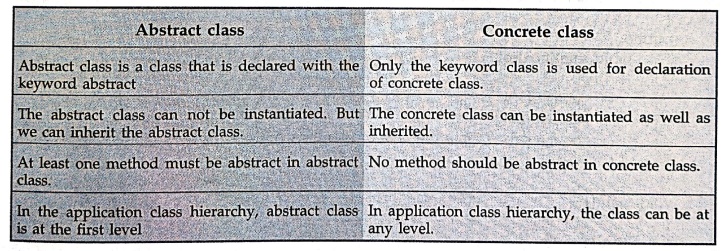
Abstract class
1.
Abstract class is a class that is declared with the keyword abstract.
2.
The abstract class can not be instantiated. But we can inherit the abstract
class.
3.
At least one method must be abstract in abstract class.
4.
In the application class hierarchy, abstract class is at the first level
Concrete class
1.
Only the keyword class is used for declaration of concrete class.
2.
The concrete class can be instantiated as well as inherited.
3.
No method should be abstract in concrete class.
4.
In application class hierarchy, the class can be at any level.
Example: 1
What are abstract
classes? Write a program having student as an abstract class and create many
derived classes such as engineering, science, medical etc. from the student
class. Create their object and process them.
Solution :
An
abstract class in C++ is a class that cannot be instantiated (we cannot create
its objects) and contains at least one pure virtual function.
#include<iostream>
#include<cstring>
using namespace std;
class Student
{
char name[10];
public:
void SetName(char n[10])
{
strcpy(name,n);
}
void GetName(char n[10])
{
strcpy(n,name);
}
virtual void qualification()=0;
}:
class Engg:public Student
{
public:
void qualification()
{
char n[10];
GetName(n);
cout<<n<<"
is a an engineering student"<<endl;
}
};
class Medical:public Student
{
public.
void qualification()
{
char n[10];
GetName(n);
cout<<n<<<<"
is a medical student"<<endl;
}
};
void main()
{
Student *s;
Engg e;
Medical m;
char nm[10];
cout<<"\n Enter the name: "<<endl;
cin>>nm;
e.SetName(nm);
s=&e;
s‒>qualification();
cout<<"\n Enter the name: "<<endl;
cin>> nm;
m.SetName(nm);
s=&m;
s‒>qualification();
}
Output
Enter the name:
Ramesh
Ramesh is a an
engineering student
Enter the name:
Suresh
Suresh is a medical
student
Example: 2
Define an abstract class
called Employee. Derive two classes called Hourly Employee and Salaried
Employee. Hourly Employee has number of hours(integer) and wage per
hour(float).
Salaried Employee has
salary of type float. Calculate salary() in an abstract function in class employee
which is inherited by derived classes. Write main program to create objects of
all classes and calculate salary of each object.
Solution :
#include <iostream>
using namespace std;
class Employee
{
public:
virtual float calculate_
salary() = 0;
};
class HourlyEmployee: public Employee
{
private:
int Hours;
float WagePerHour;
public:
void setHData()
{
cout << "\n
Enter the number of Hours: ";
cin>> Hours:
cout << "\n
Enter the Wages per Hour: ";
cin>>
WagePerHour,
}
float calculate _salary())
{
float salary;
salary =Hours
*WagePerHour;
return salary;
}
};
class SalariedEmployee : public Employee
{
float HRA, DA, Basics;
float tax;
public:
void setSData()
{
cout<<"\n
Enter Basic payment: ";
cin >> Basics;
cout << "\n
Enter HRA: ";
cin>> HRA;
cout<<"\n
Enter DA: ";
cin >> DA:
cout << "\n
Enter tax: ";
cin>> tax;
}
float calculate_salary()
{
float salary;
salary = (Basics + DA +
HRA) ‒ tax;
return salary;
}
};
int main()
{
SalariedEmployee sEmp;
HourlyEmployee hEmp;
int choice;
char ans = 'y';
do
{
cout << "\n
1. Salaried Employee \n 2. Hourly Employee \n 3. Exit";
cout << "\n
Enter your choice:
cin>> choice:
switch (choice)
{
case 1:
sEmp.setSData();
cout << "\n The salary of
Salaried Employee is: ";
cout << sEmp.calculate_salary()
<< endl;
break;
case
2:hEmp.setHData();
cout << "\n The salary of
Hourly Employee is: ";
cout << hEmp.calculate_salary()
<< endl;
break;
default:exit(0);
}
cout << "\n
Do you want to continue?";
cin>> ans;
} while (ans == 'y');
return 0;
}
Output
1. Salaried Employee
2. Hourly Employee
3. Exit
Enter your choice: 2
Enter the number of
Hours: 5
Enter the Wages per
Hour: 20
The salary of Hourly
Employee is: 100
Do you want to
continue? y
1. Salaried Employee
2. Hourly Employee
3. Exit
Enter your choice: 1
Enter Basic payment:
1000
Enter HRA: 200
Enter DA: 100
Enter tax: 10
The salary of Salaried
Employee is: 1290
Do you want to
continue? n
Data Structures using C PlusPlus: Chapter 2: Inheritance and Polymorphism : Tag: Data Structure, C++, C Programing : C++ Program - Abstract Base Classes and Concrete Classes
Data Structures using C PlusPlus: Chapter 2: Inheritance and Polymorphism
Under Subject
Data Structures using CPlusPlus
CS25C05 2nd Semester ECE Dept | 2025 Regulation | 2nd Semester 2025 Regulation
Related Subjects
English Essentials II
EN25C02 2nd Semester | 2025 Regulation | 2nd Semester 2025 Regulation
Tamils and Technology தமிழர்களும் தொழில்நுட்பமும்
UC25H02 2nd Semester | 2025 Regulation | 2nd Semester 2025 Regulation
Linear Algebra
MA25C02 2nd Semester | 2025 Regulation

Electron Devices
EC25C01 2nd Semester ECE Dept | 2025 Regulation | 2nd Semester 2025 Regulation
Data Structures using CPlusPlus
CS25C05 2nd Semester ECE Dept | 2025 Regulation | 2nd Semester 2025 Regulation

Circuits and Network Analysis
EC25C02 2nd Semester ECE Dept | 2025 Regulation | 2nd Semester 2025 Regulation

Re-Engineering for Innovation
ME25C05 2nd Semester | 2025 Regulation | 2nd Semester 2025 Regulation
Engineering Drawing - Laboratory
ME25C01 2nd Semester | 2025 Regulation | 2nd Semester 2025 Regulation
Data Structures using CPlusPlus - Laboratory
CS25C05 2nd Semester ECE Dept | 2025 Regulation | 2nd Semester 2025 Regulation
Devices and Circuits Laboratory
EC25C03 2nd Semester ECE Dept | 2025 Regulation | 2nd Semester 2025 Regulation