Data Structures using C PlusPlus: Chapter 2: Inheritance and Polymorphism
Types of Inheritance
Data Structures using C++ Program
Questions: 1. Explain with examples, the types of inheritance in C++. 2. Explain the types of inheritance with example. 3. What is multiple inheritance? Discuss the syntax and rules of multiple inheritance in C++. How can you pass parameters to the constructors of base classes in multiple inheritance? Explain with suitable example. 4. What is inheritance ? List out the advantages of inheritance. 5. Write a C++ program to illustrate the concept of hierarchical inheritance. 6. Write C++ program to implement multiple inheritance.
Types of
Inheritance
•
Various types of inheritances are as shown by following figures ‒
1. Single Inheritance
2. Multiple Inheritance
3. Multilevel Inheritance
4. Hierarchical Inheritance
5. Hybrid Inheritance
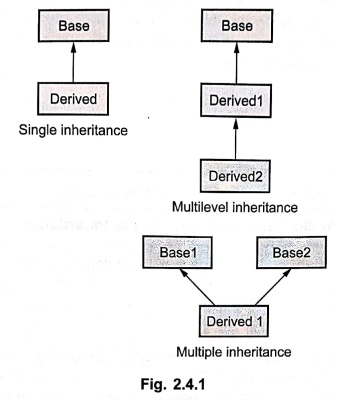
1. Single Inheritance
•
In single inheritance there is one
parent per derived class. This is the most common form of inheritance.
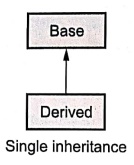
The
simple program for such inheritance is ‒
C++ Program
#include <iostream>
using namespace std;
class Base
{
public:
int x
void set _x(int
n)
{
x=n;
}
void show_
x()
{
cout<<"\n\t
Base class ...";
cout<<"\n\t
x= "<<x;
}
};
class derived : public Base
{
int y;
public:
void set_
y(int n)
{
y = n;
}
void
show_xy()
{
cout<<"\n\n\t
Derived class...";
cout<<"\n\t
x = "<<x;
cout<<"\n\t
y= "<<y;
}
};
int main()
{
derived
obj;
int x, y;
cout<<"\n
Enter the value of x";
cin>>x;
cout<<"\n
Enter the value of y";
cin>>y;
obj.set
x(x);//inherits base class
obj.set
y(y); // access member of derived class
obj.show
x();//inherits base class
obj.show
xy(); // access member of derived class
return 0;
}
Output
Enter the value of x
10
Enter the value of y
20
Base class
x= 10
Derived class ...
x = 10
y = 20
Example: 1
Define a class to
represent a string with operations string length, compare and reverse. Show its
use of base and derived classes.
Solution :
#include <iostream>
using namespace std;
class Base
{
public:
char
str1[10],str2[10];
void
getstr()
{
cout<<"\n
Enter String1: ";
cin>>str1;
cout<<"\n
Enter String2: ";
cin>>str2;
}
};
class Derived:public Base
{
public:
int
getlength(char s[10]).
{
for(int i=0;s[i]!='\0';i++);
return i‒1;
}
void
reverse()
{
int
n=getlength(str1);
for(int
i=n;i>=0;i− −)
cout<<str1[i];
cout<<endl;
}
void compare()
int i,j,flag=0;
int n1=getlength(str1);
int n2=getlength(str2);
for(i=0,j=0;i<n1,j<n2;i++j++)
{
if(str1[i]!=str2[j])
flag=1;
}
if(flag= =1)
cout<<"\n
Two strings are not equal";
else
cout<<"\n
Two strings are equal";
}
};
int main()
{
Derived
obj;
obj.getstr();
cout<<"\n
Reversing first string: ";
obj.reverse();
obj.compare();
return 0;
}
Output
Enter String1: hello
Enter String2: hello
Reversing first
string: olleh
Two strings are equal
2. Multiple Inheritance
•
In multiple inheritance the derived class is derived from more than one base
class.
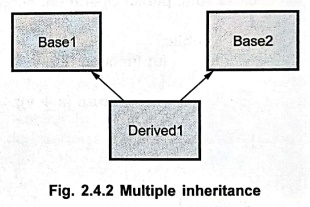
• The implementation of multiple inheritance is as shown below ‒
C++
Programs
#include <iostream>
using namespace std;
class Operation
{
protected:
int x, y,
public:
void set_
values (int a, int b)
{
x=a;
y=b;
}
};
class Coutput
{
public:
void
display (int i);
};
void Coutput::display (int i);
{
cout
<< i << endl;
}
//product class inherits two base classes ‒
//Operation and Coutput
class product: public Operation, public Coutput
{
public:
int
function ()
{
return (x * y);
}
};
//sum class inherits two base classes ‒
//Operation and Coutput
class sum: public Operation, public Coutput
{
public:
int
function ()
{
return (x
+ y);
}
};
int main()
{
product
obj_pr;//object of product class
sum obj_sum;//object of sum class
obj_pr.set_values
(10,20);
obj_sum.set_values
(10,20);
cout<<"\n
The product of 10 and 20 is "<<endl;
obj_pr.output
(obj_pr.function());
cout<<"\n
The sum of 10 and 20 is "<<endl;
obj_sum.output
(obj_sum.function());
return 0;
}
Output
The product of 10 and
20 is
200
The sum of 10 and 20
is
30
•
In above program there are two classes Operation
and Coutput. The derived class
product is derived from both Operation
and Coutput classes. Similarly the
derived class sum is derived from two classes: Operation and Coutput.
•
Then in main function obj_pr is an
object created for class product and obj_sum
is an object created for class sum. Thus multiple inheritance is achieved.
3. Multilevel Inheritance
•
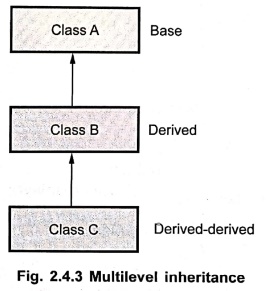
When a derived class is derived from a base class which itself is a derived
class then that type of inheritance is called multilevel inheritance.
•
For example ‒ If class A is a base class and class B is another class which is
derived from A, similarly there is another class C being derived from class B
then such a derivation leads to multilevel inheritance.
•
The implementation of multilevel inheritance is as given below ‒
C++ Program
#include<iostream>
using namespace std;
class A
{
protected:
int x;
public:
void
get_a(int);
void
put_a();
};
void A:get_a(int a)
{
x=a;
}
void A::put_a()
{
cout<<"\n
The value of x is "<<x;
}
class B: public A
{
protected:
int y;
public:
void
get_b(int);
void
put_b();
};
void B::get_b(int b)
{
y=b;
}
void B::put_b()
{
cout<<"\n
The value of y is "<<y;
}
class C::public B
{
int z;
public:
void
display();
};
void C::display()
{
z=y+10;
put_a();//member
of class A
put_b();//member
of class B
cout<<"\n
The value of z is "<<z;
}
int main()
{
C
obj://object of class C
//accessing
class A member via object of class C
obj.get_a(10);
//accessing
class B member via object of class C
obj.get_b(20);
//accessing
class C member via object of class C
obj.display();
cout<<endl;
return 0;
}
Output
The value of x is 10
The value of y is 20
The value of z is 30
•
In above program we have declared 3
classes namely A, B and C. In these classes values to variables x, y and z are
assigned.
•
In class C, which is actually derived from a derived class B(derived from A) a
display() function is written. Note that the members of class A and B are
accessible in class C as it is a derived class.
z=y+10;
put
a();//member of class A
put_b();//member
of class B
cout<<"\n
The value of z is "<<z;
Similarly
in main() function we have created an
object of class C.
C obj;
And
now using this obj we can access the
member of any class.
Thus
the multilevel inheritance is achieved.
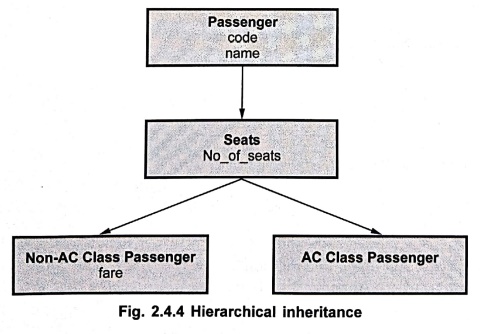
4. Hierarchical Inheritance
•
Hierarchical inheritance is a kind of inheritance in which one or more classes
are derived from the common base class. For example ‒
•
In this type of inheritance the subclass can inherit the properties of its
parent classes and at the same time it can add its new features. The subclass
can serve as a base class for the lower level classes.
• The C++ program demonstrating this type of inheritance is as shown below ‒
#include<iostream>
using namespace std;
class Passenger
{
int code:
char
name[20];
public:
void
getPassenger()
{
cout<<"\nEnter
the code and name";
cin>>code>>name;
}
void ShowDetails()
{
cout<<"\nCode:
"<<code;
cout<<"\nName:
"<<name;
}
};
class Seats:public Passenger
{
int
NoOfSeats;
public:
void
getSeats()
{
cout<<"\nEnter
the Number of Seats";
cin>>NoOfSeats;
}
void Display
_Reservation()
{
cout<<"\nNumber
of Seats: "<<NoOfSeats;
}
};
class AC_ Class:public Seats
{
double
fare;
public:
void
getFare()
}
cout<<"\nEnter the fare";
cin>>fare;
}
void DisplayFare()
{
cout<<"\nType:
AC Class Reservation";
cout<<"\nFare
Amount: "<<fare;
}
};
class NonAC_Class:public Seats
{
public:
void
DisplayClass()
{
cout<<"\nType:
Non AC Class Reservation";
}
};
using namespace std;
int main()
{
int
i,m,n,choice;
AC_Class
a[10];
NonAC
Class na[10];
cout<<"\nEnter
the number of AC Class Passengers ";
cin>>m;
for(i=0;i<m;i++)
{
cout<<"\nEnter
Details of Passenger "<<<i+1;
a[i].getPassenger();
a[i].getSeats();
a[i].getFare();
return 0;
}
cout<<"\nEnter
the number of Non‒AC Class Passengers ";
cin>>n;
for(i=0;i<n;i++)
{
cout<<"\nEnter
the Details of Passenger "<<i+1;
na[i].getPassenger();
na[i].getSeats();
}
while(1)
{
cout<<"\n
Displaying Details";
cout<<"\n 1. AC Class \n 2. Non AC Class\n 3.
Exit\n";
cout<<"\n
Enter Choice";
cin>>choice;
switch(choice)
{
case
1:for(i=0;i<m;i++)
{
a[i].ShowDetails();
a[i].Display Reservation();
a[i].DisplayFare();
}
break;
case
2:for(i=0;i<n;i++)
{
na[i].ShowDetails();
na[i].DisplayClass();
nafil Display Reservation();
}
break;
case 3:exit(0);
}
}
}
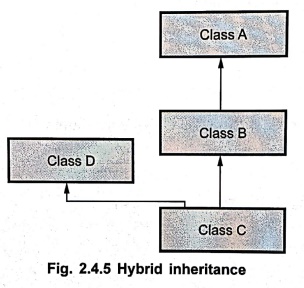
5. Hybrid Inheritance
•
When two or more types of inheritances are combined together then it forms the
hybrid inheritance. The following Fig. 2.4.5 represents the typical scenario of
hybrid inheritance.
•
The following implementation shows that multiple and multilevel inheritance is
combined together to form a hybrid inheritance.
C++
Program
#include<iostream>
using namespace std;
class A
{
protected:
int x,
public:
void
get_a(int);
void put
a();
void
A:get_a(int a)
{
x = a;
}
void
A::put a()
{
cout<<"\n
The value of x is "<<x;
}
class:B
public A
{
protected:
int y:
public:
void
get_b(int);
void
put_b();
};
void B::get_b(int b)
{
y=b;
}
void B::put_b()
{
cout<<"\n
The value of y is "<<y;
}
class D
{
protected:
int t;
public:
void
get_d(int);
void put _d();
};
void D::get_d(int d)
{
t=d;
}
void D::put d()
{
cout<<"\n
The value of t is "<<t;
}
//multiple inheritance added in the multilevel inheritance
class C:public B,public D
{
int z:
public:
void
display();
};
void C::display()
{
z=y+t+10;
put_a();//member
of class A
put_b();//member
of class B
put_d();//member
of class D
cout<<"\n
The value of z is "<<z;
}
int main()
{
C
obj://object of class C
//accessing
class A member via object of class C
obj.get_a(10);
//accessing
class B member via object of class C
obj.get_b(20);
////accessing
class C member via object of class C
obj.get_d(30);
obj.display();
cout<<endl;
return 0;
}
Output
The value of x is 10
The value of y is 20
The value of t is 30
The value of z is 60
Example:
2
Write a complete C++
program to do the following:
i) 'Student' is a base
class, having two data members: entryno and name; entryno is integer and name
of 20 characters long. The value of entryno is 1 for Science student and 2 for
Arts student, otherwise it is an error.
ii) 'Science' and
'Arts' are two derived classes, having respectively data items marks for
Physics, Chemistry, Mathematics and marks for English, History, Economics.
iii) Read appropriate
data from the screen for 3 Science and 2 Arts Students.
iv) Display entryno,
name, marks for Science students first and then for Arts students.
Solution:
#include<iostream>
using namespace std;
class student
{
protected:
int entryno;
char name[20];
public:
void Input()
{
cout<<"Enter
name of the student"<<endl;
cin>>name;
}
void display()
{
cout<<"Student
Name: "<<name<<endl;
}
};
class science:public student
{
float
physics;
float
chemistry;
float
maths;
public:
void Input()
{
student::Input();
cout<<"Enter
marks for Physics: ";
cin>>physics;
cout<<"Enter
marks for Chemistry: ";
cin>>chemistry;
cout<<"Enter
marks for Mathematics: ";
cin>>maths;
}
void display()
{
entryno=1;
cout<<"\n\t
Entry Number for Science student is: "<<entryno<<endl;
student::display();
cout<<"\nMarks
in Physics: ";
cout<<physics;
cout<<"\nMarks
in Chemistry: ";
cout<<chemistry;
cout<<"\nMarks
in Mathematics: ";
cout<<maths;
}
};
class arts:public student
{
float
english;
float
history:
float
economics;
public:
void
Input()
{
student::Input();
cout<<"\nEnter
marks for English: ";
cin>>english;
cout<<"\nEnter
marks for history: ";
cin>>history;
cout<<"\nEnter
marks for Economics: ";
cin>>economics;
}
void
display()
{
entryno=2;
cout<<"\n\t
Entry number for Arts student is: "<<entryno<<endl;
student::display();
cout<<"\nMarks
in English: ";
cout<<english;
cout<<"\nMarks
in History: ";
cout<<history;
cout<<"\nMarks
in Economics: ";
cout<<economics;
}
};
void main()
{
science
s1[3];
arts
a1[3];
int
i,j,k,l;
cout<<"\nEntry
for Science students "<<endl;
for(i=0;i<3;i++)
}
s1[j].Input();
}
cout<<"Details of three Science students are
"<<endl;
for(j=0;j<3;j++)
{
s1[j].display();
}
cout<<"\n\nEntry for Arts students
"<<endl;
for(k=0;k<3;k++)
{
a1[k].Input();
}
cout<<"Details of three Arts students are
"<<endl;
for(1=0;1<3;1++)
{
a1[1].display();
}
}
Example :3
How can you pass
parameters to the constructors of base classes in multiple inheritance? Explain
with suitable example.
Solution :
#include<iostream>
using namespace std;
class A
{
public:
A(int a)
{
cout<<"\n
Constructor for class A is called, value1= "<<a;
}
};
class B
{
public:
B(float b)
{
cout<<"\n
Constructor for class B is called, value2= "<<b;
}
};
class C:public A,public B
{
public:
C(int a,float b):A(a),B(b)
{
cout<<"\n
Constructor for child class C is called value1= "<<a<<"
value2= "<<b;
}
};
void main()
{
cout<<"\n\t
Creating class objects....";
C obj(10,20.1);
cout<<endl;
}
Output
Creating class
objects....
Constructor for class
A is called, value1= 10
Constructor for class
B is called, value2= 20.1
Constructor for child
class C is called value1= 10 value2 = 20.1
Review Questions
1. Explain with
examples, the types of inheritance in C++.
2. Explain the types
of inheritance with example.
3. What is multiple
inheritance? Discuss the syntax and rules of multiple inheritance in C++. How
can you pass parameters to the constructors of base classes in multiple
inheritance? Explain with suitable example.
4. What is inheritance
? List out the advantages of inheritance.
5. Write a C++ program
to illustrate the concept of hierarchical inheritance.
6. Write C++ program
to implement multiple inheritance.
Data Structures using C PlusPlus: Chapter 2: Inheritance and Polymorphism : Tag: Data Structure, C++, C Programing : Data Structures using C++ Program - Types of Inheritance
Data Structures using C PlusPlus: Chapter 2: Inheritance and Polymorphism
Under Subject
Data Structures using CPlusPlus
CS25C05 2nd Semester ECE Dept | 2025 Regulation | 2nd Semester 2025 Regulation
Related Subjects
English Essentials II
EN25C02 2nd Semester | 2025 Regulation | 2nd Semester 2025 Regulation
Tamils and Technology தமிழர்களும் தொழில்நுட்பமும்
UC25H02 2nd Semester | 2025 Regulation | 2nd Semester 2025 Regulation
Linear Algebra
MA25C02 2nd Semester | 2025 Regulation

Electron Devices
EC25C01 2nd Semester ECE Dept | 2025 Regulation | 2nd Semester 2025 Regulation
Data Structures using CPlusPlus
CS25C05 2nd Semester ECE Dept | 2025 Regulation | 2nd Semester 2025 Regulation

Circuits and Network Analysis
EC25C02 2nd Semester ECE Dept | 2025 Regulation | 2nd Semester 2025 Regulation

Re-Engineering for Innovation
ME25C05 2nd Semester | 2025 Regulation | 2nd Semester 2025 Regulation
Engineering Drawing - Laboratory
ME25C01 2nd Semester | 2025 Regulation | 2nd Semester 2025 Regulation
Data Structures using CPlusPlus - Laboratory
CS25C05 2nd Semester ECE Dept | 2025 Regulation | 2nd Semester 2025 Regulation
Devices and Circuits Laboratory
EC25C03 2nd Semester ECE Dept | 2025 Regulation | 2nd Semester 2025 Regulation