Object Oriented Programming: Chapter 4: Pointers and Runtime Polymorphism
Arrays and Pointers
C++ Object Oriented Programming
Write a C++ program to explain pointer arithmetic.
Arrays
and Pointers
•
Pointers are very useful for accessing the elements of an array. Using pointer
we can directly access the element at particular location.
C++ Program
/***********************************************************************
Program uses the pointers and arrays with the help of pointer
the contents of the array can be displayed.
**********************************************************************/
#include<iostream>
#include<cstdlib>
using namespace std;
void main()
{
int x[10],i;
clrscr();
cout<<"\n Enter the numbers five numbers \n";
for(i=0;i<5;i++)
cin>>x[i];
cout<<"\n You have entered ";
for(i=0;i<5;i++)
cout<<"\nAt address "<<(x+i)<<"
the value is "<<*(x+i);
getch();
}
Output
Enter the numbers five
numbers
11
22
33
44
55
You have entered
At address 0x8f6affe2
the value is 11
At address 0x8f6affe4
the value is 22
At address 0x8f6affe6
the value is 33
At address 0x8f6affe8
the value is 44
At address 0x8f6affea
the value is 55
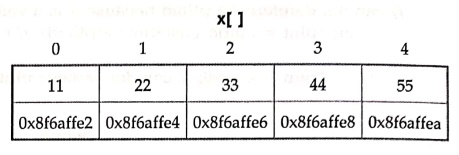
The
x+i means base address of the array x plus the offset. For example if I want to
know the value at x[5], it will be (x+5) = x[5]. The *(x+i) indicates the value
stored at the x[i]th address.
1. Pointer Arithmetic
In
C++, using pointers some arithmetic operations can be performed. These
operations are ‒
•
We can use increment (++) or decrement (‒ ‒) operator using pointers.
•
We can add or subtract an integer to a pointer variable.
/************************************************************************
Program for using a pointer arithmetic.
***********************************************************************/
#include<iostream>
#include<cstdlib>
using namespace std;
#define size 10
void main(void)
{
int x[size],n;
int *k;
clrscr();
cout<<"\n How many elements are there in an
array?\n";
cin>>n;
cout<<"\n Enter the elements in an array\n";
for(int i=0;i<n;i++).
cin>>x[i];
k=&x[0];
cout<<"\n Accessing element(base address):
"<<*k;
k++;
cout<<"\n Accessing element(k++): "<<*k;
k++;
cout<<"\n Accessing element(k++): "<<*k;
STAMU vit wonder at war's
k‒‒;
cout<<"\n Accessing element (k‒‒): "<<*k;
k=k+3;
cout<<"\n Accessing element(k+2): "<<*k;
getch();
}
Output
How many elements are
there in an array?
5
Enter the elements in
an array
10
20
30
40
50
Accessing element(base
address): 10
Accessing
element(k++): 20
Accessing element
(k++): 30
Accessing element(k):
20
Accessing
element(k+2): 50
In
above program we have taken an array of integer type. Hence each element
occupies two bytes of memory.
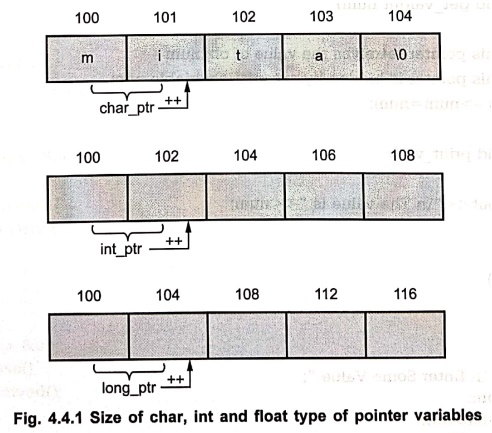
Fig. 4.4.1 Size of char, int and
float type of pointer variables
Review Question
1.Write a C++ program to explain pointer arithmetic.
Object Oriented Programming: Chapter 4: Pointers and Runtime Polymorphism : Tag: Oops, Computer Programming : C++ Object Oriented Programming - Arrays and Pointers
Object Oriented Programming: Chapter 4: Pointers and Runtime Polymorphism
Under Subject
Object Oriented Programming (OOPs)
CS25C07 2nd Semester CSE, CSE(CY) Depts | 2025 Regulation | 2nd Semester 2025 Regulation
Related Subjects
English Essentials II
EN25C02 2nd Semester | 2025 Regulation | 2nd Semester 2025 Regulation
Tamils and Technology தமிழர்களும் தொழில்நுட்பமும்
UC25H02 2nd Semester | 2025 Regulation | 2nd Semester 2025 Regulation
Linear Algebra
MA25C02 2nd Semester | 2025 Regulation
Applied Physics (CSIE) II
PH25C03 2nd Semester AIDS, CSE, IT, CSE(CY) Dept | 2025 Regulation | 2nd Semester 2025 Regulation
Digital Principles and Computer Organization
CS25C06 2nd Semester AIDS, CSE, IT, CSE(CY) Dept | 2025 Regulation | 2nd Semester 2025 Regulation

Basic Electrical and Electronics Engineering
EE25C01 2nd Semester | 2025 Regulation | 2nd Semester 2025 Regulation
Object Oriented Programming (OOPs)
CS25C07 2nd Semester CSE, CSE(CY) Depts | 2025 Regulation | 2nd Semester 2025 Regulation

Re-Engineering for Innovation
ME25C05 2nd Semester | 2025 Regulation | 2nd Semester 2025 Regulation
Object Oriented Programming (OOPs) - Laboratory
CS25C07 2nd Semester CSE, CSE(CY) Depts | 2025 Regulation | 2nd Semester 2025 Regulation