Object Oriented Programming: Chapter 4: Pointers and Runtime Polymorphism
Pure Virtual Functions and Virtual Destructors
C++ Object Oriented Programming
C++ Object Oriented Programming: Pure Virtual Functions and Virtual Destructors
Pure
Virtual Functions and Virtual Destructors
1. Pure Virtual Functions
•
A pure virtual function is a virtual
function which is to be implemented by derived class. The class that contains
the pure virtual function is called the abstract
class.
•
The pure virtual functions are declared using pure specifier i.e. = 0
•
Following program demonstrate the use of pure virtual function.
•
The class A is an abstract class in
which the pure virtual function Display() is declared. This function is
overridden by the two derived classes ‒ class B and class C.
/*********************************************************************
Program for demonstrating the pure virtual function
*********************************************************************/
#include<iostream>
using namespace std;
class A
{
public:
virtual void
Display()=0; // Pure Virtual Function
};
class B public A
{
public:
void Display()
{
cout<<"\n
In Derived Class B"<<endl;
}
};
class C: public A
{
public:
void Display()
{
cout<<"\n In Derived Class
C"<<endl;
}
};
int main()
{
A *p;
B b;
Cc;
p = &b;
p‒>Display(); //using pointer the method of
derived class is accessed
р = &c;
p‒>Display();
return 0;
}
Output
In Derived Class B
In Derived Class C
Program Explanation :
The
base class A derived two classes namely ‒ B and C. In class A, the function Display is defined by assigning = 0.
The
Display function is overridden in
class B and class C.
In
main function, the pointer object to the base class is declared. It is denoted
by variable p. By assigning the
address of class B to the pointer
variable p, the function Display of
class B is invoked. Similarly by
assigning the address of class C the
Display function of class C is invoked.
2. Virtual Destructor
• Destructor is basically used to de‒allocate the memory allocated for
the objects. Thus use of destructor is to clean up the memory allocated for the
class members. The destructor is denoted using ~ symbol.
• When a class is derived from a base class
then on calling the destructor, it does not destruct the memory of derived
class. This problem can be fixed up by making the base class destructor
virtual.
•
Following program illustrates this idea
#include<iostream>
using namespace std;
class Base
{
public:
Base()
{
cout<<"\n
Calling Base class Constructor";
}
~Base()
{
cout<<"\n
Calling Base class Destructor";
}
};
class Derived:public Base
{
public:
Derived()
{
cout<<"\n
Calling Derived class Constructor";
}
~Derived()
{
cout<<"\n
Calling Derived class Destructor";
}
};
int main()
{
Base *obj=new
Derived(); //object creation
delete obj;
return 0;
}
Output
Calling Base class
Constructor
Calling Derived class
Constructor
Calling Base class
Destructor
Now change the above
program as
#include<iostream>
using namespace std;
class Base
{
public:
Base()
{
cout<<"\n
Calling Base class Constructor";
}
virtual ~Base() //Note that this is virtual constructor
{
cout<<"\n
Calling Base class Destructor";
}
};
class Derived:public Base
{
Public:
Derived()
{
cout<<"\n
Calling Derived class Constructor";
}
~Derived()
{
cout<<"\n
Calling Derived class Destructor";
}
};
int main()
{
Base *obj=new
Derived(); //object creation
delete obj;
return 0;
}
Output
Calling Base class
Constructor
Calling Derived class
Constructor
Calling Derived class
Destructor
Calling Base class
Destructor
Review Question
1. Explain virtual
destructor with example.
Object Oriented Programming: Chapter 4: Pointers and Runtime Polymorphism : Tag: Oops, Computer Programming : C++ Object Oriented Programming - Pure Virtual Functions and Virtual Destructors
Object Oriented Programming: Chapter 4: Pointers and Runtime Polymorphism
Under Subject
Object Oriented Programming (OOPs)
CS25C07 2nd Semester CSE, CSE(CY) Depts | 2025 Regulation | 2nd Semester 2025 Regulation
Related Subjects
English Essentials II
EN25C02 2nd Semester | 2025 Regulation | 2nd Semester 2025 Regulation
Tamils and Technology தமிழர்களும் தொழில்நுட்பமும்
UC25H02 2nd Semester | 2025 Regulation | 2nd Semester 2025 Regulation
Linear Algebra
MA25C02 2nd Semester | 2025 Regulation
Applied Physics (CSIE) II
PH25C03 2nd Semester AIDS, CSE, IT, CSE(CY) Dept | 2025 Regulation | 2nd Semester 2025 Regulation
Digital Principles and Computer Organization
CS25C06 2nd Semester AIDS, CSE, IT, CSE(CY) Dept | 2025 Regulation | 2nd Semester 2025 Regulation

Basic Electrical and Electronics Engineering
EE25C01 2nd Semester | 2025 Regulation | 2nd Semester 2025 Regulation
Object Oriented Programming (OOPs)
CS25C07 2nd Semester CSE, CSE(CY) Depts | 2025 Regulation | 2nd Semester 2025 Regulation

Re-Engineering for Innovation
ME25C05 2nd Semester | 2025 Regulation | 2nd Semester 2025 Regulation
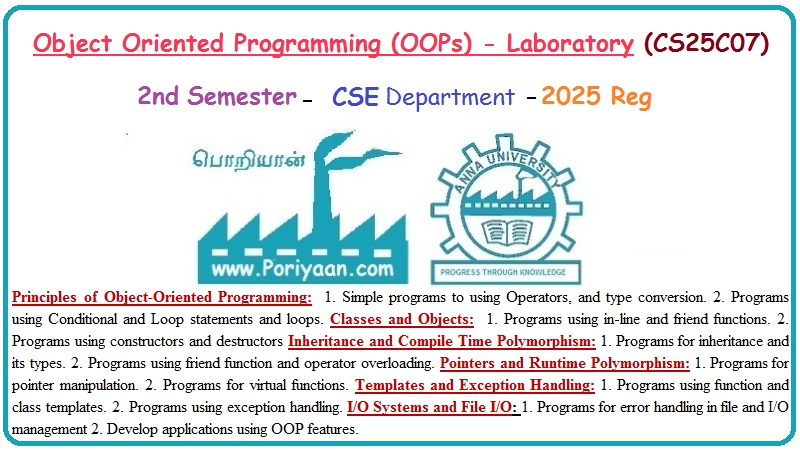
Object Oriented Programming (OOPs) - Laboratory
CS25C07 2nd Semester CSE, CSE(CY) Depts | 2025 Regulation | 2nd Semester 2025 Regulation