Object Oriented Programming: Chapter 4: Pointers and Runtime Polymorphism
Binding
C++ Object Oriented Programming
Explain the following ‒ Early binding and late binding.
Binding
•
Binding means connecting function calls
to appropriate function definition. The function call can be associated with
its definition at compile time or at run time. Depending upon it there are two
types of binding defined ‒ 1) Early
binding or static binding and 2) Late binding or dynamic binding.
1. Early Binding
This
is a type of binding in which the function
call is associated with the function
definition at the compile time only.
Hence this type of binding is also called as early binding. Following example
illustrates this concept ‒
/*****************************************************************
Program to demonstrate the static binding concept
********************************************************************/
#include<iostream>
using namespace std;
class Base
{
public:
void display()
{
cout<<"\n
In base class"<<endl;
}
};
class Derived: public Base
{
public:
void display()
{
cout<<"\n
In derived class"<<endl;
}
};
int main()
{
Base b;
Derived d;
b.display();
d.display();
return 0;
}
Output
In base class
In derived class
Program Explanation
In
above program, we have declared the single level inheritance. That is the Derived class is derived from the base
class Base. In both of these classes
we have declared a function by the same name as display. This function will get appropriately called when it is
called using its object. This process of calling the correct function at
correct time is called the early binding.
2. Late Binding
•
C++ provides facility to specify that the compiler should match function calls
with the correct definition at the run
time; this is called late binding
or dynamic binding. This type of
binding is called the late binding because the compiler can not resolve the
call to appropriate function late until the run time.
•
Late binding is achieved using virtual functions.
•
Following program illustrates this concept ‒
/**********************************************************************
Program to demonstrate the dynamic binding concept
*************************************************************************/
#include<iostream>
using namespace std;
class Base
{
public:
virtual
void display()
{
cout<<"\n
In base class"<<endl;
}
};
class Derived: public Base
{
public:
void display()
{
cout<<"\n
In derived class"<<endl;
}
};
int main()
{
Base *ptr;
Base b;
Derived d;
ptr=&b;
ptr‒>display();
ptr=&d;
ptr‒>display();
return 0;
}
Output
In base class
In derived class
Program Explanation
Base
class pointer points to derived class object. And a function is declared
virtual in base class, then the matching function is identified at run‒time. If
we do not associate the keyword virtual
to the display() function of base
class then even though the address of derived class is assigned to the base
class pointer ptr, it will select
the display function of base class
only. Thus late binding or dynamic binding is achieved by means of virtual
function.
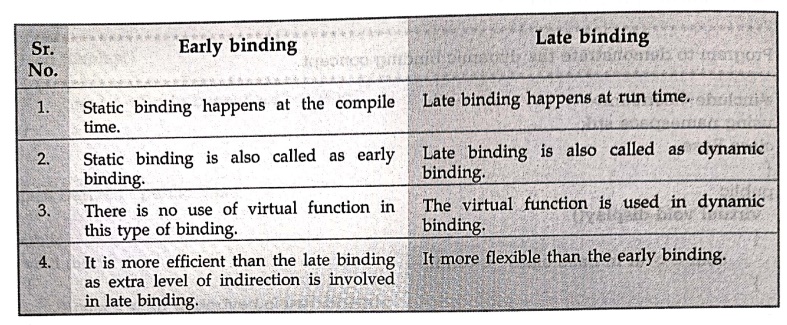
Difference between Early binding and Late binding
Early binding
1.
Static binding happens at the compile time.
2.
Static binding is also called as early binding.
3.
There is no use of virtual function in this type of binding.
4.
It is more efficient than the late binding as extra level of indirection is
involved indirection is in in late binding.
Late binding
1.
Late binding happens at run time.
2.
Late binding is also called as dynamic binding.
3.
The virtual function is used in dynamic binding.
4.
It more flexible than the early binding.
Review Question
1. Explain the
following ‒ Early binding and late binding.
Object Oriented Programming: Chapter 4: Pointers and Runtime Polymorphism : Tag: Oops, Computer Programming : C++ Object Oriented Programming - Binding
Object Oriented Programming: Chapter 4: Pointers and Runtime Polymorphism
Under Subject
Object Oriented Programming (OOPs)
CS25C07 2nd Semester CSE, CSE(CY) Depts | 2025 Regulation | 2nd Semester 2025 Regulation
Related Subjects

English Essentials II
EN25C02 2nd Semester | 2025 Regulation | 2nd Semester 2025 Regulation

Tamils and Technology தமிழர்களும் தொழில்நுட்பமும்
UC25H02 2nd Semester | 2025 Regulation | 2nd Semester 2025 Regulation
Linear Algebra
MA25C02 2nd Semester | 2025 Regulation
Applied Physics (CSIE) II
PH25C03 2nd Semester AIDS, CSE, IT, CSE(CY) Dept | 2025 Regulation | 2nd Semester 2025 Regulation
Digital Principles and Computer Organization
CS25C06 2nd Semester AIDS, CSE, IT, CSE(CY) Dept | 2025 Regulation | 2nd Semester 2025 Regulation

Basic Electrical and Electronics Engineering
EE25C01 2nd Semester | 2025 Regulation | 2nd Semester 2025 Regulation
Object Oriented Programming (OOPs)
CS25C07 2nd Semester CSE, CSE(CY) Depts | 2025 Regulation | 2nd Semester 2025 Regulation

Re-Engineering for Innovation
ME25C05 2nd Semester | 2025 Regulation | 2nd Semester 2025 Regulation
Object Oriented Programming (OOPs) - Laboratory
CS25C07 2nd Semester CSE, CSE(CY) Depts | 2025 Regulation | 2nd Semester 2025 Regulation