Object Oriented Programming: Chapter 4: Pointers and Runtime Polymorphism
Virtual Base Class
C++ Object Oriented Programming
In order to prevent the compiler from giving an error due to ambiguity in multiple path or multiple inheritance, we use the keyword virtual.
Virtual
Base Class
•
In order to prevent the compiler from giving an error due to ambiguity in multiple path or multiple inheritance, we
use the keyword virtual. That means
when we inherit from the base class in both derived classes, the base class is
made virtual. The code that illustrates the concept of virtual base class is as
given below ‒
C++
Program
#include<iostream>
using namespace std;
class base {
public:
int i;
};
class derived1:virtual public base
{
public:
int j;
};
class derived2:virtual public base
{
public:
int k;
};
//derived3 is inherited from derived1 and derived2
//but only one copy of base class is inherited.
class derived3:public derived 1,public derived2
{
public:
int sum()
{
return i+j+k;
}
};
void main()
{
derived3 obj;
Codec 100
obj.i=10;
obj.j=20;
obj.k=30;
cout<" The sum is = "<obj.sum();
}
Output
The sum is = 60
Program Explanation
In
above program if we do not write the keyword virtual while deriving the classes
derived1 and derived2 then compiler would have generated error messages stating
the ambiguity in accessing the member of base class.
The
sum is a function which can access the variables i, j and k of parent classes.
In main function we have created an object obj of derived3 class and using this
object i, j and k can be accessed.
Example:1
Develop
an object oriented program in C++ to create a payroll system for an organization
where one base class consist of employee name, code, designation and another
base class consist of a account no and date of joining. The derived class
consists of the data members such as basic pay, DA, HRA, CCA and deductions PF,
LIC, IT. (Program must use the concept of virtual base class)
Solution :
/**************************************************************************
Program to Payroll System for organization
************************************************************************/
#include<iostream>
using namespace std;
class Employee
{
public:
char name[10];
int code;
char
designation[15];
};
class Accounts:virtual public Employee
{
int accno;
char doj[10];
};
class Pay:virtual public Employee
{
public:
double BasicPay;
double DA;
double HRA;
double CCA;
double PF,LIC,IT;
};
class Derived:public Accounts,public Pay
{
public:
void get_details()
{
cout<<"\n
Enter the name of Employee: ";
cin>>name;
cout<<"\n
Enter the Employee Code: ";
cin>>code;
cout<<"\n
Enter the designation of Employee: ";
cin>>designation;
cout<<"\n
Enter the Basic Payment: ";
cin>>BasicPay;
cout<<"\n Enter amount of DA :
";
cin>>DA;
cout<<"\n
Enter the amount of HRA: ";
cin>>HRA;
cout<<"\n
Enter the amount of CCA: ";
cin>>CCA;
cout<<"\n
Enter the amount of PF:
cin>>PF;
cout<<"\n
Enter the amount of LIC: ";
cin>>LIC;
cout<<"\n
Enter the amount of IT:
cin>>IT;
}
Apa double NetPayment()
{
double amount,
deductions;
deductions=PF+LIC+IT;
amount=(BasicPay+DA+HRA+CCA)‒deductions;
return amount;
}
};
void main()
{
Derived obj;
obj.get_details();
cout<<obj.NetPayment();
}
Output
Enter the name of
Employee: ABC
Enter the Employee
Code: 100
Enter the designation
of Employee: Manager
Enter the Basic
Payment: 12000
Enter amount of DA:
3000
Enter the amount of
HRA: 2000
Enter the amount of
CCA: 700
Enter the amount of
PF: 1200
Enter the amount of
LIC: 1000
Enter the amount of
IT: 3000
12500
Object Oriented Programming: Chapter 4: Pointers and Runtime Polymorphism : Tag: Oops, Computer Programming : C++ Object Oriented Programming - Virtual Base Class
Object Oriented Programming: Chapter 4: Pointers and Runtime Polymorphism
Under Subject
Object Oriented Programming (OOPs)
CS25C07 2nd Semester CSE, CSE(CY) Depts | 2025 Regulation | 2nd Semester 2025 Regulation
Related Subjects
English Essentials II
EN25C02 2nd Semester | 2025 Regulation | 2nd Semester 2025 Regulation
Tamils and Technology தமிழர்களும் தொழில்நுட்பமும்
UC25H02 2nd Semester | 2025 Regulation | 2nd Semester 2025 Regulation
Linear Algebra
MA25C02 2nd Semester | 2025 Regulation
Applied Physics (CSIE) II
PH25C03 2nd Semester AIDS, CSE, IT, CSE(CY) Dept | 2025 Regulation | 2nd Semester 2025 Regulation
Digital Principles and Computer Organization
CS25C06 2nd Semester AIDS, CSE, IT, CSE(CY) Dept | 2025 Regulation | 2nd Semester 2025 Regulation

Basic Electrical and Electronics Engineering
EE25C01 2nd Semester | 2025 Regulation | 2nd Semester 2025 Regulation
Object Oriented Programming (OOPs)
CS25C07 2nd Semester CSE, CSE(CY) Depts | 2025 Regulation | 2nd Semester 2025 Regulation

Re-Engineering for Innovation
ME25C05 2nd Semester | 2025 Regulation | 2nd Semester 2025 Regulation
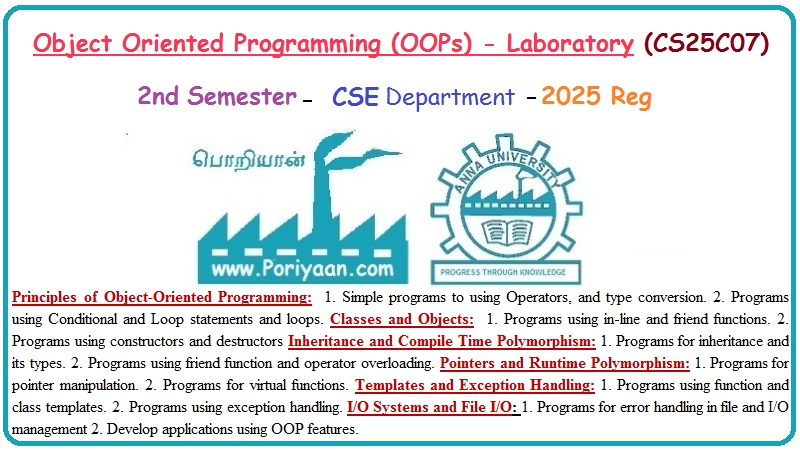
Object Oriented Programming (OOPs) - Laboratory
CS25C07 2nd Semester CSE, CSE(CY) Depts | 2025 Regulation | 2nd Semester 2025 Regulation