Digital Principles and Computer Organization: Chapter 1: Fundamentals of Digital Systems and Arithmetic
Binary Codes
1. Classification of Binary Codes 2. BCD (Binary Coded Decimal) Codes 3. Other 4-bit BCD Codes 4. Excess-3 Code 5. Gray Code 6. Five-bit BCD Codes 7. Alphanumeric Codes. Questions: 1. What is meant by weighted and non-weighted coding? 2. Define reflective and sequential codes. 3. What do you mean by alphanumeric codes? 4. What are error detecting and correcting codes ? 5. What is the advantage of gray codes over the binary number sequence? 6. Show that the excess-3 code is self-complementing. 7. Encode the ten decimal digits in the 2 out of 5 code. 8. Explain the gray code to binary converter with the necessary diagram. 9. Write the application of gray code.
Binary Codes
•
When numbers, alphabets or words are represented by a specific group of
symbols, we can say that they are encoded.
•
The group of symbols used to encode them are called codes. The digital data is represented, stored and transmitted as
groups of binary digits (bits).
•
The group of bits, also known as binary
code, represent both numbers and letters of the alphabets as well as many
special characters and control functions. They are classified as numeric or alphanumeric.
•
Numeric codes are used to represent numbers.
•
Alphanumeric codes are used to represent characters : Alphabetic letters and numerals.
1. Classification of Binary Codes
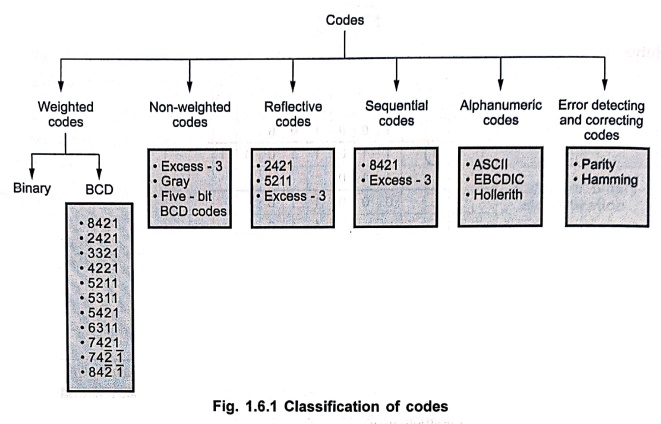
Fig.
1.6.1 shows the classification of codes.
The
codes are broadly classified as
1.
Weighted codes
2.
Non–weighted codes
3.
Reflective codes
4.
Sequential codes
5.
Alphanumeric codes
6.
Error detecting and correcting codes.
Weighted codes
•
In weighted codes, each digit position of the number represents a specific
weight.
•
For example, in decimal code, if number is 567 then weight of 5 is 100, weight
of 6 is 10 and weight of 7 is 1.
•
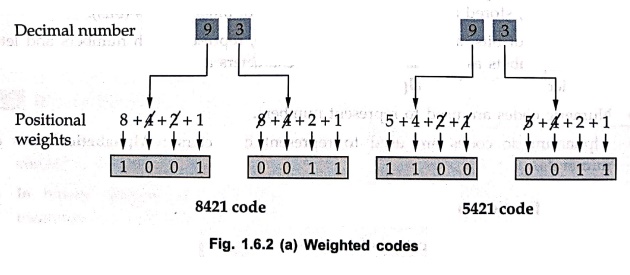
In weighted binary code each bit has a weight 8, 4, 2 or 1 and each decimal
digit is represented by a group of four bits, as shown in Fig. 1.6.2 (a).
Non–weighted codes
•
Non–weighted codes are not assigned with any weight to each digit position,
i.e., each digit position within the number is not assigned fixed value.
•
Excess–3 and gray codes are the non–weighted codes.
Reflective codes
•
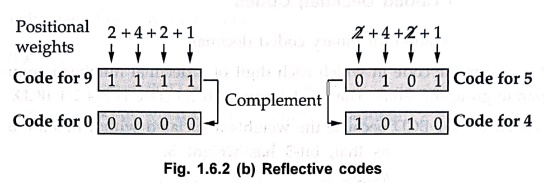
A code is said to be reflective when the code for 9 is the complement for 0,
the code for 8 is complement for 1, 7 for 2, 6 for 3 and 5 for 4. This is
illustrated in Fig. 1.6.2 (b).
•
Like 2421, codes 5211 and excess–3 are also reflective. The 8421 code is not
reflective.
•
Reflectivity is desirable in a code when the nine's complement must be found,
such as in nine's complement subtraction.
Sequential codes
•
In sequential codes each succeeding code is one binary number greater than its
preceding code.
•
This greatly aids mathematical manipulation of data.
•
The 8421 and excess–3 are sequential, whereas the 2421 and 5211 codes are not.
Alphanumeric codes
•
The codes which consists of both numbers and alphabetic characters are called alphanumeric codes.
•
Most of these codes, however, also represent symbols and various instructions
necessary for conveying intelligible information.
•
The most commonly used alphanumeric codes are : ASCII (American Standard Code
for Information Interchange), EBCDIC (Extended Binary Coded Decimal Interchange
Code) and Hollerith code.
Error detecting and correcting codes
•
When the digital information in the binary form is transmitted from one circuit
or system to another circuit or system an error may occur. This means a signal
corresponding to 0 may change to 1 or vice versa due to presence of noise.
•
To maintain the data integrity between transmitter and receiver, extra bit or
more than one bit are added in the data.
•
These extra bits allow the detection and sometimes correction of error in the
data.
•
The data along with the extra bit/bits forms the code. Codes which allow only
error detection are called error
detecting codes and codes which allow error detection and correction are
called error detecting and correcting
codes.
2. BCD (Binary Coded Decimal) Codes
•
BCD is an abbreviation for binary coded decimal.
•
BCD is a numeric code in which each digit of a decimal number is represented by
a separate group of 4–bits. The most common BCD code is 8–4–2–1 BCD.
•
It is called 8–4–2–1 BCD because the weights associated with 4 bits are 8–4–2–1
from left to right. This means that, bit–3 has weight 8, bit–2 has weight 4 bit–1
has weight 2 and bit–0 has weight 1.
•
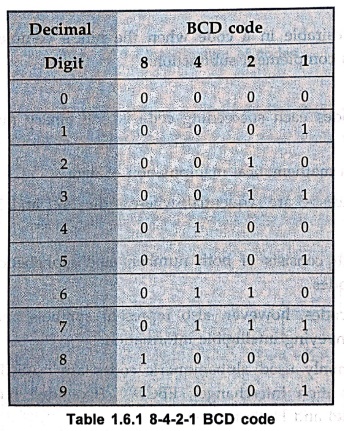
Table 1.6.1 shows the 4–bit 8–4–2–1 BCD code used to represent a single decimal
digit.
•
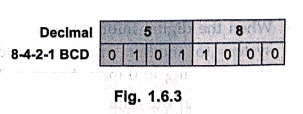
In multidigit coding, each decimal digit is digit is individually coded with 8–4–2–1
BCD code, as shown in Fig. 1.6.3. Total 8–bits are required to encode 5810
in 8–4–2–1 BCD.
Advantage
1.
Easy to convert between it and decimal.
Disadvantages
1.
Since it requires more binary digits to represent multi–digit number than
binary number system. It is less efficient.
For example, to represent the same number (58) in binary : 1110102,
we require only 6 digits.
2.
Arithmetic operations are more complex.
1. BCD Addition
•
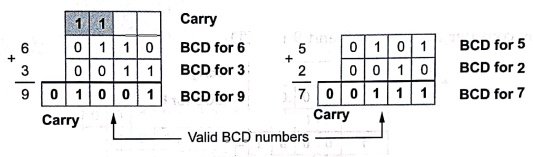
The addition of two BCD numbers can be best understood by considering the three
cases that occur when two BCD digits are added.
Case 1 :
Sum equals 9 or less
with carry 0
Let
us consider additions of 3 and 6 in BCD.
•
The addition is carried out as in normal binary addition and the sums are 1 0 0
1 and 0 1 1 1 which are valid BCD codes.
Case 2 :
Sum greater than 9 with
carry 0
•
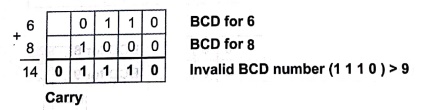
Let us consider addition of 6 and 8 in BCD.
•
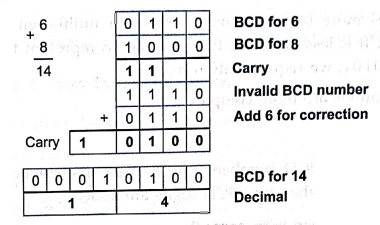
The sum 1 1 1 0 is an invalid BCD number. This has occurred because the sum of
the two digits exceeds 9. Whenever this occurs the sum has to be corrected by
the addition of six (0110) in the invalid BCD number, as shown follows.
•
After addition of 6 carry is produced into the second decimal position.
Case 3 :
Sum equals 9 or less
with carry 1
•
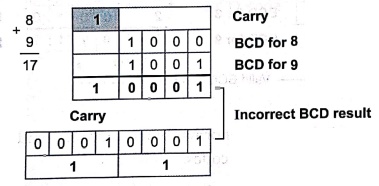
Let us consider addition of 8 and 9 in BCD.
•
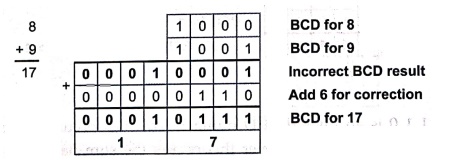
In this case, result (0001 0001) is valid BCD number, but it is incorrect. To
get the correct BCD result correction factor of 6 has to be added to the least
significant digit sum, as shown.
Procedure of BCD addition
•
Going through these three cases of BCD addition we can summarize the BCD
addition procedure as follows :
1.
Add two BCD numbers using ordinary binary addition.
2.
If four–bit sum is equal to or less than 9, no correction is needed. The sum is
in proper BCD form.
3.
If the four–bit sum is greater than 9 or if a carry is generated from the four–bit
sum, the sum is invalid.
4.
To correct the invalid sum,
■
Add 6 (01102) to the four–bit sum and ignore carry of this sum.
■
If a carry results.
■
Add 1(0001)2 to the next higher–order BCD digit.
Example: 1
Perform the code
conversion: (137)10 = (?) NBCD.
Solution :
NBCD
= 8421 BCD
(137)10
= (0001 0011 0111) NBCD
Example: 2
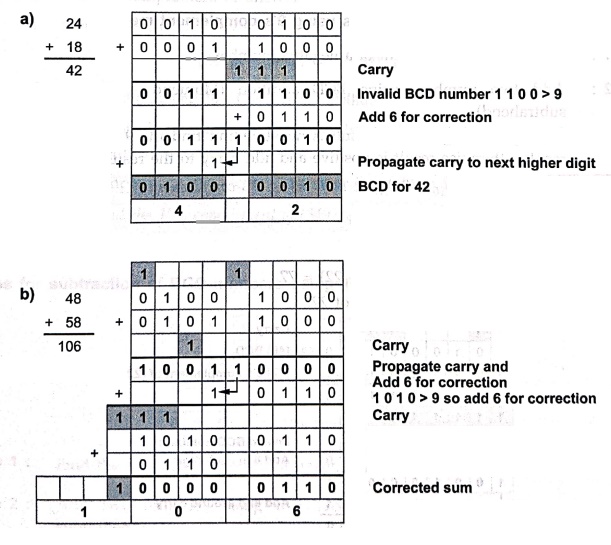
Perform each of the
following decimal additions in 8–4–2–1 BCD.
a) 24
+ 48
–––––––––––
b) 18
+ 58
––––––––––––––
Solution :
2. BCD Subtraction using 9's Complement Method
•
Subtraction of BCD numbers can be performed by representing negative numbers in
the 9's complement form.
•
The 9's complement of a decimal number is found by subtracting each digit in
the number from 9.
•
The 9's complement of each of the decimal digits is as follows :

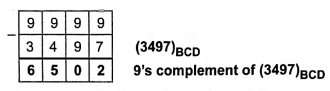
Example: 3
Find the 9's complement
of (3497)BCD
Solution :
Steps for subtraction
of BCD numbers using 9's complement method
Step 1:
Find
the 9's complement of a negative number.
Step 2 :
Add
two numbers using BCD addition (Minuend + 9's complement of subtrahend).
Step 3 :
If
carry is not generated result is negative and find the 9's complement of the result,
otherwise result is positive and add carry to the result.
Example: 4
Perform (46)10
– (22)10 in BCD using 9's complement.
Solution :
Step 1 :
Find
9's complement of 22.
9's
complement of 22 = (99 – 22) = 77
Step 2 :
Add
46 and 9's complement of 22.
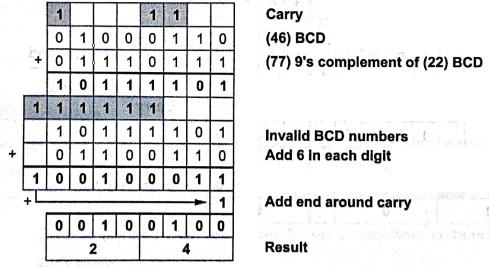
Since
there is a carry the result is positive and true.
(46)BCD – (22)BCD = (24)BCD
Example: 5
Perform (24)10
– (56)10 in BCD using 9's complement.
Solution :
Step 1 :
Find
9's complement of 56
9's
complement of 56 = 99 – 56 = 43
Step 2 :
Add
(24)10 and 9's complement of 56
Since
carry is 0 the answer is negative.
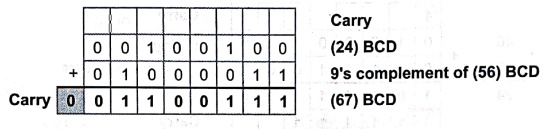
Step 3 :
Take
9's complement of answer
9's
complement of 67 = 99 – 67 = 32
(24)10
– (56)10 = (–32)10
3. BCD Subtraction using 10's Complement Method
•
Subtraction of BCD numbers can also be performed by representing negative
numbers in the 10's complement form.
•
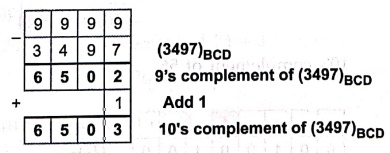
The 10's complement of a decimal number is equal to the 9's complement plus 1.
Example: 6
Find the 10's
complement of (3497)BCD
Solution :
Steps for subtraction
of BCD numbers using 10's complement method
Step 1 :
Find
the 10's complement of a negative number.
Step 2 :
Add
two numbers using BCD addition (Minuend + 10's complement of subtrahend).
Step 3 :
If
carry is not generated result is negative and find the 10's complement of the
result, otherwise result is positive and discard carry.
Example: 7
Perform (46)10
– (22)10 in BCD using 10's complement.
Solution :
Step 1:
Find
10's complement of 22.
10's
complement of 22 = 9's complement of 22 + 1
= (99 – 22)
+ 1 = 78
Step 2 :
Add
46 and 10's complement of 22.
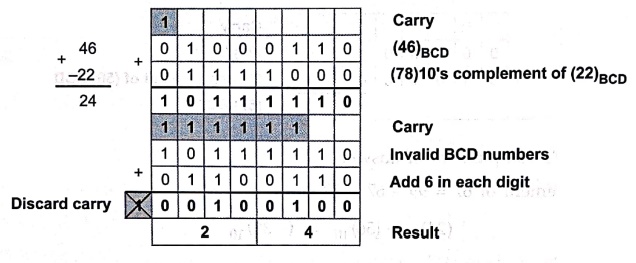
Since
there is a carry the result is positive and true.
(46)BCD
– (22)BCD = (24)BCD
Example: 8
Perform (24)10
– (56)10 in BCD using 10's complement.
Solution :
Step 1:
Find
10's complement of 56.
10's
complement of 56 of 56 = 9's complement of 56 + 1
=
(99 – 56) + 1 = 44
Step 2 :
Add
(24)10 and 10's complement of 56.
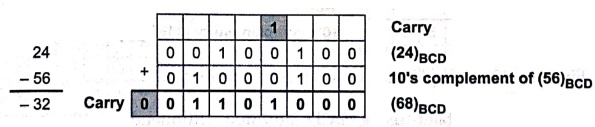
Since
carry is 0 the answer is negative.
Step 3 :
Take
10's complement of answer.
10's
complement of 68 = 9's complement of 68 + 1
= (99 – 68)
+ 1 = 32
(24)10
– (56)10 = – (32)10
Example: 9
Perform 9's and 10's
complement subtraction between 18 and – 24.
Solution :
Using 9's complement
representation.
Step 1 :
Find
9's complement of 24
9's
complement of 24 = 99 – 24 = 75
Step 2 :
Add
18 and 9's complement of 24
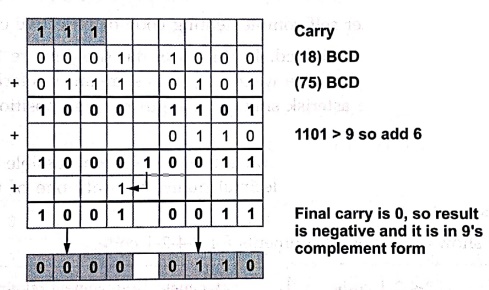
(18) – (24)
= – 6
Using 10's complement
representation
Step 1 :
Find
10's complement of 24
10's
complement of 24 = 9's complement of 24 + 1
= 75+1 = 76
Step 2 :
Add
18 and 10's complement of 24
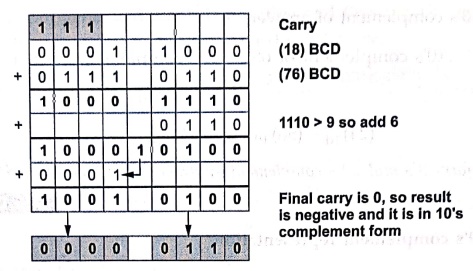
(18) – (24)
= – 6
3. Other 4–bit BCD Codes
1. 2–4–2–1 Codes
•
The 2–4–2–1 BCD is another self complementing code or reflective code.
•
Its 4–bit code groups are weighted. In this case, the weights are 2–4–2–1,
meaning that bit 1 and bit 3 have the same weight (2). It is sometimes referred
to as 2*– 4–2–1 code, where the asterisk simply distinguishes one position with
weight 2 from the other.
•
Since two positions have the same weight, there are two possible bit patterns
that could be used to represent some decimal digits, but only one of those
patterns is actually assigned.
•
Table 1.6.3 shows the code assignments for 2–4–2–1 code.
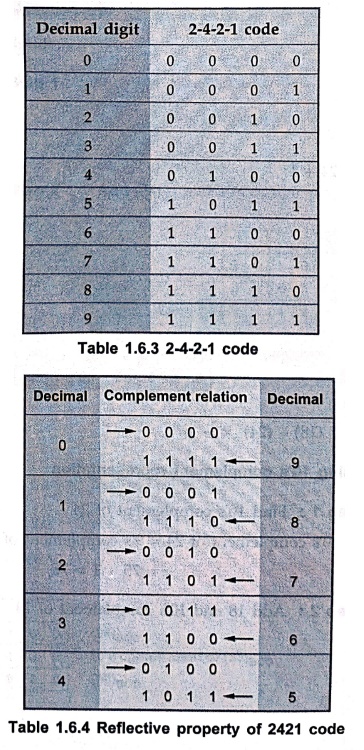
•
Table 1.6.4 shows the reflective or self complementing property of 2421 code.
•
It shows that, in 2421 code, code for 9 is complement of code 0, code for 8 is
complement of code 1 and so on.
2. Other Weighted BCD Codes
•
There are various other weighted 4–bit BCD codes, each developed to have
certain properties useful for special applications.
•
Table 1.6.5 shows these codes, identified by the weights assigned to their bit
positions.
•
The  code is somewhat different than the other codes.
When 1 occurs in either of the two rightmost positions means that the weight of
that position is subtracted, rather than added, to determine the decimal value.
code is somewhat different than the other codes.
When 1 occurs in either of the two rightmost positions means that the weight of
that position is subtracted, rather than added, to determine the decimal value.
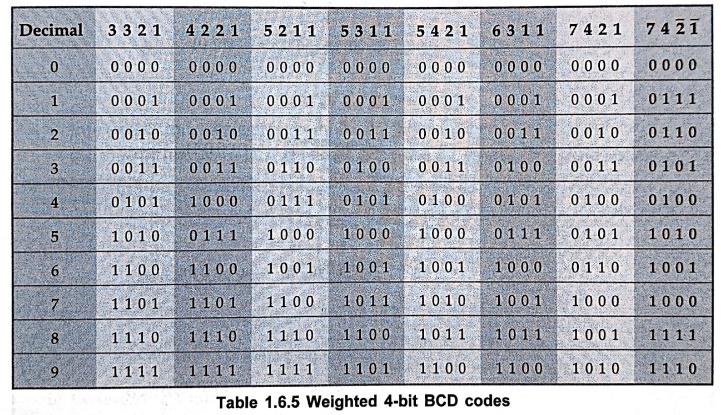
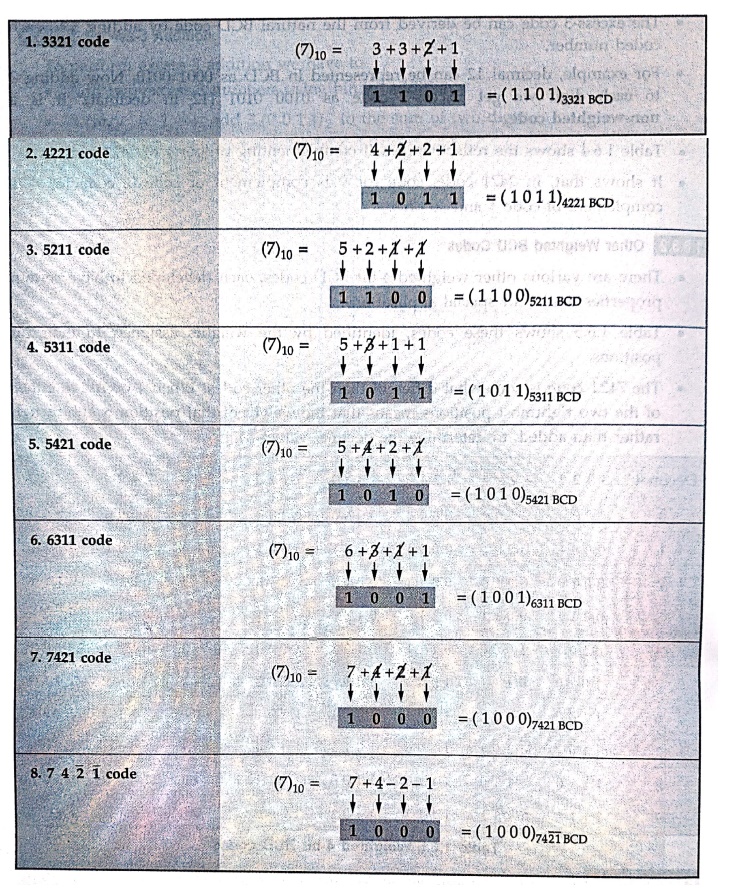
Example: 10
Represent (7)10
using all the weighted 4–bit BCD codes listed in Table 1.6.5.
Solution :
4. Excess–3 Code
•
The excess–3 code can be derived from the natural BCD code by adding 3 to each
coded number.
•
For example, decimal 12 can be represented in BCD as 0001 0010. Now adding 3 to
each digit we get Excess–3 code as 0100 0101 (12 in decimal). It is a non–weighted code.
•
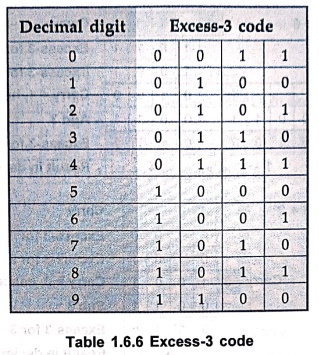
Table 1.6.6 shows excess–3 codes to represent single decimal digit. It is sequential code because we get any code
word by adding binary 1 to its previous code word as shown in Table 1.6.6.
•
In excess–3 code we get 9's complement of a number by just complementing each
bit. Due to this excess–3 code is called self–complementing
code or reflective code.
Example: 11
Find the excess–3 code
and its 9's complement for following decimal numbers.
a) 592 b) 403
Solution :
a) By referring Table
1.6.6.

b) By referring Table
1.6.6.

1. Excess–3 Addition
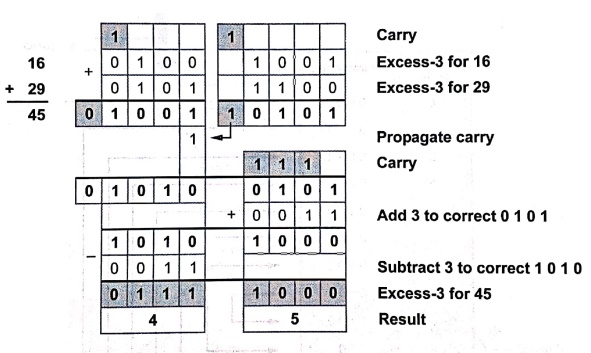
To
perform excess–3 addition we have to
•
Add two excess–3 numbers using binary addition.
•
If carry = 1 → add 3 (0 0 1 1)2 to the sum of two digits.
= 0 → subtract 3 (0 0 1 1)2 from
the sum.
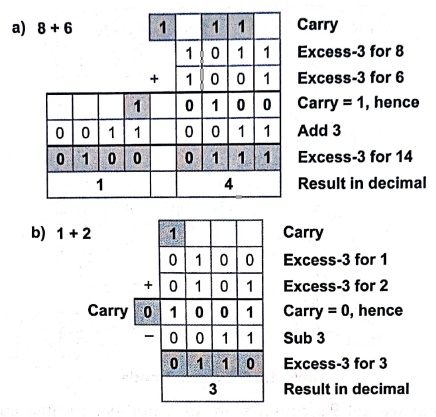
Example: 12
Perform the excess–3
addition of a) 8, 6 b) 1, 2.
Solution :
a) 8+6
b) 1+ 2
2. Excess–3 Subtraction
•
To perform excess–3 subtraction we have to
■
Complement the subtrahend.
■
Add complemented subtrahend to minuend.
■
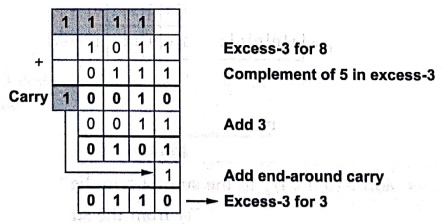
If carry = 1 Result is positive. Add 3 (0 0 1 1)2 and end–around
carry.
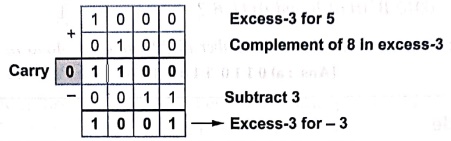
If carry = 0 Result is negative. Subtract 3
(0 0 1 1)2.
Example: 13
Perform the excess–3
subtraction of
a) 8 – 5,
b) 5 – 8.
Solution :
a) 8 – 5
Note :
In excess–3, 9's complement and complement of any number is same. So this
excess–3 subtraction method is also known as excess–3 subtraction using 9's
complement.
b) 5 – 8
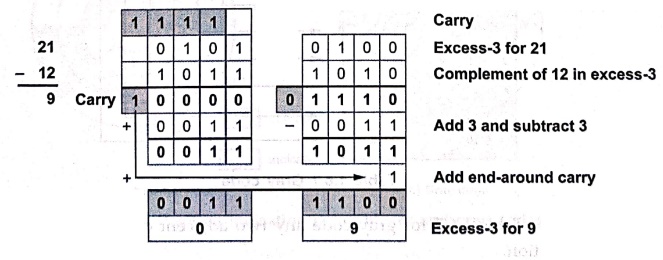
Example: 14
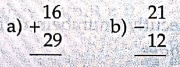
Perform each of the
following operations in excess–3 code.
a)
16
+
29
–––––––
b)
21
– 12
––––––––
Solution :
a)
b)
Examples for Practice
Example: 15
Represent decimal
number 327 in Excess–3 code.
[ Answer: 0110 0101 1010]
Example: 16
What is Excess–3 code
of binary numbers :
0010 B, 0110 B and 0111
B?
[ Answer: 0101, 1001, 1010]
Example:
17
Represent the decimal
number a) 396 and b) 4096 in Excess–3 code.
[ Answer: a) 0110 1100 1001 b)
0111001111001001]
5. Gray Code
•
Gray code is a non–weighted code and
is a special case of unit–distance code.
•
In unit–distance code, bit patterns for two consecutive numbers differ in only
one bit position. These codes are also called cyclic codes.
•
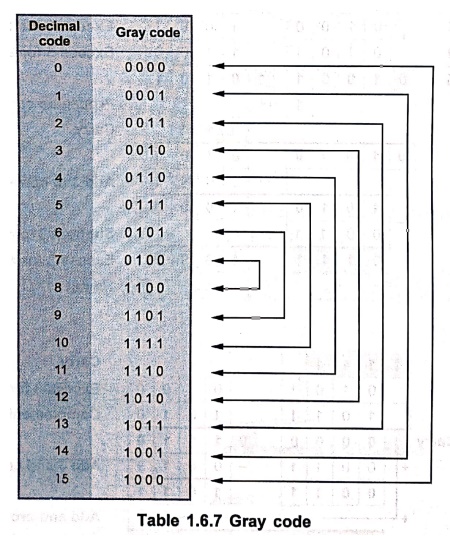
Table 1.6.7 shows the bit patterns assigned for gray code from decimal 0 to
decimal 15.
•
As shown in Table 1.6.7 for gray code any two adjacent code groups differ only
in one bit position.
• Reflective Property :
The gray code is also called reflected
code. Notice that the two least significant bits for 410 through
710 are the mirror images of those for 00 a through 310.
Similarly, the three least significant bits for 810 through 1510
are the mirror images of those for 010 through 710.
•
In general, the n least significant bits for 2n through 2n+ 1
–1 are the mirror images of those for 0 through 2n –1.
1. Application of Gray Code
•
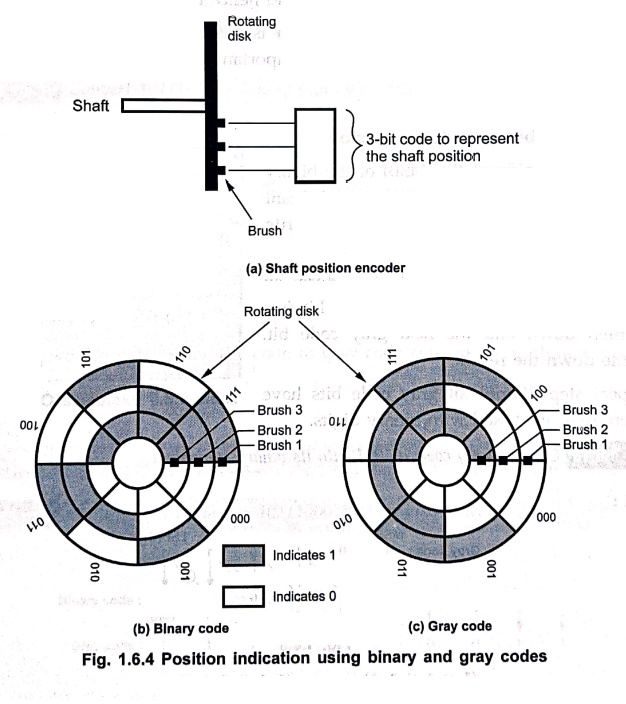
Let us consider an application where 3–bit binary code is provided to indicate
position of the rotating disk with the help of brushes.
•
When brushes are on the black portion, they output a 1. When on the white portion,
they output a 0.
•
Now consider what happens when the brushes are on the 111 sector and almost
ready to enter the 000 sector.
•
If one brush is slightly ahead of the other, say the 3rd brush, then
the position is indicated by a 011 instead of a 111 or 000. This results, a
180° error in the disk position.
•
Since it is physically impossible to have all the brushes precisely aligned,
some error will always be present at the edges of the sectors.
•
If we use gray code to represent disk position then error due to improper brush
alignment can be reduced. This is because the gray code assures that only one
bit will change each time the decimal number is incremented.
•
So in 3–bit code, error may occur due to one bit position. Other two bits
positions two bits of two adjacent sectors are always same and hence there is
no possibility of error.
•
Therefore in 3–bit code probability of error is reduced upto 66 %. In case of 4–bit
code it is reduced upto 75 %. This is an important advantage of gray code.
2. Gray to Binary Conversion
Steps for gray to
binary code conversion
1.
The Most Significant Bit (MSB) of the binary number is the same as the most
significant bit (MSB) of the gray code number. So write down MSB as it is.
2.
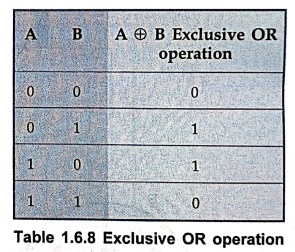
To obtain the next binary digit, perform an exclusive–OR–operation between the
bit just written down and the next gray code bit. Write down the result.
3.
Repeat step 2 until all gray code bits have been exclusive–ORed with binary
digits.
Example: 18
Convert gray code
101011 into its binary equivalent.
Solution :
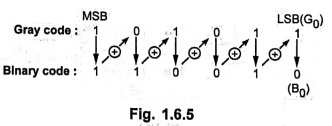
(101011) gray = (1 1 0 0 1 0)2
In
general we can perform gray code to binary code conversion as shown below :
Bn
(MSB) = Gn (MSB)
Bn–1
= Bn ⊕ Gn–1
Bn–2
= Bn–1 ⊕
Gn–2
…
B2 = B3
⊕ G2
B1
= B2 ⊕ G1
B0
= B1 ⊕
G0
3. Binary to Gray Code Conversion
Steps for binary to
gray code conversion
1.
The MSB of the gray code is the same as the MSB of the binary number. So write down MSB as it is.
2.
To obtain the next gray digit, perform an exclusive–OR–operation between
previous and current binary bit. Write down the result.
3.
Repeat step 2 until all binary bits have been exclusive–ORed with their
previous ones.
Example: 19
Convert 10111011 in
binary into its equivalent gray code.
Solution :
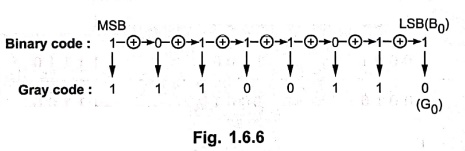
(10111011)2 = (11100110)gray
In
general we can perform binary code to gray code conversion as shown below :
Gn(MSB)
= Bn (MSB)
Gn–1
= Bn ⊕
Bn–1
Gn–2
= Bn–1 ⊕ Bn–2
…
G2
= B3 ⊕ B2
G1 = B2
⊕ B1
G0
= B1 ⊕
B0
Example: 20
Convert binary number
1011100010 to its gray code.
Solution :

(1011100010)2 = (1110010011)gray
6. Five–bit BCD Codes
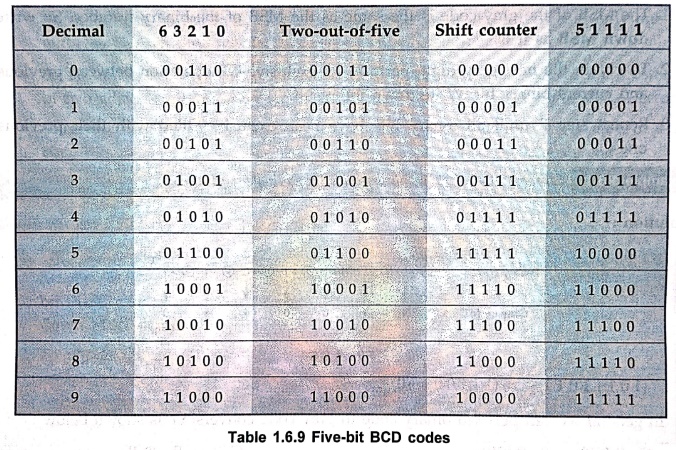
Table
1.6.9 shows some 5–bit BCD codes having special characteristics. These special
characteristics of the code are useful for error detection. As shown in Table
1.6.9, 63210 and two–out–of–five codes have two 1s in every code group. The
63210 code is a weighted code (except for decimal digit 0) and it is used for
storing data on magnetic tape. On the other hand two–out–of–five code is
unweighted code and is used in the telephone and communications industries.
Shift counter code, also known as Johnson so known code and 51111 code has
specific sequences of 1s which are useful for error detection.
7. Alphanumeric Codes
•
The codes which consists of both numbers and alphabetic characters are called alphanumeric codes.
•
The most commonly used alphanumeric codes are : ASCII (American Standard Code
for Information Interchange) and EBCDIC (Extended Binary Coded Decimal
Interchange Code).
•
These codes consists of symbols to represent –
■ 26 alphabets with capital and small letters.
■
Numbers from 0 to 9.
■ Punctuation marks and other symbols.
1. ASCII
•
ASCII code is a seven–bit code in which the decimal digits are represented by
the BCD code preceded by 011.
•
Since it is a 7–bit code, it represent 27 = 128 symbols.
•
Capital A to Z alphabets are represented by 41 to 5A (7–bit) codes,
respectively. For example, ASCII code for A = 41, B 42, C 43 and so on.
•
Small a to z alphabets are represented by 61 to 6A (7–bit) codes, respectively.
For example, a = 61, b = 62, c = 62, c = 63 and so on.
•
Numbers 0 to 9 are represented by 30 to 39 (7–bit) codes, respectively. For example,
0= 30, 1 = 31, 2 = 32 and so on.
Example: 21
Write the ASCII code
for 'ELECTRONICS'.
Solution :
45,
4C, 45, 43, 54, 52, 4F, 4E, 49, 43, 53 i.e.,
1000101
1001100 1000101 1000011 1010100 1010010
1001111
1001110 1001001 1000011 1010011
Example: 22
Encode the word
'BINARY' in ASCII form.
Solution :
42,
49, 4E, 41, 52, 59 i.e.,
1000010
1001001 1001110 1000001 1010010 1011001
Examples for Practice
Example:
23
Find gray codes for the
following binary numbers :
i) 11001100 ii) 01011110.
[ Answer: i) 10101010 ii) 01110001]
Example:
24
What will be the gray
code of binary number 1100 B, 0111 B and 1101 B ?
[ Answer: 1010, 0100, 1011]
Example:
25
Explain ASCII code and
convert NMU JALGAON into its equivalent ASCII code.
Review Questions
1. What is meant by
weighted and non–weighted coding?
2. Define reflective
and sequential codes.
3. What do you mean by
alphanumeric codes?
4. What are error
detecting and correcting codes ?
5. What is the
advantage of gray codes over the binary number sequence?
6. Show that the
excess–3 code is self–complementing.
7. Encode the ten
decimal digits in the 2 out of 5 code.
8. Explain the gray
code to binary converter with the necessary diagram.
9. Write the
application of gray code.
Digital Principles and Computer Organization: Chapter 1: Fundamentals of Digital Systems and Arithmetic : Tag: Digital, Computer : - Binary Codes
Digital Principles and Computer Organization: Chapter 1: Fundamentals of Digital Systems and Arithmetic
Under Subject

Digital Principles and Computer Organization
CS25C06 2nd Semester AIDS, CSE, IT, CSE(CY) Dept | 2025 Regulation | 2nd Semester 2025 Regulation
Related Subjects

English Essentials II
EN25C02 2nd Semester | 2025 Regulation | 2nd Semester 2025 Regulation

Tamils and Technology தமிழர்களும் தொழில்நுட்பமும்
UC25H02 2nd Semester | 2025 Regulation | 2nd Semester 2025 Regulation
Linear Algebra
MA25C02 2nd Semester | 2025 Regulation

Applied Physics (CSIE) II
PH25C03 2nd Semester AIDS, CSE, IT, CSE(CY) Dept | 2025 Regulation | 2nd Semester 2025 Regulation
Digital Principles and Computer Organization
CS25C06 2nd Semester AIDS, CSE, IT, CSE(CY) Dept | 2025 Regulation | 2nd Semester 2025 Regulation

Basic Electrical and Electronics Engineering
EE25C01 2nd Semester | 2025 Regulation | 2nd Semester 2025 Regulation

Python for Data Science
AD25201 2nd Semester AIDS Dept | 2025 Regulation | 2nd Semester 2025 Regulation

Re-Engineering for Innovation
ME25C05 2nd Semester | 2025 Regulation | 2nd Semester 2025 Regulation

Python for Data Science - Laboratory
AD25201 2nd Semester AIDS Dept | 2025 Regulation | 2nd Semester 2025 Regulation