Digital Principles and Computer Organization: Chapter 1: Fundamentals of Digital Systems and Arithmetic
Digital Systems
Characteristics, Advantages
Questions: 1. Define an analog system with one example. 2. Define a digital system with one example. 3. Explain the characteristics of analog systems in detail with examples. 4. Explain the characteristics of digital systems in detail with examples. 5. Compare analog systems and digital systems. 6. What is a binary signal? 7. What are the advantages of digital systems.
Chapter 1
Fundamentals of Digital Systems and Arithmetic
Digital Systems
•
A system is a collection of components that work together to process
information. This information–whether it is sound, an image, or a temperature
reading–must be represented in a format that the system can understand and
manipulate.
•
Systems are broadly classified into Analog
Systems and Digital Systems, based on how they represent and process
information.
•
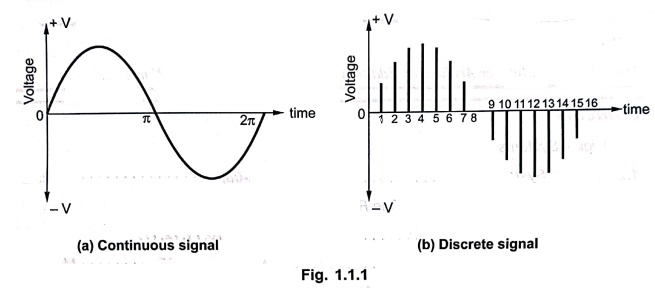
Analog systems : They represent
information using continuous signals. A continuous signal can take
any value within a given range and directly corresponds to the physical
quantity being measured.
Characteristics of analog systems
•
Continuous : The signal varies
smoothly, continuously over time and can have an infinite number of possible
values.
•
Proportional : The amplitude or
value of the signal is directly proportional to the physical quantity (e.g.,
voltage proportional to temperature).
• Noise sensitive :
Analog signals are prone to noise and distortion; once disturbed, the signal
cannot be recovered perfectly.
•
Examples : A mercury thermometer, where the height of mercury continuously
varies with temperature.
•
Digital systems represent information using discrete signals. These signals are restricted to a finite set of
values, most commonly the binary system
(0 and 1). Digital representation is the foundation of modern computers and
electronic devices.
Characteristics of digital systems
•
Discrete : Signals exist only at
specific levels (e.g., 0 or 1) rather than varying continuously. They can take
one of a finite number of values at any instant.
• Binary representation
: Information
is encoded in bits, making it easy to store, process and transmit.
• Noise–immune : Minor
fluctuations due to noise do not affect the interpretation of signals.
• Versatile :
Digital signals enable mathematical operations, data storage and programmable
processing.
•
Examples : Computers, smartphones, and digital cameras all operate on digital
data.
•
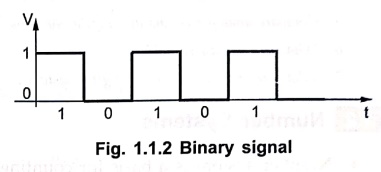
Binary signal : The most common
digital signal, with two levels–logic 0
(OFF/low) and logic 1 (ON/high).
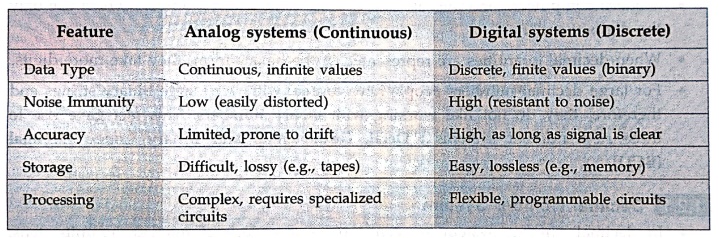
Differences between analog and digital systems
Advantages of digital systems
•
The widespread use of digital systems is due to the following advantages :
1.
Easy to design and flexible.
2.
Provide higher accuracy compared to
analog systems.
3.
Less affected by noise, temperature variations
and component aging.
4.
Can store and process large amounts of data
using memory.
5. Easier to add new functionality.
6.
Produce consistent and repeatable results for the same inputs.
7.
Information display is convenient and accurate.
8.
Cost–effective and scalable.
9.
Can be described and designed using HDLs
(Hardware Description Languages).
10.
Communication between digital
systems is simple and reliable.
Review Questions
1. Define an analog
system with one example.
2. Define a digital
system with one example.
3. Explain the
characteristics of analog systems in detail with examples.
4. Explain the
characteristics of digital systems in detail with examples.
5. Compare analog
systems and digital systems.
6. What is a binary
signal?
7. What are the
advantages of digital systems.
Digital Principles and Computer Organization: Chapter 1: Fundamentals of Digital Systems and Arithmetic : Tag: Digital, Computer : Characteristics, Advantages - Digital Systems
Digital Principles and Computer Organization: Chapter 1: Fundamentals of Digital Systems and Arithmetic
Under Subject
Digital Principles and Computer Organization
CS25C06 2nd Semester AIDS, CSE, IT, CSE(CY) Dept | 2025 Regulation | 2nd Semester 2025 Regulation
Related Subjects

English Essentials II
EN25C02 2nd Semester | 2025 Regulation | 2nd Semester 2025 Regulation
Tamils and Technology தமிழர்களும் தொழில்நுட்பமும்
UC25H02 2nd Semester | 2025 Regulation | 2nd Semester 2025 Regulation
Linear Algebra
MA25C02 2nd Semester | 2025 Regulation
Applied Physics (CSIE) II
PH25C03 2nd Semester AIDS, CSE, IT, CSE(CY) Dept | 2025 Regulation | 2nd Semester 2025 Regulation
Digital Principles and Computer Organization
CS25C06 2nd Semester AIDS, CSE, IT, CSE(CY) Dept | 2025 Regulation | 2nd Semester 2025 Regulation

Basic Electrical and Electronics Engineering
EE25C01 2nd Semester | 2025 Regulation | 2nd Semester 2025 Regulation
Python for Data Science
AD25201 2nd Semester AIDS Dept | 2025 Regulation | 2nd Semester 2025 Regulation

Re-Engineering for Innovation
ME25C05 2nd Semester | 2025 Regulation | 2nd Semester 2025 Regulation
Python for Data Science - Laboratory
AD25201 2nd Semester AIDS Dept | 2025 Regulation | 2nd Semester 2025 Regulation