Digital Principles and Computer Organization: Chapter 1: Fundamentals of Digital Systems and Arithmetic
Fundamentals of Digital Systems and Arithmetic: Two Marks Important Questions and Answers
Digital Principles and Computer Organization
Digital Principles and Computer Organization: Chapter 1: Fundamentals of Digital Systems and Arithmetic: Anna University Part A Two Marks Important Questions and Answers
Digital Principles
and Computer Organization:
Chapter 1: Fundamentals of Digital Systems and
Arithmetic
Two Marks Questions
with Answers
1. Define
an analog system with one example.
Answer:
An
analog system represents information
using continuous signals that vary smoothly over time.
Example :
A mercury thermometer, where the height of mercury continuously varies with
temperature.
2. State
two characteristics of analog systems.
Answer:
1. Continuous :
Signal varies smoothly over time and can have infinite values.
2. Noise Sensitive :
Analog signals are easily affected by noise and distortion.
3. What
is a digital system ?
Answer:
A digital
system represents information using discrete
signals, most commonly the binary system (0 and 1). It is the foundation of
modern computers and electronics.
4. State
two characteristics of digital systems.
Answer:
1. Discrete :
Signals exist only at specific levels (0 or 1).
2. Noise–Immune :
Small fluctuations due to noise do not affect interpretation.
5. What
is a binary signal ?
Answer:
A binary signal is the most common digital
signal with two levels : logic 0 (OFF/low) and logic 1 (ON/high).
6. Write
two differences between analog and digital systems.
Answer:
• Analog :
Continuous signals, low noise immunity.
• Digital :
Discrete signals, high noise immunity.
7. Why
are digital systems widely used? (Any two reasons)
Answer:
1.
They provide higher accuracy and are
less affected by noise.
2.
They are easy to design, flexible,
and can store and process large data
using memory.
8. What
is the binary number system?
Answer:
The
binary system uses only two digits,
0 and 1, with base 2. Each digit is called a bit.
9. Convert
(1011)2 into decimal.
Answer:
(1011)2 = (1×23+0×22+1×21+1×20) =
8+0+2+1 = (11)10 (1011)2
=
(1×23 +0×22 +1×21 +1×20) = 8+0+2+1
= (11)10 (1011)2.
=
(1×23 + 0×22 + 1×21 + 1×20) = 8+0+2+1 = (11)10
10. What
is the octal number system ?
Answer:
The
octal system uses eight digits (0–7)
with base 8.
11. Convert
(57)8 into decimal.
Answer:
(57)8
= (5×81+7×80) = 40+7 = (47)10 (57)8 = (5×81+7×80)
= 40+7 =(47)10 (57)8
=
(5×81+7×80) = 40+7 = (47)10
12. What
is the hexadecimal number system ?
Answer:
The
hexadecimal system has base 16 and
uses digits 0–9 and letters A–F (A=10, … F=15).
11.
Convert (2F)16 into decimal.
Answer:
(2F)16
= (2×161+15×160) = 32+15=(47)10 (2F)16 = (2×161+15×160)
=
32+15 = (47)10 (2F)16 = (2×161+15×160) = 32+15=(47)10
Complements
14. What
is 1's complement of a binary number?
Answer:
The
1's complement is obtained by changing all 1's to 0's and all 0's to 1's in a
binary number.
15. Find
the 1's complement of (11010100) ?
Answer:
(11010100)2
→ (00101011)2 (11010100)2 → (00101011)2
(11010100)2 → (00101011)2
16. What
is 2's complement of a binary number?
Answer:
The
2's complement is obtained by adding 1 to the 1's complement of a binary
number.
17. Find the 2's complement of (11000100)2
Answer:
1's
complement of (11000100)2 =(00111011)2
Add
1 → (00111011)2 + (1)2 = (00111100)2
18. Why
is 2's complement preferred over 1's complement ?
Answer:
Because
the 2's complement system has only one
zero representation and allows simpler
arithmetic operations compared to 1's complement.
19.
Represent +9 and –9 using 8–bit 2's complement representation.
Answer:
+9
= (00001001)2
–
9 = Take 2's complement of 00001001 = (11110111)2
20. State
the rules of binary addition.
Answer:
•
0 + 0 = 0
•
0 + 1 = 1
•
1 + 0 = 1
•
1 + 1 = 10 (sum = 0, carry = 1)
21. State
the rules of binary subtraction.
Answer:
•
0 – 0 = 0
•
1 – 0 = 1
•
1 – 1 = 0
•
0 – 1 = 1 (with borrow = 1)
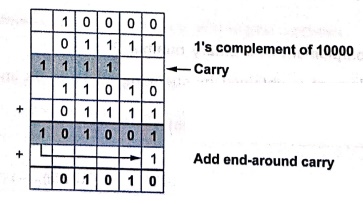
22. Perform
subtraction using 1's complement (11010)2 − (10000)2.
Answer:
23. Find
the octal equivalent of hexadecimal number AB.CD.
Answer:
(231.4065)8
24.
Perform the following code conversions :
(1010.10)16
→ (?)2 → (?)2 → (?)10
Answer:
(1000000010000.0001)2, (10020.02)8,
(4112.0625)10
25. Subtract
11001 from 01101 using 2's complement.
Answer:
1100.
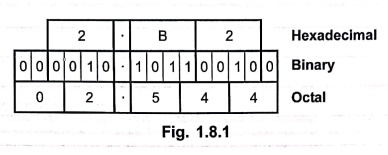
26. Convert
(2.B2)16 to binary and octal numbers.
Answer:
(2.B2)16 = (2.544)8 =
(10.1011001)2
27. What
is meant by weighted and non–weighted coding ?
Answer:
Weighted codes : In
weighted codes, each digit position of the number represents a specific weight.
For example, in decimal code, if number is 567 then weight of 5 is 100, weight
of 6 is 10 and weight of 7 is 1. In weighted binary codes each digit has a
weight 8, 4, 2 or 1.
The
codes 8421, 2421 and 5211 are all weighted codes. (Refer Tables 1.6.1, 1.6.3
and 1.6.5)
Non–weighted codes :
Non–weighted codes are not assigned with any weight to each digit position,
i.e., each digit position within the number is not assigned fixed value. Excess–3
and gray codes are the non–weighted codes.
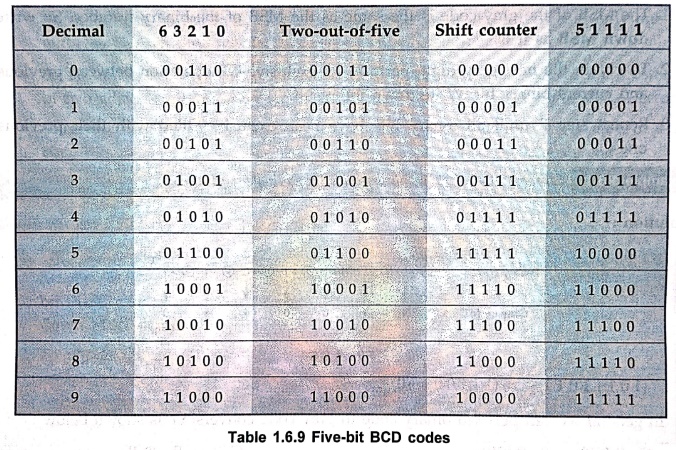
28. Encode
the ten decimal digits in the 2 out of 5 code.
Answer:
Table
1.6.9 shows some 5–bit BCD codes having special characteristics. These special
characteristics of the code are useful for error detection. As shown in Table
1.6.9, 63210 and two–out–of–five codes have two 1s in every code group. The
63210 code is a weighted code (except for decimal digit 0) and it is used for
storing data on magnetic tape. On the other hand two–out–of–five code is
unweighted code and is used in the telephone and communications industries.
Shift counter code, also known as Johnson so known code and 51111 code has
specific sequences of 1s which are useful for error detection.
29. Show
that the excess–3 code is self–complementing.
Answer:
In
excess–3 code we get 9's complement of a number by just complementing each bit.
Due to this excess–3 code is called self–complementing
code or reflective code.
30. What
is the advantage of gray codes over the binary number sequence?
Answer:
•
If we use gray code to represent disk position then error due to improper brush
alignment can be reduced. This is because the gray code assures that only one
bit will change each time the decimal number is incremented.
•
So in 3–bit code, error may occur due to one bit position. Other two bits
positions two bits of two adjacent sectors are always same and hence there is
no possibility of error.
•
Therefore in 3–bit code probability of error is reduced upto 66 %. In case of 4–bit
code it is reduced upto 75 %. This is an important advantage of gray code.
31. What
are error detecting codes ?
Answer:
•
When the digital information in the binary form is transmitted from one circuit
or system to another circuit or system an error may occur. This means a signal
corresponding to 0 may change to 1 or vice versa due to presence of noise.
•
To maintain the data integrity between transmitter and receiver, extra bit or
more than one bit are added in the data.
•
These extra bits allow the detection and sometimes correction of error in the
data.
•
The data along with the extra bit/bits forms the code. Codes which allow only
error detection are called error
detecting codes and codes which allow error detection and correction are
called error detecting and correcting
codes.
Digital Principles and Computer Organization: Chapter 1: Fundamentals of Digital Systems and Arithmetic : Tag: Digital, Computer : Digital Principles and Computer Organization - Fundamentals of Digital Systems and Arithmetic: Two Marks Important Questions and Answers
Digital Principles and Computer Organization: Chapter 1: Fundamentals of Digital Systems and Arithmetic
Under Subject
Digital Principles and Computer Organization
CS25C06 2nd Semester AIDS, CSE, IT, CSE(CY) Dept | 2025 Regulation | 2nd Semester 2025 Regulation
Related Subjects

English Essentials II
EN25C02 2nd Semester | 2025 Regulation | 2nd Semester 2025 Regulation

Tamils and Technology தமிழர்களும் தொழில்நுட்பமும்
UC25H02 2nd Semester | 2025 Regulation | 2nd Semester 2025 Regulation
Linear Algebra
MA25C02 2nd Semester | 2025 Regulation
Applied Physics (CSIE) II
PH25C03 2nd Semester AIDS, CSE, IT, CSE(CY) Dept | 2025 Regulation | 2nd Semester 2025 Regulation
Digital Principles and Computer Organization
CS25C06 2nd Semester AIDS, CSE, IT, CSE(CY) Dept | 2025 Regulation | 2nd Semester 2025 Regulation

Basic Electrical and Electronics Engineering
EE25C01 2nd Semester | 2025 Regulation | 2nd Semester 2025 Regulation
Python for Data Science
AD25201 2nd Semester AIDS Dept | 2025 Regulation | 2nd Semester 2025 Regulation

Re-Engineering for Innovation
ME25C05 2nd Semester | 2025 Regulation | 2nd Semester 2025 Regulation
Python for Data Science - Laboratory
AD25201 2nd Semester AIDS Dept | 2025 Regulation | 2nd Semester 2025 Regulation