Digital Principles and Computer Organization: Chapter 1: Fundamentals of Digital Systems and Arithmetic
Number Systems
1. Decimal Number System, 2. Binary Number System, 3. Octal Number System, 4. Hexadecimal Number System, 5. Format of a Binary Number, 6. Counting in Radix (Base) r . Questions: 1. Explain various number systems. 2. Name the number system used in computers.
Number Systems
•
Number system is a basis for counting various items.
•
The decimal number system has 10 digits: 0, 1, 2, 3, 4, 5, 6, 7, 8 and 9.
•
Modern computers communicate and operate with binary numbers which use only the
digits 0 and 1.
•
When decimal quantities are represented in the binary form, they take more
digits.
•
For large decimal numbers people have to deal with very large binary strings
and therefore, they do not like working with binary numbers. This fact gave
rise to three new number systems : Octal,
Hexadecimal and Binary Coded Decimal
(BCD).
1. Decimal Number System
•
In decimal number system we can express any decimal number in units, tens, hundreds,
thousands and so on.
•
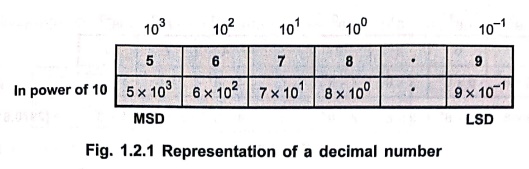
When we write a decimal number say, 5678.9, we know it can be represented as
5000 + 600 + 70 + 8 + 0.9 = 5678.9.
•
The decimal number 5678.9 can also be written as 5678.910, where the
10 subscript indicates the radix or
base.
•
The position of ad a digit with reference to the decimal point determines its
value/weight. The sum of all the digits multiplied by their weights gives the
total number being represented.
•
The leftmost digit, which has the greatest weight is called the most significant digit and the
rightmost digit, which has the least weight, is called the least significant digit.
•
Fig. 1.2.1 shows decimal digit and its weights expressed as a power of 10.
2. Binary Number System
•
Binary system with its two digits is a base–two
system.
•
The two binary digits (bits) are 1 and 0.
•
In binary system, weight is expressed as a power of 2.
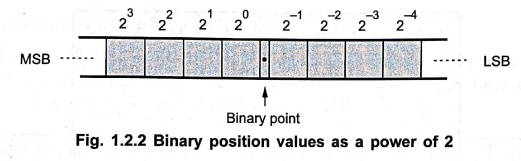
Fig.
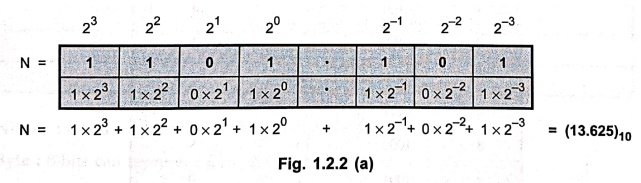
1.2.2 (a) shows representation of binary number 1101.101 in power of 2.
N
= 1×23 + 1×22 + 0×21 + 1×20 +
1×2–1 + 0×2 – 2
+ 1×2–3 = (13.625)10
•
By adding each digit of a binary number in a power of 2 we can find the decimal
equivalent of the given binary number.
3. Octal Number System
•
The octal number system uses first eight digits of decimal number system : 0,
1, 2, 3, 4, 5, 6 and 7. As it uses 8 digits, its base is 8.
•
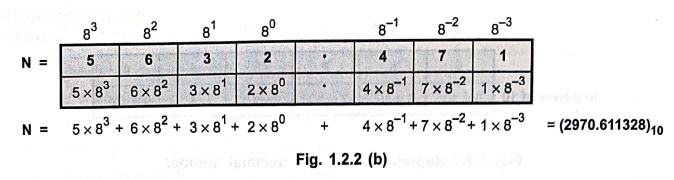
For example, the octal number 5632.471 can be represented in power of 8 as
shown in Fig. 1.2.2 (b).
•
By adding each digit of an octal number in a power of 8 we can find the decimal
equivalent of the given octal number.
N
= 5×83 + 6×82 + 3×81 + 2×80 +
4×8–1 + 7×8–2 + 1×8–3 = (2970.611328)10
4. Hexadecimal Number System
•
The hexadecimal number system has a base of 16 having 16 characters: 0, 1, 2,
3, 4, 5, 6, 7, 8, 9, A, B, C, D, E and F.
•
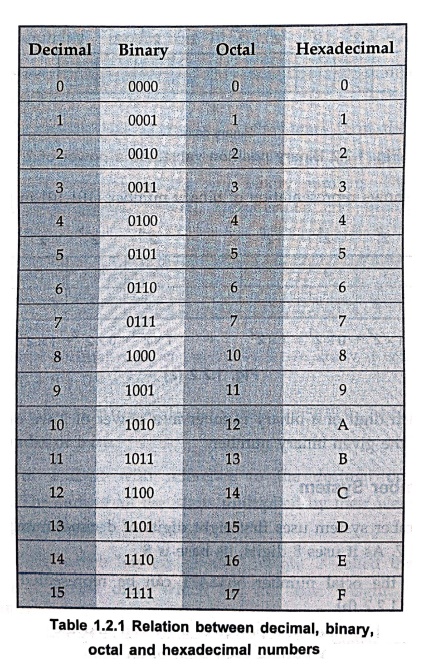
Table 1.2.1 shows the relationship between decimal, binary, octal and
hexadecimal.
•
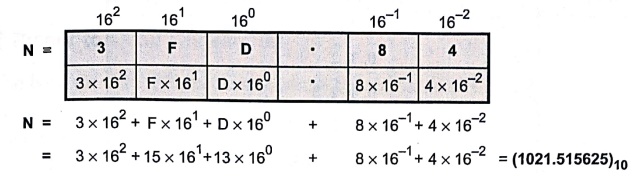
For example, 3FD.84 can be represented in power of 16 as shown below.
N
= 3 × 162 + F × 161 + D × 160 + 8 × 16–1 + 4 ×16–2
= 3 × 162 + 15 × 161
+ 13 × 160 + 8 × 16–1 + 4 ×16–2 = (1021.515625)10
•
By adding each digit of a hexadecimal number in a power of 16 we can find
decimal equivalent of the given hexadecimal number.
5. Format of a Binary Number
•
A single digit in the binary number is called bit.
•
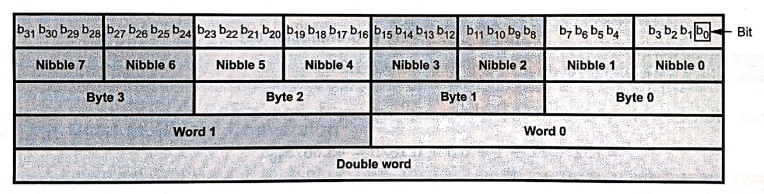
The following figure shows the format of binary number. Four binary digits form
a nibble, eight binary digits form a
byte, sixteen binary digits form a
word and thirty–two binary digits form a double–word.
Nibble :
4–bits can represent 24 = 16 distinct values
Byte :
8–bits can represent 28 = 256 distinct values
Word :
16–bits can represent 216 = 65536 distinct values
Double word :
32–bits can represent 232 = 4294967296 distinct values
6. Counting in Radix (Base) r
•
Each number system has r set of characters. For example, in decimal number
system r equals to 10 has 10 characters from 0 to 9, in binary number system r
equals to 2 has 2 characters 0 and 1 and so on.
•
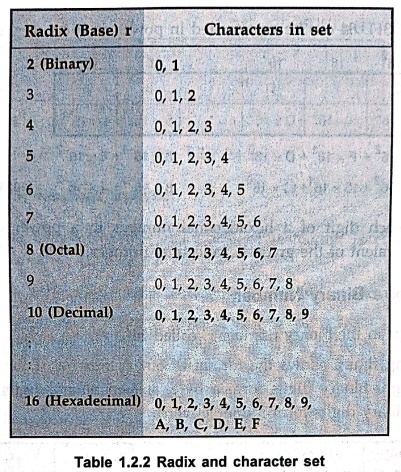
In general we can say that, a number represented in radix r, has r characters
in its set and r can be any value. This is illustrated in Table 1.2.2.
Example: 1
Find the decimal
equivalent of (231.23)4
Solution :
N
= 2 ×42 + 3×41 + 1×40 + 2×4–1 + 3×4–2
= 32 + 12 + 1 + 0.5 + 0.1875 = 45.687510
Example: 2
Count from 0 to 9 in
radix 5.
Solution :
Table
1.2.2 indicates that radix 5 has 5 characters. A count sequence from 0 decimal
to 9 decimal is
00,
01, 02, 03, 04, 10, 11, 12, 13, 14
Example: 3
What is the largest
binary number that can be expressed with 12–bits? What is the equivalent
decimal and hexadecimal ?
Solution :
(1111
1111 1111)2, (4095)10, (FFF)H .
Review Questions
1. Explain various
number systems.
2. Name the number
system used in computers.
Digital Principles and Computer Organization: Chapter 1: Fundamentals of Digital Systems and Arithmetic : Tag: Digital, Computer : - Number Systems
Digital Principles and Computer Organization: Chapter 1: Fundamentals of Digital Systems and Arithmetic
Under Subject
Digital Principles and Computer Organization
CS25C06 2nd Semester AIDS, CSE, IT, CSE(CY) Dept | 2025 Regulation | 2nd Semester 2025 Regulation
Related Subjects

English Essentials II
EN25C02 2nd Semester | 2025 Regulation | 2nd Semester 2025 Regulation

Tamils and Technology தமிழர்களும் தொழில்நுட்பமும்
UC25H02 2nd Semester | 2025 Regulation | 2nd Semester 2025 Regulation
Linear Algebra
MA25C02 2nd Semester | 2025 Regulation

Applied Physics (CSIE) II
PH25C03 2nd Semester AIDS, CSE, IT, CSE(CY) Dept | 2025 Regulation | 2nd Semester 2025 Regulation
Digital Principles and Computer Organization
CS25C06 2nd Semester AIDS, CSE, IT, CSE(CY) Dept | 2025 Regulation | 2nd Semester 2025 Regulation

Basic Electrical and Electronics Engineering
EE25C01 2nd Semester | 2025 Regulation | 2nd Semester 2025 Regulation
Python for Data Science
AD25201 2nd Semester AIDS Dept | 2025 Regulation | 2nd Semester 2025 Regulation

Re-Engineering for Innovation
ME25C05 2nd Semester | 2025 Regulation | 2nd Semester 2025 Regulation
Python for Data Science - Laboratory
AD25201 2nd Semester AIDS Dept | 2025 Regulation | 2nd Semester 2025 Regulation