Digital Principles and Computer Organization: Chapter 1: Fundamentals of Digital Systems and Arithmetic
Integer Arithmetic
1. Addition of Signed Numbers 2. Subtraction of Signed Numbers, 3. Binary Multiplication, 3. Binary Division
Integer Arithmetic
1. Addition and Subtraction of Signed Numbers
•
We can relate addition and subtraction operations of numbers by the following
relationship :
(A)
– (+B) = (A) + (–B) and
(A)
− (−B) = ( A) + (+B)
•
Therefore, we can change subtraction operation to an addition operation by
changing the sign of the subtrahend.
1. Binary Addition
•
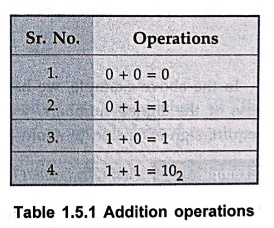
The addition consists of four possible elementary operations, as shown in Table
1.5.1.
•
The first three operations produce a sum whose length is one digit, but when
the last operation is performed sum is two digits.
•
The higher significant bit of this result is called a carry and lower significant bit is called sum.
•
Such a operation is known as half
addition.
•
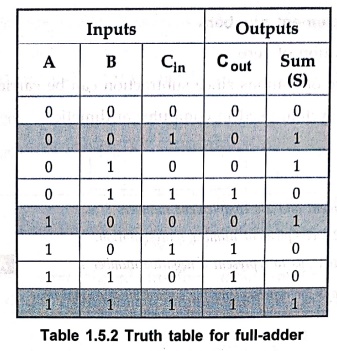
The operation which performs addition of three bits (two significant bits and a
previous carry) is called a full
addition.
•
Table 1.5.2 shows the truth table for full addition.
Addition method
1.
Add bits column–wise starting from LSB with carry if any.
2.
Put the sum at the bottom of the same column.
3.
Put the carry, if any, on the top of next column.
Example: 1
Perform addition of
(11001100)2 and (11011010)2.
Solution :
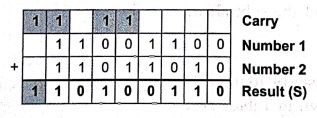
In
the above example, we have seen the addition of two unsigned binary numbers. In
case of the signed numbers, we have to consider the sign of the number and we
may require sign extension to avoid possible overflow.
Example:
2
Add (28)10
and (15)10 by converting them into binary.
Solution :
Using
decimal to binary conversion technique discussed in section 1.3.8 we have,
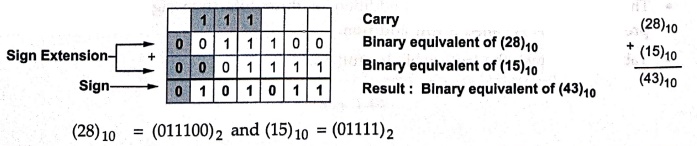
(28)10
= (011100)2 and (15)10
= (01111)2
2. Binary Subtraction
•
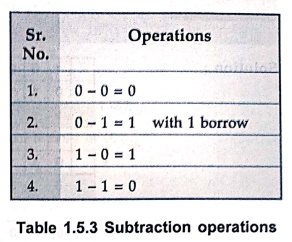
The subtraction consists of four possible elementary operations, as shown in
Table 1.5.3.
•
In all operations, each subtrahend bit is subtracted from the minuend bit. In
case of second operation the minuend bit is smaller than the subtrahend bit,
hence 1 is borrowed.
Subtraction method
1.
Subtract bits column–wise starting from LSB with borrow if any.
2.
Put the difference at the bottom of the same column.
3.
Take the borrow, if required from the next column.
Example: 3
Perform (11101100)2
−(00110010)2
Solution :
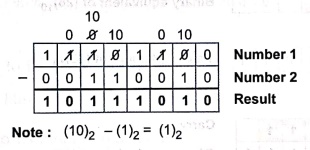
Note :
(10)2 – (1)2 = (1)2
•
However, the subtraction technique we have just seen is difficult to implement
in a computer. Thus, computer uses 2's complement representation to implement negative
number.
3. Binary Subtraction using 1's Complement Method
•
In a 1's complement subtraction, negative number is represented in the 1's
complement form and actual addition is performed to get the desired result.
•
For example, operation A – B is performed using following steps:
1.
Take 1's complement of B.
2.
Result← A + 1's complement of B.
3.
If carry is generated then the result is positive and in the true form. Add
carry to the result to get the final result.
4.
If carry is not generated then the result is negative and in the 1's complement
form.
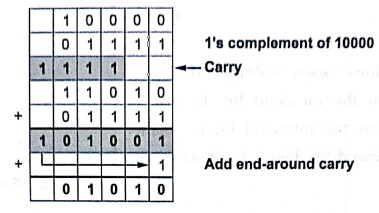
Example: 4
Perform subtraction
using 1's complement (11010)2– (10000)2.
Solution:
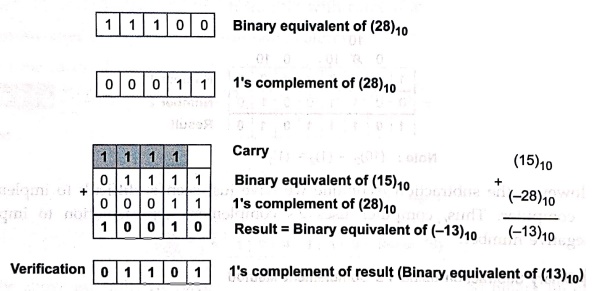
Example: 5
Perform (15)10
– (28)10 using 1's complement representation.
Solution :
(15)
10 = (01111)2
(28)
10 = (11100)2
4. Binary Subtraction using 2's
Complement Method
•
In a 2's complement subtraction, negative number is represented in the 2's
complement form and actual addition is performed to get the desired result.
•
For example, operation A – B is
performed using following steps :
1.
Take 2's complement of B.
2.
Result ← A + 2's complement of B.
3.
If carry is generated then the result is positive and in the true form. In this
case, carry is ignored.
4.
If carry is not generated then the result is negative and in the 2's complement
form.
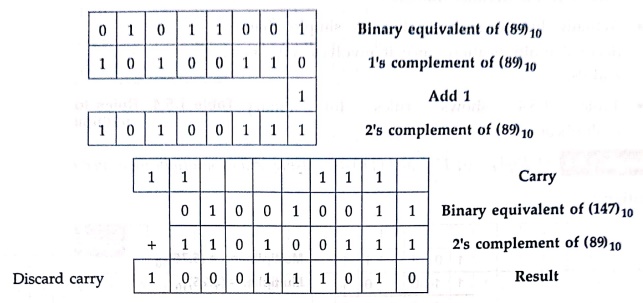
Example: 6
Perform (147–89) using
2's complement binary arithmetic.
Solution :
Example: 7
Using 2's complement
perform (42)10 – (68)10.
Solution :
Step 1 :
Convert
(42)10 to its binary equivalent.
(42)10
= (101010)2
Step 2 :
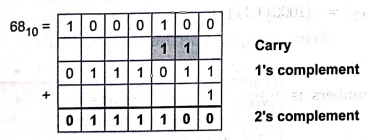
Convert
6810 to its binary equivalent.
6810
= (1000100)2
Step 3 :
Find
2's complement of 68.
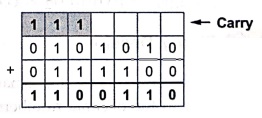
Step 4 :
Add
(1 0 1 0 1 0)2 and
(0
1 1 1 1 0 0)2
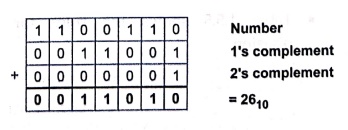
Step 5 :
Find
2's complement of (1100110)2.
Since
we have taken 2's complement result is (–26)10.
Since
we have subtracted larger number from smaller number result is negative and
hence it is necessary to take 2's complement of this result.
2. Binary Multiplication
•
The multiplication process for binary numbers is similar to the decimal
numbers.
•
Actually binary multiplication is simple than decimal multiplication since it
involves only 1s and 0s.
•
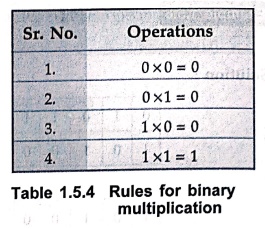
Table 1.5.4 shows rules for binary multiplication
Example: 8
Multiply (101.11)2
and (110.01)2 using binary multiplication method.
Solution:
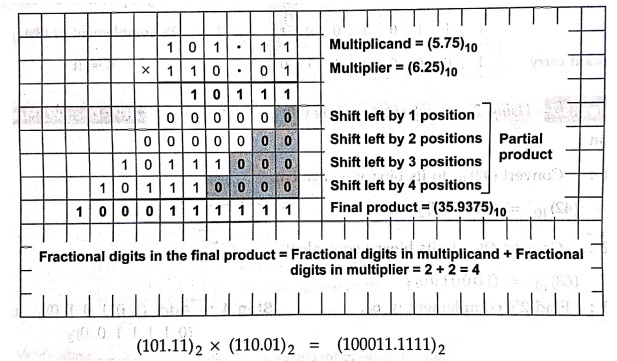
Fractional
digits in the final product = Fractional digits in multiplicand + Fractional digits in multiplier = 2 + 2 = 4
(101.11)2
× (110.01)2 = (100011.1111)2
3. Binary Division
•
The division process for binary numbers is similar to the decimal numbers.
•
In binary division, division by 0 has no meaning.
•
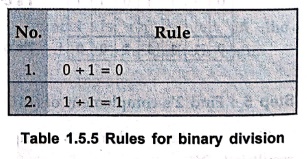
Table 1.5.5 shows the rules for binary division
Example: 9
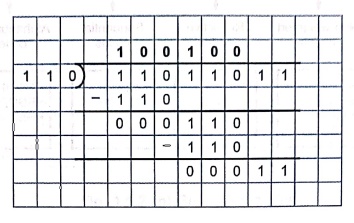
Divide 110110112
by 1102.
Solution :
Review Questions
1. Illustrate the
rules for binary addition and subtraction using 2's complement arithmetic. Give
examples.
2. State the rules for
binary multiplication.
3. State the rules for
binary division.
Digital Principles and Computer Organization: Chapter 1: Fundamentals of Digital Systems and Arithmetic : Tag: Digital, Computer : - Integer Arithmetic
Digital Principles and Computer Organization: Chapter 1: Fundamentals of Digital Systems and Arithmetic
Under Subject
Digital Principles and Computer Organization
CS25C06 2nd Semester AIDS, CSE, IT, CSE(CY) Dept | 2025 Regulation | 2nd Semester 2025 Regulation
Related Subjects

English Essentials II
EN25C02 2nd Semester | 2025 Regulation | 2nd Semester 2025 Regulation

Tamils and Technology தமிழர்களும் தொழில்நுட்பமும்
UC25H02 2nd Semester | 2025 Regulation | 2nd Semester 2025 Regulation
Linear Algebra
MA25C02 2nd Semester | 2025 Regulation
Applied Physics (CSIE) II
PH25C03 2nd Semester AIDS, CSE, IT, CSE(CY) Dept | 2025 Regulation | 2nd Semester 2025 Regulation
Digital Principles and Computer Organization
CS25C06 2nd Semester AIDS, CSE, IT, CSE(CY) Dept | 2025 Regulation | 2nd Semester 2025 Regulation

Basic Electrical and Electronics Engineering
EE25C01 2nd Semester | 2025 Regulation | 2nd Semester 2025 Regulation
Python for Data Science
AD25201 2nd Semester AIDS Dept | 2025 Regulation | 2nd Semester 2025 Regulation

Re-Engineering for Innovation
ME25C05 2nd Semester | 2025 Regulation | 2nd Semester 2025 Regulation
Python for Data Science - Laboratory
AD25201 2nd Semester AIDS Dept | 2025 Regulation | 2nd Semester 2025 Regulation