Applied Chemistry I: UNIT 2: Nanochemistry
Classification (or) Types of Nano Materials
Examples, Applications, Properties, Uses, Structures
Based on dimensions, nano materials are classified in to four types. 1. Nanoparticles 2. Nanoclusters 3. Nanowire 4. Nanorods 5. Nanotubes
CLASSIFICATION (OR) TYPES OF NANO
MATERIALS
Based on dimensions,
nano materials are classified in to four types.
1. Nanoparticles
2. Nanoclusters
3. Nanowire
4. Nanorods
5. Nanotubes
1. Nanoparticles
Nanoparticles are the
particles, the size of which ranges from 1 to 100 nm. These are tiny aggregates
of atoms but smaller than their crystals but bigger than molecules.
Examples
TiO2, gold,
silver, ZnO, etc.,
Properties of nanoparticles
1. Nanoparticles have
anti‒reflective properties, so they can be used as a hard coatings on eye
glasses.
2. Hard nanoparticles
increase the reinforcement of soft polymers to stronger plastics.
3. Nanoparticles are
manipulated by the use of magnetic field, so self‒agglomeration can be
prevented.
4. Absorption of solar
radiation in photovoltaic cell is much higher in nanoparticles than in thin
film of bulk materials.
5. Nanoparticles have
enhanced diffusion at elevated temperatures. Due to this property, sintering
occurs at lower temperature than the larger particles.
Applications of Nanoparticles
1. TiO2 is
used in cosmetics as they are very good UV absorber.
2. Nano silver
particles are used as a catalyst in industries.
3. Nanoparticles are
used in medicine.
4. Nano silver
particles are used in making bone cement, surgical instruments, etc.,
2. Nanoclusters
Nanoclusters are fine
aggregates of atoms (or) molecules. The size of which ranges from 0.1 to 10 nm.
Of all the nano materials, nanoclusters are the smallest sized nano materials
because of their close packing arrangement of atoms.
Examples:
CdS,
ZnO, etc.,
All the atoms, in
nanocluster, are bound by forces like metallic, covalent, ionic, hydrogen bond
(or) Vander Waals forces of attraction. Clusters of certain critical size are
more stable than others. Nanoclusters consisting of up to a couple of hundred
atoms, but larger aggregates, containing 103 (or) more atoms, are
called nanoparticles.
Magic number
Magic number is the
number of atoms present in the clusters of criticle sizes with higher
stability.
Different types of
nanoclusters can be distinguished from the nature of forces present between
atoms. Generally clusters containing transition metal atom have unique
chemical, electronic and magnetic properties. These properties vary with the
number of constituent atoms, the type of element and the net charge on the
cluster.
Properties of nanoclusters
1. Atomic clusters (or)
molecular clusters are formed by the nucleation of atoms (or) molecules
respectively.
2. The reactivity of nanoclusters
are decreased due to their decrease in size.
3. The melting point of
nanoclusters are lower than the bulk materials due to high surface to volume ratio.
4. The electronic
structure of the nanocluster is more confined than the bulk materials.
Applications of nanocluster
1. Nanoclusters are
used as catalysts in many reactions.
2. It is used in nano
based chemical sensors.
3. It is also used as a
light emitting diode in quantum computers.
3. Nanorods
Nanorod is one
dimensional cylindrical solid material having an aspect ratio i.e., length to
width ratio less than 20.
Examples
Zinc oxide, Cadmium
sulphide, Gallium nitride nano rods.
Synthesis of nanorods
Nano‒rods are produced
by direct chemical synthesis. A combination of ligands act as shape control
agents and bond to different facets of the nano‒rods with different strength.
This allows different
nanorods to grow at different rates producing an elongated objects. Many of the
above nanorods are not manufactured due to lack of commercial demand.
Properties of nanorods
1. Nanorods are one‒dimensional
materials.
2. It exhibits optical
and electrical properties.
Applications of nanorods
1. Nanorods find
application in display technologies.
2. It is also used in
the manufacturing of micro mechanical switches.
3. Nanorods are used in
an applied electric field, micro electro mechanical systems, etc.,
4. Nanorods along with
noble metal nanoparticles function as theragnostic agents.
5. They are used in
energy harvesting and light emitting devices.
6. Nanorods have used
as cancer therapeutics.
4. Nanowires
Nanowire is one
dimensional cylindrical solid material having an aspect ratio ie., length to
width ratio greater than 20. Diameter of the nanowire ranges from 10 ‒ 100 nm.
Examples : Different types of nanowires
Types of nanowires
1. Metallic nanowires‒ Examples:
Au, Ni, Pt
2. Nanowires of
semiconductors ‒ Examples: InP, Si, GaN
3. Nanowires of
insulators ‒ Examples: SiO2, TiO2
4. Molecular nanowires ‒
Examples: DNA
Synthesis of Nanowires
1.
Template‒assisted synthesis
Template assisted
synthesis of nanowires is a simple way to fabricate nanostructures. These
templates contain very small cylindrical pores (or) voids within the host
material and the empty spaces are filled with the chosen material to form
nanowires.
2.
VLS (Vapour Liquid ‒ Solid) method
It involves the
absorption of the source material from the gas phase into a liquid phase of catalyst.
Upon supersaturation of the liquid alloy, a nucleation event generates a solid
precipitate of the source material. This seed serves as a preferred site for
further deposition of material at the interface of the liquid droplet,
promoting the elongation of the seed into a nanowire.
Properties of nanowires
1. Nanowires are one‒dimensional
material.
2. Conductivity of a
nanowire is less than that of the corresponding bulk materials.
3. It exhibits distinct
optical, chemical, thermal and electrical properties due to this large surface
area.
4. Silicon nanowires
show strong photoluminescence characteristics.
Uses of nanowires
1. Nanowires are used
for enhancing mechanical properties of composites.
2. It is also used to
prepare active electronic components such as p‒n junction and logic gates.
3. Semiconductor
nanowire crossings are expected to play a important role in future of digital
computing.
4. Nanowires find
applications in high‒density data storage either as magnetic read heads (or) as
patterned storage media.
5. Nanowires replace
conventional copper wires used in computers, televisions.
6. It is also used to
link tiny components into very small circuits.
5. Nanotubes
Nanotubes are tube like
structures with diameter of 1‒100 nm and a length of few nm to microns.
Nanotubes consist of tiny cylinders of carbon and other materials like boron
nitride. Nanotubes may be organic (or) inorganic.
Examples
1. Carbon nanotube
2. Silicon nanotube
3. DNA nanotube
4. Boron nitride
nanotube
1. Carbon nanotubes (CNTs)
Carbon nanotube is a
tubular form of carbon with 1‒3 nm diameter and a length of few nm to microns.
Generally carbon in the
solid phase exits in different allotropic forms like graphite, diamond,
fullerence and nano tubes.
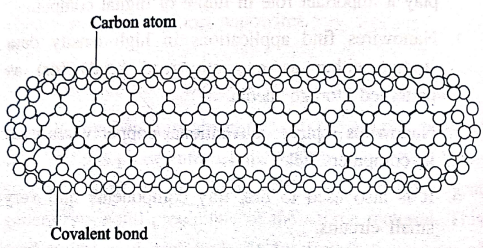
Carbon nanotubes are
tubular forms of carbon. When graphite sheets are rolled into a cylinder, their
edges join to each other form carbon nanotubes. Each carbon atom in the carbon
nanotubes is linked by covalent bonds. But the number of nanotubes align into
ropes and are held together by weak Vander Walls forces.
Structures (or) types of carbon nanotubes
Depending upon the way
in which graphite sheets are rolled, two types of CNTs are formed.
1. Single‒walled
nanotubes (SWNTs).
2. Multi‒walled
nanotubes (MWNTs).
1. Single‒walled nanotubes (SWNTs)
SWNTs consist of one
tube of graphite. It is one‒atom thick having a diameter of 2 nm and a length
of 100 μm. SWNTs are very important, because they exhibit important electrical
properties. It is an excellent conductor.
Three kinds of
nanotubes are resulted, based on the orientation of the hexagon lattice.
(a)
Arm‒chair structures: The lines of hexagons are parallel to
the axis of the nanotube.
(b)
Zig‒zag structures: The lines of carbon bonds are down the
centre.
(c)
Chiral nanotubes: It exhibits twist (or) spiral around
the nanotubes.

It has been confirmed
that arm‒chair carbon nanotubes are metallic while zig‒zag and chiral nanotubes
are semiconducting.
2. Multi ‒ walled nanotubes (MWNTs)
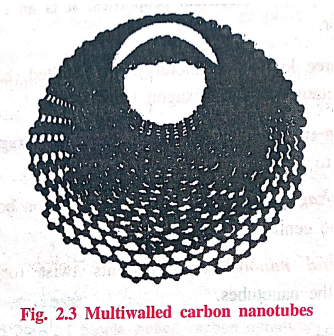
MWNTs (nested
nanotubes) consist of multiple layers of graphite rolled in on themselves to
form a tube shape. It exhibits both metallic and semiconducting properties. It
is used for storing fuels such as hydrogen and methane.
Synthesis (or) Fabrication of Carbon Nanotubes
Carbon nanotubes can be
synthesized by the following methods.
1. Pyrolysis of
hydrocarbons.
2. Laser evaporation.
1.
Pyrolysis
Carbon nanotubes are
synthesized by the pyrolysis of hydrocarbons such as acetylene at about 700°C
in the presence of Fe‒silica (or) Fe‒graphite catalyst under inert conditions.
2.
Laser evaporation
It involves
vapourization of graphite target, containing small amount of cobalt and nickel,
by exposing it to an intense pulsed laser beam at higher temperature (1200°C)
in a quartz tube reactor. An inert gas such as argon (or) helium is
simultaneously allowed to pass into the reactor to sweep the evaporated carbon
atoms from the furnace to the colder copper collector, on which they condense
as carbon nanotubes.

Properties of CNTs
1. CNTs are very
strong, withstand extreme strain in tension and posses elastic flexibility.
2. The atoms in a nano‒tube
are continuously vibrating back and forth.
3. It is highly
conducting and behaves like metallic (or) semiconducting materials.
4. It has very high
thermal conductivity and kinetic properties.
Uses of CNTs
1. It is used in
battery technology and in industries as catalyst.
2. It is also used as
light weight shielding materials for protecting electronic equipments.
3. CNTs are used
effectively inside the body for drug delivery.
4. It is used in
composites, ICs.
5. It also acts as an
efficient catalysts for some chemical reactions.
6. It acts as a very
good biosensor. Due to its chemical inertness carbon nanotubes are used to
detect many molecules present in the blood.
7. It is also used in
water softening process as a filter.
Applied Chemistry I: UNIT 2: Nanochemistry : Tag: Applied Chemistry : Examples, Applications, Properties, Uses, Structures - Classification (or) Types of Nano Materials
Applied Chemistry I: UNIT 2: Nanochemistry
Under Subject

Applied Chemistry I
CY25C01 1st Semester | 2025 Regulation | 1st Semester 2025 Regulation
Related Subjects

English Essentials I
EN25C01 1st Semester | 2025 Regulation | 1st Semester 2025 Regulation

தமிழர் மரபு - Heritage of Tamils
UC25H01 1st Semester | 2025 Regulation | 1st Semester 2025 Regulation
Applied Calculus
MA25C01 Maths 1 M1 - 1st Semester | 2025 Regulation | 1st Semester 2025 Regulation
Applied Physics I
PH25C01 1st Semester | 2025 Regulation | 1st Semester 2025 Regulation
Applied Chemistry I
CY25C01 1st Semester | 2025 Regulation | 1st Semester 2025 Regulation
Makerspace
ME25C04 1st Semester | 2025 Regulation | 1st Semester 2025 Regulation
Computer Programming C
CS25C01 1st Semester | 2025 Regulation | 1st Semester 2025 Regulation

Computer Programming Python
CS25C02 1st Semester | 2025 Regulation | 1st Semester 2025 Regulation
Fundamentals of Electrical and Electronics Engineering
EE25C03 1st Semester | 2025 Regulation | 1st Semester 2025 Regulation
Introduction to Mechanical Engineering
ME25C03 1st Semester | 2025 Regulation | 1st Semester 2025 Regulation

Introduction to Civil Engineering
CE25C01 1st Semester Civil Department | 2025 Regulation | 1st Semester 2025 Regulation
Essentials of Computing
CS25C03 1st Semester - AID CSE IT Department | 2025 Regulation | 1st Semester 2025 Regulation

Applied Physics I Laboratory
PH25C01 1st Semester practical Laboratory Manual | 2025 Regulation | 1st Semester Laboratory 2025 Regulation

Applied Chemistry I Laboratory
CY25C01 1st Semester practical Laboratory Manual | 2025 Regulation | 1st Semester Laboratory 2025 Regulation

Computer Programming C Laboratory
CS25C01 1st Semester practical Laboratory Manual | 2025 Regulation | 1st Semester Laboratory 2025 Regulation

Computer Programming Python Laboratory
CS25C02 1st Semester practical Laboratory Manual | 2025 Regulation | 1st Semester Laboratory 2025 Regulation
Engineering Drawing
ME25C01 EEE Mech Dept | 2025 Regulation | 2nd Semester 2025 Regulation

Basic Electronics and Electrical Engineering
EE25C04 1st Semester ECE Dept | 2025 Regulation | 2nd Semester 2025 Regulation