Applied Chemistry I: UNIT 2: Nanochemistry
Size Dependent Properties
Nanochemistry
Important Properties of Nanomaterials: 1. Electrical Properties 2. Optical Properties 3. Mechanical properties 4. Magnetic properties
SIZE DEPENDENT PROPERTIES
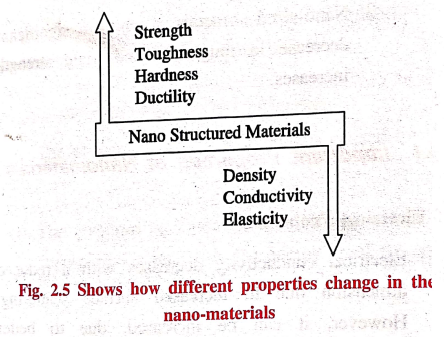
Nearly all the
properties as shown in figure 2.5, like hardness, strength, ductility, melting
point and density, change for nanomaterials. These behaviors vary so
significantly by a mere reduction in grain size. Nanomaterials are composed of
grains and grain boundaries. Nanometre sized grains contains only a few
thousands of atoms with in each grain.
A large number of atoms
reside at the grain boundaries. As the grain size decreases, there is a
significant increase in the volume fraction of grain boundaries (or)
interfaces.
The properties of the
materials are bound to be governed to a large extent by defect configurations.
Hence the mechanical and chemical properties of nanomaterials are significantly
altered due to defect dynamics. The elastic property of nanomaterials are
different from that of bulk alloys due to the presence of increased fraction of
defects.
Examples
1. Nanocrystalline
ceramics are tougher and stronger than those with coarse grains.
2. Nano‒sized metals
exhibit significant decrease in toughness and yield strength increases.
Important Properties of Nanomaterials
1. Electrical Properties
(i) Electrical
conductivity decreases with a reduced dimension due to increased surface
scattering. However, it can be increased, due to better ordering in micro‒structure.
Example: Polymeric fibres.
(ii) Nanocrystalline
materials are used as very good separator plates in batteries, because they can
hold more energy than the bulk materials.
Example: Nickel‒metal hydride
batteries made of nanocrystalline nickel and metal hydride, require far less
frequent recharging and last much longer.
2. Optical Properties
Reduction of material
dimensions has pronounced effects on the optical properties. Optical properties
of nano‒materials are different from bulk forms.
Reason for change in optical properties
The change in optical
properties is caused by two factors
(i) The quantum
confinement of electrons within the nano‒particles increases the energy level
spacing.
Example: The optical
absorption peak of a semiconductor nano‒particles shifts to a short wavelength,
due to an increased band gap.
(ii) Surface plasma
resonance, which is due to smaller size of nano‒particles than the wavelength
of incident radiation.
Example: The colour of
metallic nano‒particles may change with their sizes due to surface plasma
resonance.
3. Mechanical properties
The nano‒materials have
less defects compared to bulk materials, which increases the mechanical
strength.
(i) Mechanical properties
of polymeric materials can be increased by the addition of nano‒fillers.
(ii) As nano‒materials
are stronger, harder and more wear resistant and corrosion resistant, they are
us they are used in spark plugs.
Example: Nano‒crystalline
carbides are much stronger, harder and wear resistant and are used in micro
drills.
4. Magnetic properties
Magnetic properties of
nano materials are different from that of bulk materials. Ferro‒magnetic
behaviour of bulk materials disappear, when the particle size is reduced and
transfers to super‒paramagnetics. This is due to the huge surface area.
Applied Chemistry I: UNIT 2: Nanochemistry : Tag: Applied Chemistry : Nanochemistry - Size Dependent Properties
Applied Chemistry I: UNIT 2: Nanochemistry
Under Subject

Applied Chemistry I
CY25C01 1st Semester | 2025 Regulation | 1st Semester 2025 Regulation
Related Subjects

English Essentials I
EN25C01 1st Semester | 2025 Regulation | 1st Semester 2025 Regulation

தமிழர் மரபு - Heritage of Tamils
UC25H01 1st Semester | 2025 Regulation | 1st Semester 2025 Regulation
Applied Calculus
MA25C01 Maths 1 M1 - 1st Semester | 2025 Regulation | 1st Semester 2025 Regulation
Applied Physics I
PH25C01 1st Semester | 2025 Regulation | 1st Semester 2025 Regulation
Applied Chemistry I
CY25C01 1st Semester | 2025 Regulation | 1st Semester 2025 Regulation

Makerspace
ME25C04 1st Semester | 2025 Regulation | 1st Semester 2025 Regulation
Computer Programming C
CS25C01 1st Semester | 2025 Regulation | 1st Semester 2025 Regulation

Computer Programming Python
CS25C02 1st Semester | 2025 Regulation | 1st Semester 2025 Regulation
Fundamentals of Electrical and Electronics Engineering
EE25C03 1st Semester | 2025 Regulation | 1st Semester 2025 Regulation
Introduction to Mechanical Engineering
ME25C03 1st Semester | 2025 Regulation | 1st Semester 2025 Regulation

Introduction to Civil Engineering
CE25C01 1st Semester Civil Department | 2025 Regulation | 1st Semester 2025 Regulation
Essentials of Computing
CS25C03 1st Semester - AID CSE IT Department | 2025 Regulation | 1st Semester 2025 Regulation

Applied Physics I Laboratory
PH25C01 1st Semester practical Laboratory Manual | 2025 Regulation | 1st Semester Laboratory 2025 Regulation

Applied Chemistry I Laboratory
CY25C01 1st Semester practical Laboratory Manual | 2025 Regulation | 1st Semester Laboratory 2025 Regulation

Computer Programming C Laboratory
CS25C01 1st Semester practical Laboratory Manual | 2025 Regulation | 1st Semester Laboratory 2025 Regulation

Computer Programming Python Laboratory
CS25C02 1st Semester practical Laboratory Manual | 2025 Regulation | 1st Semester Laboratory 2025 Regulation
Engineering Drawing
ME25C01 EEE Mech Dept | 2025 Regulation | 2nd Semester 2025 Regulation

Basic Electronics and Electrical Engineering
EE25C04 1st Semester ECE Dept | 2025 Regulation | 2nd Semester 2025 Regulation