Digital Principles and Computer Organization: Chapter 3: Computer System
Performance Metrics: MIPS, MFLOPS, CPI, Throughput
1. Defining Performance 2. CPU Execution Time 3. Basic Performance Equation 4. Performance Metrics: MIPS (Million Instructions Per Second), MFLOPS (Million Floating-Point Operations Per Second), CPI (Cycles Per Instruction), Throughput 5. Components Affecting Computer Performance. Questions: 1. What is performance? 2. Define response time and execution time. 3. What is user CPU time and system CPU time? 4. Explain the concept of relative performance with the help of example. 5. State the basic performance equation. 6. State the performance factors. 7. State the components that affects the factors in the CPU performance equation and reason behind it. 8. State the CPU performance equation and discuss the factors that affect performance. 9. Explain the important measures of the performance of a computer and derive the basic performance equation. 10. Define MIPS. 11. Define MFLOPS. 12. What is throughput?
Performance Metrics :
MIPS, MFLOPS, CPI, Throughput
•
Performance is one of the most important attributes of a computer. It is a key
criterion in selecting a system for any application, whether it is for personal
use, scientific computation, or large–scale server operations. Since users and
organizations often compare systems, it becomes essential to define performance
clearly and to establish standard ways of measuring it.
•
There are many ways to evaluate computer performance. Some metrics emphasize
speed, while others focus on efficiency, throughput, or specific computational capabilities.
In this section, we define performance, study the methods of measurement, and
also point out the limitations of these measurements.
1. Defining Performance
•
When we say one computer is faster than another, we compare their speeds and
observes that the faster computer runs a program in less time than other
computers.
•
The computer center manager running a large server system may say a computer is
faster when it completes more jobs in an hour.
•
The computer user is always interested in reducing the time between the start
and the completion of the program or
event, i.e. reducing the execution time.
•
The execution time is also referred to as response
time. Reduction in response time increases the throughput (the total amount of work done in a given time). The
performance of the computer is directly related to throughput and hence it is
reciprocal of execution time.
PerformanceA
= 1 / Execution time A
•
This means that for two computers A and B if the performance of A is greater
than the performance of B, we have
Performance
A > Performance B
1
/ Execution time A ˃ 1 / Execution time B
Execution time B > Execution time A
•
That is, the execution time on B is longer than that on A, if A is faster than
B.
•
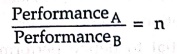
In discussing a computer design, we often want to relate the performance of two
different computers quantitatively. We will use the phrase "A is n times
faster than B" or equivalently "A is n times as fast as B" to
mean.
Performance
A / Performance B = n
•
If A is n times faster than B then the execution time on B is n times longer
than it is on A :

Performance
A / Performance B = Execution time B / Execution time A = n
Example: 1
If computer A runs a
program in 10 seconds and computer B runs the same program in 25 seconds, how
much faster is A than B ?
Solution :
We know that A is n times faster than B if
Performance
A / Performance B = Execution time B / Execution time A = n
Thus
the performance ratio is
25
/ 10 = 2.5
and
A is therefore 2.5 times faster than B.
•
In the above example, we could also say that computer B is 2.5 times slower
than computer A, since
Performance
A / Performance B =
2.5
mean
that
Performance
A / 2.5 = Performance B
•
For simplicity, we will normally use the terminology faster than when we try to
compare computers quantitatively. Because performance and execution time are
reciprocals, increasing performance requires decreasing execution time. To
avoid the potential confusion between the terms increasing and decreasing, we
usually say "improve performance" or "improve execution
time" when we mean "increase performance" and "decrease
execution time".
2. CPU Execution Time
•
The most widely used performance measure is CPU execution time, or simply CPU
time. This is the amount of time the CPU spends computing for a particular
task. It excludes waiting time for input/output (I/O) operations and time spent
running other programs.
•
CPU time can be divided into :
■ User CPU time –
The time spent running the actual program instructions.
■
System CPU time – The time spent by
the operating system on behalf of the program.
•
Since it is difficult to assign system time accurately to a single program, CPU
performance generally refers to user CPU
time.
3. Basic Performance Equation
•
The execution time of a program depends on three key factors :
1.
The number of instructions in the
program (N)
2.
The average number of cycles per
instruction (CPI)
3.
The clock cycle time (or,
equivalently, the clock rate R)
•
The relationship is given by the basic performance equation :
T
= N×CPI / R = N×CPI / Clock rate = N × CPI × Clock cycle time
where
CPI : The average number of clock cycles each instruction takes to execute.
It
is given by
CPI
= CPU clock cycles / Instruction count
N
: Number of instructions.
R
: Clock rate measured in clocks/second.
•
This equation shows that performance can be improved by :
■
Reducing the number of instructions executed,
■
Lowering the average CPI, or
■
Increasing the clock rate.
Example: 2
Consider three
different processors, P1, P2 and P3, executing the same instruction set. P1 has
a 3 GHz clock rate and a CPI of 1.5. P2 has a 2.5 GHz clock rate and a CPI of
1.0. P3 has a 4.0 GHz clock rate and has a CPI of 2.2.
a) Which processor has
the highest performance expressed in instructions per second?
b) If the processors
each execute a program in 10 seconds, find the number of cycles and the number
of instructions executed on each processor.
Solution :
Three processors P1, P2, and P3
execute the same instruction set. Their characteristics are :
• P1 :
Clock rate = 3.0 GHz, CPI = 1.5
• P2 :
Clock rate = 2.5 GHz, CPI = 1.0
• P3 :
Clock rate = 4.0 GHz, CPI = 2.2
a)
P2 has the highest performance.
Performance
of P1 (instructions/sec) = 3×10⁹ / 1.5 = 2×10⁹
Performance
of P2 (instructions/sec) = 2.5×10⁹ / 1.0 = 2.5×10⁹
Performance
of P3 (instructions/sec) = 4.0 ×10⁹ / 2.2 = 1. 82
× 109
b)
Number of cycles = Time ×Clock rate
Cycles
(P1)= 10×3×109 = 30×109
Cycles
(P2) = 10×2.5×109 = 25×109
Cycles
(P3) = 10×4.0×109 = 40×109
Time
= (Number of instructions × CPI) / Clockrate
Number
of instructions = (Time × Clock rate) / CPI
= Number of cycles / CPI
No.
of Instructions (P1) = 30×109 / 1.5 = 20×109
No.
of Instructions (P2) = 25×109 / 1.0 = 25×109
No.
of Instructions (P3) = 40×109 / 2.2 = 18.18×10⁹
Example: 3
Consider two different
implementations of the same instruction set architecture. The instructions can
be divided into four classes according to their CPI (class A, B, C and D). P1
with a clock rate of 2.5 GHz and CPIs of 1, 2, 3 and 3 respectively and P2 with
a clock rate of 3 GHz and CPIs of 2, 2, 2 and 2 respectively. Given a program
with a dynamic instruction count of 1.0x10⁶ instructions divided
into classes as follows : 10 % class A, 20 % class B, 50% class C and 20 %
class D, which implementation is faster? What is the global CPI for each
implementation? Find the clock cycles required in both cases.
Solution :
a)
Class A : 105 instruction, Class B : 2×10⁵ instruction,
Class C : 5×10⁵ instruction, Class D : 2x10⁵ instruction.
Time
= No. of instructions × CPI/Clock rate
Total
time P1 = (105 + 2×105 × 2 + 5×105×3 + 2×105×3)
/ (2.5×10⁹)
= 10.4×10⁻⁴s
Total
time P2 = (105×2+2×105 ×2+5×105×2+2×105×2)
/ (3×10⁹)
= 6.66×10⁻⁴s
CPI
(P1) 10.4×10–4×2.5×109 / 106 = 2.6
CPI
(P2) = 6.66×10–4×3×109 / 106 = 2.0
P2
implementation is faster.
b)
Clock cycles (P1) = 105 ×1+2×105 × 2+5×105 ×3+2×105×3
= 26×105
Clock
cycles (P2) = 105 ×2+2×105 × 2+5×105×2+2×105
×2 = 20×105
4. Performance Metrics
•
To evaluate and compare processors, several specific performance metrics are
commonly used. Each metric captures a different aspect of system performance.
1. MIPS (Million Instructions Per Second)
•
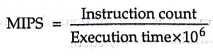
MIPS measures how many millions of instructions a processor can execute per the
second :
MIPS
= Instruction count / (Execution time ×106)
•
It provides a simple measure of speed but does not account for instruction
complexity. Different instruction sets may require different numbers of cycles,
making MIPS an incomplete metric for cross–architecture comparisons.
2. MFLOPS (Million Floating–Point Operations Per Second)
•
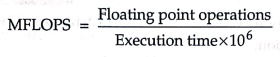
MFLOPS measures how many millions of floating–point operations a system can
perform per second. It is particularly relevant in scientific and engineering
applications where floating–point calculations dominate.
MFLOPS
= Floating point operations / (Execution time ×106)
3. CPI (Cycles Per Instruction)
•
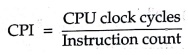
CPI represents the average number of clock cycles required to execute one instruction
:
CPI
= Total CPU cycles / Instruction count
•
A smaller CPI value indicates better efficiency, since fewer cycles are needed
per instruction.
4. Throughput
•
Throughput measures the number of tasks, jobs, or instructions completed per
unit time. For example, if a processor executes 5 instructions per nanosecond,
the throughput is 5 instructions/ns.
•
High throughput means that the system can handle a greater workload in less
time.
5. Components Affecting Computer Performance
•
The performance of a computer system cannot be assessed by considering only a
single factor such as clock rate, CPI, or instruction count. Instead,
performance depends on the combined effect of several interrelated factors.
While comparing two systems, all components of performance must be carefully
examined, must be carefully examined especially when some of the factors are
identical. Since CPI varies the instruction mix (the dynamic frequency of
different instructions in a program), both CPI
and instruction count must be
evaluated, even if the clock rates are the same. Furthermore, program
performance is also influenced by the algorithm used, the programming language,
the compiler, the instruction set architecture, and the actual hardware.
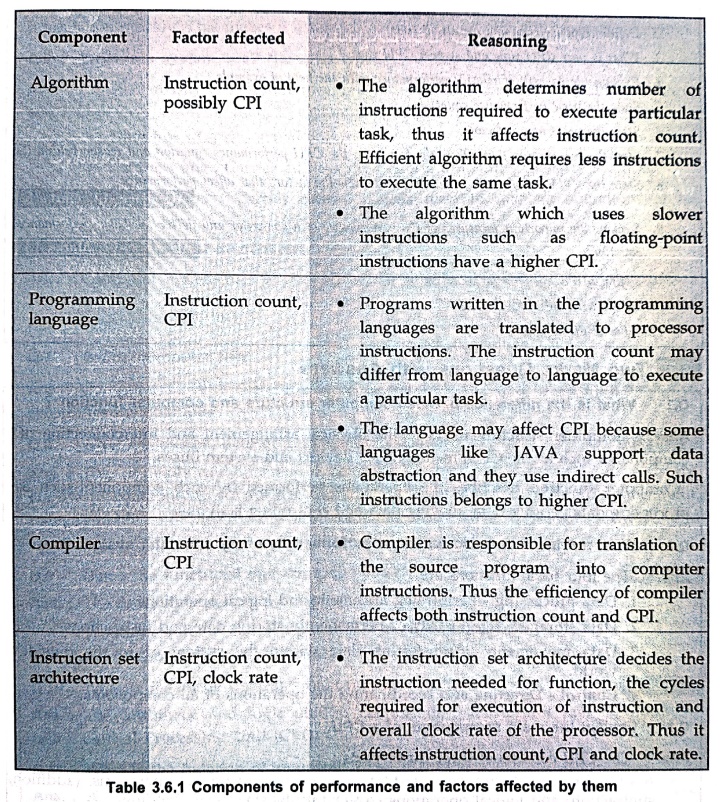
•
Table 3.6.1 summarizes the components that influence computer performance and
the specific factors they affect in the CPU performance equation.
Review Questions
1. What is
performance?
2. Define response
time and execution time.
3. What is user CPU
time and system CPU time?
4. Explain the concept
of relative performance with the help of example.
5. State the basic
performance equation.
6. State the
performance factors.
7. State the
components that affects the factors in the CPU performance equation and reason
behind it.
8. State the CPU
performance equation and discuss the factors that affect performance.
9. Explain the
important measures of the performance of a computer and derive the basic
performance equation.
10. Define MIPS.
11. Define MFLOPS.
12. What is
throughput?
Digital Principles and Computer Organization: Chapter 3: Computer System : Tag: : - Performance Metrics: MIPS, MFLOPS, CPI, Throughput
Digital Principles and Computer Organization: Chapter 3: Computer System
Under Subject
Digital Principles and Computer Organization
CS25C06 2nd Semester AIDS, CSE, IT, CSE(CY) Dept | 2025 Regulation | 2nd Semester 2025 Regulation
Related Subjects

English Essentials II
EN25C02 2nd Semester | 2025 Regulation | 2nd Semester 2025 Regulation

Tamils and Technology தமிழர்களும் தொழில்நுட்பமும்
UC25H02 2nd Semester | 2025 Regulation | 2nd Semester 2025 Regulation

Linear Algebra
MA25C02 2nd Semester | 2025 Regulation

Applied Physics (CSIE) II
PH25C03 2nd Semester AIDS, CSE, IT, CSE(CY) Dept | 2025 Regulation | 2nd Semester 2025 Regulation
Digital Principles and Computer Organization
CS25C06 2nd Semester AIDS, CSE, IT, CSE(CY) Dept | 2025 Regulation | 2nd Semester 2025 Regulation

Basic Electrical and Electronics Engineering
EE25C01 2nd Semester | 2025 Regulation | 2nd Semester 2025 Regulation

Python for Data Science
AD25201 2nd Semester AIDS Dept | 2025 Regulation | 2nd Semester 2025 Regulation

Re-Engineering for Innovation
ME25C05 2nd Semester | 2025 Regulation | 2nd Semester 2025 Regulation
Python for Data Science - Laboratory
AD25201 2nd Semester AIDS Dept | 2025 Regulation | 2nd Semester 2025 Regulation