Computer Programming C: UNIT V: File Operations
Types of files: Operations on Sequential, Indexed and Random Files
C Programming
We are going to discuss three types of files mainly, and these types of files are formed depending on the organization of data in the file. (i) Sequential file (ii) Indexed Sequential file (iii) Random Access file
OPERATIONS ON SEQUENTIAL AND RANDOM
FILES
Types of files
We
are going to discuss three types of files mainly, and these types of files are
formed depending on the organization of data in the file.
(i)
Sequential file
(ii)
Indexed Sequential file
(iii)
Random Access file
i. Sequential file
As
the name implies that the records are stored and retrieved sequentially i.e.,
one after another. Sequential file is a data structure which consists of a
sequence of records of the same type and size. The records in the file can be
read only sequentially. i.e., One after another starting from the beginning of the
file.
The
primary advantage of a sequential file compared to an any other file is that it
can grow or shrink dynamically. The sequential access is the disadvantage.
Usually the records in the file are arranged in ascending or descending order
of this key field.
To
understand the sequential file, lets starts with an example. Consider the
example of a tape or rather a cassette where the songs are stored sequentially.
Storing data sequentially is the simplest form of file, but a tedious one.
Reading data to a file or writing data from it takes a lot of time as the data
is not stored. The data is stored on FCFS
(First Come First Serve) basis. Taking example where we want to retrieve a
record which is unfortunately stored at the last position in the file requires
to search the entire file. Hence the time required is very large in this case.
Advantages
•
Sequential files are simple to manage.
•
Easy to learn and write.
Disadvantages
•
Efficiency is less.
•
Time required to retrieve any record is more, as the entire file is searched.
So
owing to these drawbacks, let us start with other file which will overcome
these drawbacks.
Example: Program for
a sequential file organization, the input data is string of songs and the play
function plays (actually displays) the desired song.
/*
Program for a sequential file organization, the input data is string of songs
and the play function plays the desired song */
#include <stdio.h>
#include <conio.h>
#include<stdlib.h> /*standard library function header
file*/
#include <string.h> /*add(), play (), display() are the
functions */
void add();
void play();
void display();
struct tape /*tape is a structure with integer sno and character
string*/
{
int sno;
char song[20];
};
struct tape t;
FILE *fp = NULL; /* file_pointer */
void main()
{
int ch;
char ans = 'y';
while (ans == 'y' || ans == 'Y')
{
printf("MENU
\n");
printf(" 1 ADD
SONG \n");
printf(" 2
DISPLAY SONG \n");
printf(" 3 PLAY
SONG \n");
printf(" 4 EXIT
\n");
printf("Enter
your choice :");
scanf("%d",
&ch);
switch (ch)
{
case 1:
add(); /*
function call */
break;
case 2:
display(); /*
function call */
break;
case 3:
play(); /*
function call */
break;
case 4:
exit(0);
break;
default:
exit(0);
} /* switch */
printf("\n \t continue to menu(y/n)...");
scanf("%c",&ans);
} /* while */
/* main */
void add()
{
char next = 'y';
fp=fopen("music.dat", "a"); /*fopen function creates a new file*/
if(fp== NULL)
{
printf("file
open error ");
exit(0);
} /* if */
while (next == 'y' || next == 'Y')
{
printf("Enter
song No :\t");
scanf("%d",
&t. sno);
printf("Enter
song name:\t");
gets (t.song);
fwrite(&t,
sizeof(t),1,fp); /* fwrite function
writes data to the file! */
printf("Add
more songs (y/n)....");
scanf("%c",
&next);
} /* while */
fclose(fp);
} /* add()* */
void display()
{
fp = fopen("music.dat", "r");
if(fp== NULL)
{
printf("file
open error");
exit(0);
} /* if */
while (fread(&t, sizeof(t), 1,fp))
{
printf("\n
\t");
printf("%d\t%s",
&t.sno, t.song);
} /* while */
fclose(fp);
} /* display */
void play()
{
char name[20]; /* name is a character array */
int flag = 0;
printf("Enter song name to play :");
scanf("%s", name);
fp = fopen("music.dat", "r");
if(fp == NULL)
{
printf("file
open error");
exit(0);
} /* if */
while (fread(&t, sizeof(t),1,fp))
{
if(strcmp(t.song, name)==0)
{
flag = 1;
break;
} /* if */
} /* while */
if(flag == 1)
{
printf("\n
playing song……\n");
printf("song
No.... %d\n", t.sno);
printf("song
name.... %s", t.song);
} /* if */
else
printf("Not found");
fclose(fp); /* file close function closes a file*/
} /* play() */
OUTPUT
Menu
1 Add song
2 DISPLAY song
3 Play song
4 EXIT
Enter your choice :1
Enter song No: 1
Enter song name : o
podu
Add more songs
(y/n)....
continue to
menu(y/n)...y
Menu
1 Add song
2. DISPLAY song
3 Play song
4 EXIT
Enter your choice : 1
Enter song No : 2
Enter song name: raja
Add more songs
(y/n)....
continue to
menu(y/n)...y
Menu
1 Add song
2 DISPLAY song
3 Play song
4 EXIT
Enter your choice
choice :1
Enter song No : 3
Enter song name :
kanne
Add more songs
(y/n)....
continue to
menu(y/n)...
Menu
1 Add song
2 DISPLAY song
3 Play song
4 EXIT
Enter your choice : 3
Enter song name to
play : raja
playing song.....
song No.... 2
song name.... raja
continue to
menu(y/n)... n
ii. Indexed Sequential file
Since,
we are clear with sequential file, let us now go to another type indexed
sequential file format. There are many advantages of using an indexed
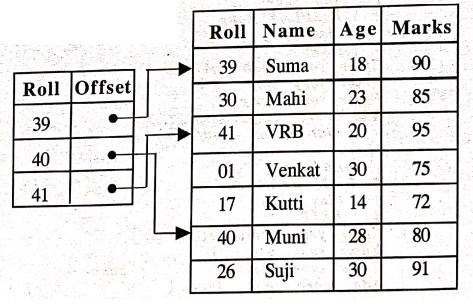
sequential over sequential. The indexed sequential file maintain two files,
they are sequential file and sorted indexed file.
Whatever
the data we store it in the sequential file and in the index file we have the
primary key of the sequential file along with the offset of that particular
record in the sequential file.
To
be more precise, lets take the following example. We have to maintain student
details, we have
Roll, Name, Age, Marks
To
refer to any student, we have another file, which contain
Roll and Offset
This
will be in sorted format for the index file. Hence whenever we are referring to
any record, first the index file will be searched. From that search the offset
is retrieved and the required record can be seek from the sequential file. You
will become clearer from the following figure and program.
Example: Program for
the indexed sequential file for the student database.
/* Programs for the indexed sequential file for the student
database */
#include <stdio.h>
#include <conio.h>
#include <stdlib.h>
/*standard library function header file */
typedef struct student /*student
is a structure with elements*/
{
int rno;
char name[20];
int age;
int marks;
}ss;
typedef struct index /* index is a structure with integer *
{
int irno;
long offset;
int flag;
}is;
FILE *ptr= NULL; /* file
pointer NULL */
FILE *iptr=NULL;
void main()
{
int ch;
int status;
int rno;
char opl='y';
ptr=fopen("std.dat",
"wb");
if(ptr == NULL)
{
printf("file
not found");
getch();
exit(0);
} /* if */
iptr=fopen("stdl.dat" "wb");
if(iptr== NULL)
{
printf("file
not found");
getch();
exit(0);
} /* if */
fclose(ptr); /* file close function closes a file*/
fclose(iptr);
while((op1= 'y') || (op1 = 'Y'))
{
printf("\n1. Add");
printf("\n2. Delete");
printf("\n3. Modify");
printf("\n4. Search");
printf("\n5. Display");
printf("\n6. Exit\n");
printf("Enter your option (1‒6):");
scanf("%d", &ch);
switch(ch)
{
case 1:
status =
ADD_record();
if(status == 1)
printf("Record Successfully
Added");
else
printf("Record
could not be Added");
break;
case 2:
printf("Enter
the rollno of the record to delete");
scanf("%d",
&rno);
status=DELETE_RECORD(rno);
if(status == 1)
printf("Record
deleted successfully");
else
printf("Record
could not be deleted");
break;
case 3:
printf("Enter
rollno of the record to modify:");
scanf("%d",
&rno);
status=MODIFY
RECORD(rno);
if(status == 1)
printf("Record
modified successfully");
else
printf("Record
could not be modified");
break;
case 4:
printf("Enter
the rollno to search: ");
scanf("%d",
&rno);
status =
SEARCH_RECORD(rno);
if(status == 1)
printf("Record
found");
else
printf("Record
not found");
getch();
break;
case 5:
DISPLAY
ALL_RECORD();
break;
case 6:
exit(0);
} /* switch */
fflush(stdin); /* flush function is used to flush a file */
printf("\nDo You want to continue (Y/N): ");
scanf("%c", &op1);
if((op1 == 'n') || (op1== 'N'))
break;
} /* while */
} /* main */
int ADD RECORD()
{
ss stud;
is ind;
long offset;
ptr=fopen("std.dat", "rb+ ");
if(ptr== NULL)
{
printf("File not
opened");
return ‒1;
} /* if */
while(fread(& stud, sizeof(stud), 1,ptr));
offset=ftell(ptr); /*ftell() is used to specify the position */
printf("Rollno: ");
scanf("%d", &stud. rno);
printf("Name of the student: ");
scanf("%s", & stud.name);
printf("Age: ");
scanf("%d", &stud. age);
printf("Marks: ");
scanf("%d", & stud.marks);
fwrite(&stud, sizeof(stud), 1,ptr); /*fwrite writes data to
file*/
fclose(ptr); /* fclose closes a file associated with pointer*/
iptr=fopen("std1.dat", "ab+");
if(iptr== NULL)
printf("File
not opened");
return ‒1;
} /* if */
ind.irno stud.rno;
ind.offset offset;
ind.flag = 1;
fwrite(&ind, sizeof(ind), 1,iptr);
fclose(iptr);
SORT FILE();
return 1;
} /* ADD RECORD() */
int DELETE RECORD(int_rno)
{
is ind;
int flag=0;
iptr=fopen("std1.dat",
"rb + ");
if(iptr== NULL)
{
printf("File
not opened");
return ‒1;
} /* if */
while (fread(&ind, sizeof(is),1,iptr));
{
if(ind.irno ==rno)
{
flag = 1;
} /* if */
} /* while */
if(flag==1)
{
ind.flag = ‒1;
fseek(iptr, ‒(long) sizeof(is), SEEK_CUR);
fwrite(&ind, sizeof(is),1,iptr);
fclose(iptr);
return 1;
} /* if */
fclose(iptr);
return ‒1;
} /* DELETE_RECORD() */
int MODIFY RECORD (int rno).
{
is ind;
ss stud;
int flag=0;
iptr=fopen("std1.dat", "rb+ ");
if(iptr== NULL)
{
printf("File not
opened");
return ‒1;
} /* if */
while (fread(&ind, sizeof(is), 1,iptr))
if(ind.irno == rno)
{
flag=1;
break;
} /* if */
} /* while */
fclose(iptr); /* file close */
if(flag == 1)
{
ptr=fopen("std.dat",
"rb+ "); /* file open */
if(ptr == NULL)
{
printf("File
not opened");
return ‒1;
} /* if */
fseek(ptr, ind.offset, SEEK_SET); /*fseek() position pointer*/
fread(&stud, sizeof(stud), 1,ptr); /*fread() used to read
data*/
printf("Enter Name:");
scanf("%s", stud. name);
printf("Age:");
scanf("%d", &stud. age);
printf("Marks: ");
scanf("%d", & stud. marks);
fseek(ptr, (long) sizeof(stud), SEEK CUR);
fwrite(& stud, sizeof(stud), 1,ptr); /* file write */
fclose(ptr); /* file close */
return 1;
} /* if */
return ‒1;
} /* MODIFY RECORD */
int SEARCH_RECORD(int rno)
{
is ind;
ss stud;
iptr=fopen("stdl.dat", "rb+ ");
if(iptr== NULL)
{
printf("File not
opened");
return ‒1;
} /* if */
while (fread(&ind, sizeof(is), 1,iptr))
{
if(ind.irno ==rno && ind. flag==1)
{
fclose(iptr);
return 1;
} /* if */
} /* while */
fclose(iptr); /* file close*/
return ‒1;
} /* SEARCH_RECORD() */
int DISPLAY ALL RECORD()
{
is ind;
ss stud;
iptr=fopen("std1.dat", "rb + ");
if(iptr== NULL)
{
printf("File not
opened");
return ‒1;
} /* if */
ptr=fopen("std.dat", "rb+ ");
if(ptr== NULL)
{
printf("file not
opened");
return ‒1;
} /* if */
while(fread(&ind, sizeof(is), 1,iptr)) /* file read */
{
if(ind.flag == 1)
{
fseek(ptr, ind.
offset, SEEK_SET);
fread(&stud, sizeof(stud), 1, ptr); /*
file read */
printf("\n\n
Rollno %d", stud.rno);
printf("\n Name
: %s", stud.name);
printf("\n Age :
%d", stud.age);
printf("\n
Marks: %d", stud.marks);
} /* if */
} /* while */
fclose(iptr); /* file close */
fclose(ptr); /* file close */
return 1;
} /* DISPLAY ALL RECORD() */
int SORT FILE()
{
int size;
int i,j,flag=0;
is ind, ind_temp;
ss stud;
iptr=fopen("stdl.dat", "rb + ");
if(iptr == NULL)
{
printf("File not
opened");
return ‒1;
} /* if */
ptr=fopen("std.dat", "rb+ ");
if(ptr= = NULL)
{
printf("File not
opened");
return ‒1;
} /* if */
size=0;
while(fread(&ind, sizeof(is),1,iptr))
size++;
fclose(iptr);
iptr=fopen("std.dat", "rb+");
if(iptr== NULL)
{
printf("File not
opened");
return ‒1;
} /* if */
for(i=0;i< size;i++)
{
flag = 0;
for(j=0;j< size‒(i+1);j++)
{
fseek(iptr,j*
sizeof(is), SEEK__set);
fread(&ind,
sizeof(is), 1,iptr);
fread(&ind_temp,
sizeof(is), 2, iptr);
if(ind.irno > ind_temp. irno)
{
fseek(ptr,j*sizeof(is),
SEEK_SET);
fwrite(&ind_temp,
sizeof(is),1,iptr);
fseek(iptr,
(j+1)*sizeof(is), SEEK_SET);
fwrite(&ind,
sizeof(is),1,iptr);
flag=1;
} /* if */
if (flag === 0)
break;
} /* for */
fclose(iptr);
return 1;
} /* for */
} /* SORT FILE() */
OUTPUT
1. Add
2. Delete
3. Modify
4. Search
5. Display
6. Exit
Enter your option (1‒6):1
Rollno:01
Name of the student: muni
Age:25
Marks:78
Record Successfully
Added
Do You want to
continue (Y/N): y
1. Add
2. Delete
3. Modify
4. Search
5. Display
6. Exit
Enter your option (1‒6):1
Rollno:02
Name of the student:
venkat
Age:24
Marks:67
Record Successfully
Added
Do You want to
continue (Y/N): y
1. Add
2. Delete
3. Modify
4. Search
5. Display
6. Exit
Enter your option (1‒6):1
Rollno:03
Name of the student:
shankar
Age:30
Marks:79
Record Successfully
Added
Do You want to
continue(Y/N): y
1. Add
2. Delete
3. Modify
4. Search
5. Display
6. Exit
Enter your option (1‒6):2
Enter the rollno of
the record to delete 02
Record could not be
deleted
Do you want to
continue(Y/N): y
1. Add
2. Delete
3. Modify
4. Search
5. Display
6. Exit
Enter your option (1‒6):3
Enter rollno of the
record to modify: 3
Enter Name: shankar
Age:30
Marks:89
Record modified
successfully
Do You want to
continue (Y/N): y
1. Add
2. Delete
3. Modify
4. Search
5. Display
6. Exit
Enter your option (1‒6):5
Rollno : 1
Name: muni
Age : 25
Marks : 78
Rollno: 2
Name: mahi
Age : 24
Marks : 67
Rollno: 3
Name: suma
Age : 30
Marks : 89
Do You want to
continue (Y/N):6
EXPLANATION:
The structure student and index are declared as global structure. The main
function opens the file std.dat. If the file is NULL. Then prints file not
found. Then open the file std1.dat if the file is NULL then prints file not
found and close the both file pointer. The while loop reads the value of option
ch and executes to switch case statement depends upon the user entered value.
The ADD_RECORD() function opens the file std.dat and reads stud.no, stud.name,
stud.age, stud.marks, and executes the body of the function. The function
DELETE_RECORD() executes the body of function and while loop, if statements are
executed in the body. This function is used for Delete the items. The
MODIFY_RECORD() function executes the body and reads stud.name, stud.age,
stud.marks, SEARCH_RECORD() function executes the body and close the file iptr.
The DISPLAY_ALL_RECORD() function prints the stud.rno, stud.name, stud.age,
stud.marks and closed the file pointer iptr. The SORT_FILE() function used the
if statement and for loop structure reads and writes the file and finally used
the file prints iptr and terminates the program.
iii. Random Access Files
In
case of sequential file or indexed sequential file we are writing records to
the sequential file as they come. But in case of direct access files, we write
the record to a particular position. Since we are deciding the position of the
particular record, there is some relation between the key (which is used to
access the record) using which we are deciding the position of the record.
Hence using the relation between the key and record number, we can determine if
a given record is present in the file or not.
Computer Programming C: UNIT V: File Operations : Tag: Computer Science : C Programming - Types of files: Operations on Sequential, Indexed and Random Files
Computer Programming C: UNIT V: File Operations
Under Subject
Computer Programming C
CS25C01 1st Semester | 2025 Regulation | 1st Semester 2025 Regulation
Related Subjects

English Essentials I
EN25C01 1st Semester | 2025 Regulation | 1st Semester 2025 Regulation

தமிழர் மரபு - Heritage of Tamils
UC25H01 1st Semester | 2025 Regulation | 1st Semester 2025 Regulation
Applied Calculus
MA25C01 Maths 1 M1 - 1st Semester | 2025 Regulation | 1st Semester 2025 Regulation

Applied Physics I
PH25C01 1st Semester | 2025 Regulation | 1st Semester 2025 Regulation

Applied Chemistry I
CY25C01 1st Semester | 2025 Regulation | 1st Semester 2025 Regulation
Makerspace
ME25C04 1st Semester | 2025 Regulation | 1st Semester 2025 Regulation
Computer Programming C
CS25C01 1st Semester | 2025 Regulation | 1st Semester 2025 Regulation
Computer Programming Python
CS25C02 1st Semester | 2025 Regulation | 1st Semester 2025 Regulation

Fundamentals of Electrical and Electronics Engineering
EE25C03 1st Semester EEE Depart | 2025 Regulation | 1st Semester 2025 Regulation

Introduction to Mechanical Engineering
ME25C03 1st Semester Mechanical Dept | 2025 Regulation | 1st Semester 2025 Regulation

Introduction to Civil Engineering
CE25C01 1st Semester Civil, Agri Departments | 2025 Regulation | 1st Semester 2025 Regulation
Essentials of Computing
CS25C03 1st Semester - AIDS, CSE, CSE(CY), IT Department | 2025 Regulation | 1st Semester 2025 Regulation

Applied Physics I Laboratory
PH25C01 1st Semester practical Laboratory Manual | 2025 Regulation | 1st Semester Laboratory 2025 Regulation

Applied Chemistry I Laboratory
CY25C01 1st Semester practical Laboratory Manual | 2025 Regulation | 1st Semester Laboratory 2025 Regulation

Computer Programming C Laboratory
CS25C01 1st Semester EEE, ECE, CSE, CSE(CY), AIDS, IT practical Laboratory Manual | 2025 Regulation | 1st Semester Laboratory 2025 Regulation

Computer Programming Python Laboratory
CS25C02 1st Semester practical Laboratory Manual | 2025 Regulation | 1st Semester Laboratory 2025 Regulation
Engineering Drawing
ME25C01 EEE, Mech, Agri, EEE Depts | 2025 Regulation | 2nd Semester 2025 Regulation

Basic Electronics and Electrical Engineering
EE25C04 1st Semester ECE Dept | 2025 Regulation | 1st Semester 2025 Regulation
Essentials of Computing - Laboratory
CS25C03 1st Semester AIDS, CSE, CSE(CY), IT Depts | practical Laboratory Manual | 2025 Regulation | 1st Semester 2025 Regulation