Computer Organization and Architecture: Chapter 5: Advanced ILP and Parallel Processing
Advanced ILP and Parallel Processing: Two Marks Important Questions and Answers
Computer Organization and Architecture
Computer Organization and Architecture: Chapter 5: Advanced ILP and Parallel Processing: Anna University Part A Two Marks Important Questions and Answers
Computer Organization and Architecture
Chapter 5: Advanced
ILP and Parallel Processing
Two Marks
Questions with Answers
1. Define
parallel processing.
To
fulfil increasing demands for higher performance it is necessary to process
data concurrently to achieve better throughput instead of processing each
instruction sequentially as in a conventional computer. Processing data
concurrently is known as parallel
processing.
2. Define
multiprocessors.
System
may have two or more processors operating concurrently.
We
know that, the earlier processors had only one Arithmetic and Logic Unit (ALU)
in its CPU. Furthermore, the ALU could only perform one function at a time,
resulting quite slow Processing process for executing a long sequence of
arithmetic and logical instructions.
3. Define
multiprocessor system.
Answer: A computer
system with at least two processors is called multiprocessor system.
4. Define
task‒level or process level parallelism.
Answer: Utilizing
multiple processors for executing independent programs simultaneously is known
as task‒level parallelism or process‒level parallelism.
5. Define
parallel processing program.
Answer: It is referred
to a single program that runs on multiple processors simultaneously.
6. What
is cluster ?
Answer: A set of
computers connected over a local area network that function as a single large
multiprocessor is called cluster.
7. What
is multicore ?
Answer: A multicore is
an architecture design that places multiple processors on a single die
(computer chip) to enhance performance and allow simultaneous processing of
multiple tasks more efficiently.
8. What
do you mean by CMPs ?
Answer: The multicore
architecture designs that allow single chip multiprocessing are known as Chip Multiprocessors (CMPs).
9. What
are the limitations to increase clock frequency or processor speed?
Answer:
■
Higher frequency requires more power.
■
More power consumption results it harder and more expensive to cool the system.
■
More power consumption also affects sizing and packaging considerations.
10. Define
SMPS.
One
of the important aspect of multicore architecture is that, there is no real
significant difference between programming for multiple processors in separate
packages and programming for multiple processors contained in a single package
on a single chip. Thus software developers who are familiar with
multiprocessing can easily switch to multicore development.
These
multicores are almost always Shared
Memory Processors (SMPs), as they usually share a single physical address
space.
11. State
the need for speculation.
Answer: It is the most
important methods for finding and exploiting more ILP.
12. What
is ILP? Why is it needed?
Answer:
When
instructions in a sequence are independent and can be executed in parallel by
overlapping, there is an Instruction
Level Parallelism (ILP). Since instructions are executed in parallel it is
very much needed to achieve high performance.
13. What
is issue slots ?
Answer: The positions
from which instructions could issue in a given clock cycle is called issue
slot.
14. What
is issue packet ?
Answer: It is the set of
instructions that issues together in one clock cycle is called issue packet.
The packet may be determined statically by the compiler or dynamically by the
processor.
15. What
is speculation?
Answer: An approach that
allows the compiler or the processor to "guess" the outcome of an
instruction to remove it as a dependence in executing other instructions is
called speculation.
16. What
is VLIW ?
Answer: VLIW stands for
Very Long Instruction Word (VLIW). It is a style of instruction set
architecture that launches many operations that are defined to be independent
in a single wide instruction, typically with many separate opcode fields.
17.
Define use latency.
Answer: Number of clock
cycles between a load instruction and an instruction that can use the result of
the load without stalling the pipeline is called use latency.
18. Define
register renaming.
Answer: During the
unrolling process, the compiler introduces additional registers to eliminate
dependences that are not true data dependences, but could either lead to
potential hazards. The goal of this process, is called register renaming.
19. Define
anti‒dependence or name dependence.
Answer: An ordering
forced by the reuse of a name, typically a register, rather than by a true
dependence that carries a value between two instructions is called anti‒dependence
or name dependence.
20. Define
superscalar.
Answer: It is an
advanced pipelining technique that enables the processor to execute more than
one instruction per clock cycle by selecting them during execution.
21. Define
super scalar processor.
Answer: A processor
capable of parallel instruction execution and having performance level greater
than one instruction per cycle is known as superscaler processor.
22. What
is multiple issue?
Answer: A scheme whereby
multiple instructions are launched in one clock cycle is called multiple issue.
23. What
is static multiple issue?
Answer: An approach for
implementing a multiple‒issue processor where many decisions are made by the
compiler before execution is called static
multiple issue.
24. What
is dynamic multiple issue?
Answer: An approach for
implementing a multiple‒issue processor where many decisions are made during
execution by the processor is called dynamic
multiple issue.
25. What
is dynamic pipeline scheduling ?
Answer: Dynamic pipeline
scheduling is a hardware support for reordering the order of instruction
execution so as to avoid stalls.
26.
Define commit unit.
Answer: It is the unit
in a dynamic or out‒of‒ order execution pipeline that decides when it is safe
to release the result of an operation to programmer‒ visible registers and
memory.
27.
Define reservation station.
Answer: It is a buffer
within a functional unit that holds the operands and the operation.
28.
Define reorder buffer.
Answer: The buffer that
holds results in a dynamically scheduled processor until it is safe to store
the results to memory or a register is called reorder buffer.
29. What
is out‒of‒order execution ?
Answer: A situation in
pipelined execution when an instruction blocked from executing does not cause
the following instructions to wait is called out‒of‒order execution.
30. What
is in‒order commit ?
Answer: A commit in
which the results of pipelined execution are written to the programmer‒visible
state in the same order that instructions are fetched is called in‒order
commit.
31 State
the primary methods to increase ILP.
Answer: There are two
primary methods for increasing the potential amount of instruction‒level
parallelism. The first is increasing the depth of the pipeline to overlap more
instructions and second is to replicate the internal components of the computer
so that it can launch multiple instructions in every pipeline stage.
32. What
is multiple issue?
Answer: A technique by
which multiple instructions are launched in one clock cycle is called multiple
issue.
33. What
is Instruction‒Level Parallelism (ILP) ?
Answer:
Instruction‒Level
Parallelism (ILP) is the ability of a processor to execute multiple
instructions simultaneously. It is achieved by identifying independent
instructions in a program and executing them in parallel to improve performance
and reduce execution time.
34. What
is the role of a superscalar processor in exploiting ILP ?
Answer: A superscalar
processor issues and executes multiple instructions in a single clock cycle. It
uses hardware to dynamically select independent instructions and execute them
in parallel pipelines. Most modern CPUs (Intel, AMD, ARM) use superscalar
designs to increase ILP.
35. What
is register renaming and why is it important for ILP?
Answer: Register
renaming is a hardware technique where the processor assigns extra physical
registers to eliminate false dependencies like WAR and WAW. This prevents
pipeline stalls, allows more instructions to run in parallel, and improves ILP.
It is typically implemented using rename tables and the Reorder Buffer (ROB).
36. How
does speculation improve ILP?
Answer: Speculation
allows the CPU to execute instructions ahead of time based on predicted branch
outcomes.
•
If the prediction is correct, performance improves.
•
If wrong, speculative results are discarded using the ROB.
•
Speculation works together with branch prediction and enables higher instruction
throughput.
37. What
is dynamic scheduling in ILP ?
Answer: Dynamic
scheduling is a technique where the hardware (not the compiler) decides the
order of instruction execution during runtime.
It
allows the processor to:
•
Avoid stalls caused by data hazards
•
Execute independent instructions out of order
•
Improve pipeline efficiency and ILP
38. What
is the role of the Reorder Buffer (ROB) in ILP?
Answer: The Reorder
Buffer (ROB) stores results of out‒of‒order executed instructions and commits them
in correct program order.
Its
functions include:
•
Supporting register renaming
•
Holding speculative results
•
Ensuring precise exceptions
•
Allowing safe recovery from branch mispredictions
•
ROB is essential for implementing out‒of‒order execution and speculation.
39. What
is the purpose of branch prediction in modern processors ?
Answer: Branch
prediction is used to guess the outcome of branch instructions before the
actual result is known. This prevents pipeline stalls caused by control hazards
and allows the processor to continue fetching and executing instructions,
thereby increasing Instruction‒Level Parallelism (ILP). Accurate branch
prediction reduces wasted cycles and improves performance.
40. What
are true data dependencies (RAW), and why do they limit ILP?
Answer: True data
dependencies, also called Read After Write (RAW) hazards, occur when an
instruction requires the result of a previous instruction. Since the dependent
instruction must wait for the earlier one to finish, these dependencies cannot
be eliminated by hardware. They fundamentally restrict how many instructions
can be executed in parallel, thus limiting ILP.
41. Why
can real processors not achieve the ILP of an ideal processor ?
Answer: Real processors
have limited hardware resources such as a finite number of ALUs, FPUs, register
rename entries, and small instruction windows. Additionally, memory delays,
cache misses, and branch mispredictions reduce performance. Designing very wide
superscalar processors is costly, complex and consumes high power. Hence, real
ILP remains far below theoretical maximums.
42. What
modern trends have emerged due to the limited growth of ILP ?
Answer: Because ILP
improvements show diminishing returns, modern processors now focus on other
forms of parallelism, such as:
Multicore processors :
Multiple independent cores on a single chip
Simultaneous
Multithreading (SMT): Running
instructions from multiple threads on one core
Vector units (SIMD) :
Executing operations on multiple data elements in parallel
These
techniques provide greater performance gains than relying only on ILP.
43. What
is multithreading?
Answer: A mechanism by
which the instruction streams is divided into several smaller streams (threads)
and can be executed in parallel is called multithreading.
44. What
is hardware multithreading?
Answer: Increasing
utilization of a processor by switching to another thread when one tread is
stalled is called hardware multithreading.
45. What
is thread ?
Answer: In
multithreading, the instruction stream is divided into several smaller streams,
called threads, such that the
threads can be executed in parallel.
A
thread includes the program counter, stack pointer and its own area for a
stack. It executes sequentially and can be interrupted to transfer control to
an another thread.
46. What
is process?
Answer: A process is an
instance of a program running on a computer.
47. What
is process switch?
Answer: A process switch
is an operation that switches the process or control from one process to
another. It first saves all the process control data, registers and other
information and then replaces them with the process information for the second.
48. What
is thread switch?
Answer: A thread switch
is an operation that switches the processor control from one thread to another
within the same process. This is cheaper than a process switch.
49. Give
the comparison between process switch and thread switch.
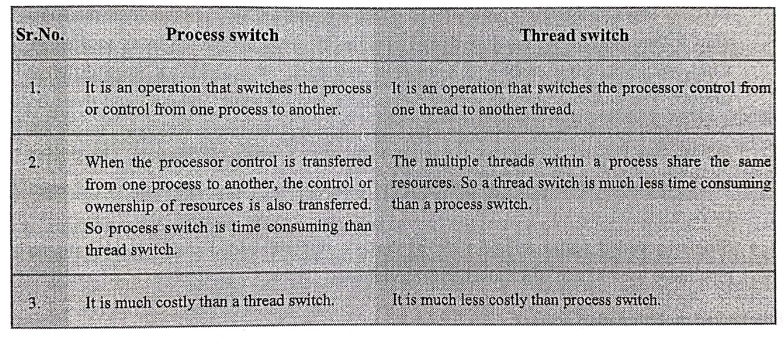
Process switch
1.
It is an operation that switches the process or control from one process to
another.
2.
When the processor control is transferred from one process to another, the
control or ownership of resources is also transferred. So process switch is
time consuming than thread switch.
3.
It is much costly than a thread switch.
Thread switch
1.
It is an operation that switches the processor control from one thread to
another thread.
2.
The multiple threads within a process share the same resources. So a thread
switch is much less time consuming than a process switch.
3.
It is much less costly than process switch.
50. What
are explicit threads ?
Answer: User level
threads which are visible to the application program and kernel‒level threads
which are visible only to operating system, both are referred to as explicit
threads.
51. What
do you mean by implicit multithreading?
Answer: Implicit
multithreading refers to the concurrent execution of multiple threads extracted
from a single sequential program.
52. What
do you mean by explicit multithreading?
Answer: Explicit
multithreading refers to the concurrent execution of instructions from
different explicit threads, either by interleaving instructions from different
threads on shared pipelines or by parallel execution on parallel pipelines.
53.
Define interleaved or fine‒grained multithreading.
Answer: A version of
hardware multithreading that suggests switching between threads after every
instruction is called interleaved or fine‒grained multithreading.
54.
Define blocked or coarse‒grained multithreading.
Answer:
A
version of hardware multithreading that suggests switching between threads only
after significant events, such as a cache miss is called blocked or coarse‒grained
multithreading.
55.
Define simultaneous multithreading (SMT).
Answer: A version of
multithreading that lowers the cost of multithreading by utilizing the
resources needed for multiple issue (dynamically schedule microarchitecture) is
called simultaneous multithreading (SMT).
56. What
is chip multiprocessing ?
Answer: The processor is
replicated on a single chip and each processor executes separate threads. This
approach effectively utilizes the available logic data on a chip without
increasing pipeline design complexity. This is referred to as chip multiprocessing.
Computer Organization and Architecture: Chapter 5: Advanced ILP and Parallel Processing : Tag: Computer : Computer Organization and Architecture - Advanced ILP and Parallel Processing: Two Marks Important Questions and Answers
Computer Organization and Architecture: Chapter 5: Advanced ILP and Parallel Processing
Under Subject
Computer Organization and Architecture
CW25201 3rd Semester IT department. | 2025 Regulation | 3rd Semester 2025 Regulation
Related Subjects
Discrete Mathematics
MA25C14 3rd Semester CSE,IT,CY,AIDS departments. | 2025 Regulation | 3rd Semester 2025 Regulation
Data Structures
CS25C08 3rd Semester CSE,IT,CY,AIDS departments. | 2025 Regulation | 3rd Semester 2025 Regulation
Computer Organization and Architecture
CW25201 3rd Semester IT department. | 2025 Regulation | 3rd Semester 2025 Regulation
Object Oriented Programming
CS25C07 3rd Semester IT department. | 2025 Regulation | 3rd Semester 2025 Regulation
Web Technologies
IT25301 3rd Semester IT department. | 2025 Regulation | 3rd Semester 2025 Regulation
English Communication Skills Laboratory I
EN25C03 3rd Semester all department. | 2025 Regulation | 3rd Semester 2025 Regulation
Skill Development Course I
3rd Semester all department. | 2025 Regulation | 3rd Semester 2025 Regulation