Computer Organization and Architecture: Chapter 5: Advanced ILP and Parallel Processing
Multithreading
Questions: 1. What is multithreading? 2. Define process, resource ownership, process switch, thread and thread switch related to multithreading? 3. Give comparison between process switch and thread switch. 4. What do you mean by implicit and explicit multithreading. 5. Discuss various approaches to explicit multithreading. 6. What is multicore? 7. Write a note on chip multiprocessing. 8. Explain the term: Hardware multithreading. 9. What is hardware multithreading? Compare and contrast Fine grained Multi-Threading and Coarse grained Multi Threading. 10. Explain in detail about hardware multithreading. 11. Explain the four principle approaches to multithreading with necessary diagrams. 12. Explain any three types of hardware multithreading.
Multithreading
•
The performance of a processor can be measured by the rate of instruction
execution. It can be calculated by taking product of processor clock frequency
(fclk) in MHz and the average number of instructions executed per
cycle (Ipc). Thus, it can be expressed as
MIPS
rate = fclk × Ipc.
•
Hence, we can say that the performance of the processor can be increased by
increasing its clock frequency and / or by increasing number of instructions
executed per cycle.
•
The Ipc can be increased by using instruction pipeline. It can be
further increased in a superscalar architecture by using multiple parallel
instruction pipelines.
•
When pipelining is used, it is essential to maximize the utilization of each
pipeline stage to improve throughput. It can be accomplished by executing some
instructions in a different order rather than executing them sequentially as
they occur in the instruction stream and initiating execution of some
instructions eventhough it is not required. However, this approach needs
complex mechanisms in the design. The designer can not cross the limitations of
circuit complexity and power consumption. Therefore, an another approach is
used, called multithreading.
•
In multithreading, the instruction stream is divided into several smaller
streams, called threads, such that
the threads can be executed in parallel. Here, a high degree of instruction‒level parallism can be
achieved without increasing circuit complexity or power consumption.
Implicit and Explicit Multithreading
Let
us discuss some important terms used in multithreaded processors.
■
Process : A process is an instance
of a program running on a computer. The process image is the collection of
program data, stack and attributes that define the process. The process image
is stored at a virtual address space. Two important characteristics of a fer
process are discussed below.
■
Resource ownership : A process may
get control of resources such as main memory, I/O channels, I/O devices and
files from time to time.
■
Scheduling / execution : A process
execution takes places through one or more programs. This execution may
interleaved with that of other processes. An operating system decides an
execution state of each process such as running, ready, dispatching priority.
Process switch :
A process switch is an operation that switches the process or control from one
process to another. It first saves all the process control data, registers and
other information and then replaces them with the process information for the
second.
Thread :
A thread includes the program counter, stack pointer and its own area for a
stack. It executes sequentially and can be interrupted to transfer control to
an another thread.
Thread switch : A thread switch is an operation that switches the processor control from one thread to another within the same process. This is cheaper than a process switch.
Comparison of process switch and thread switch
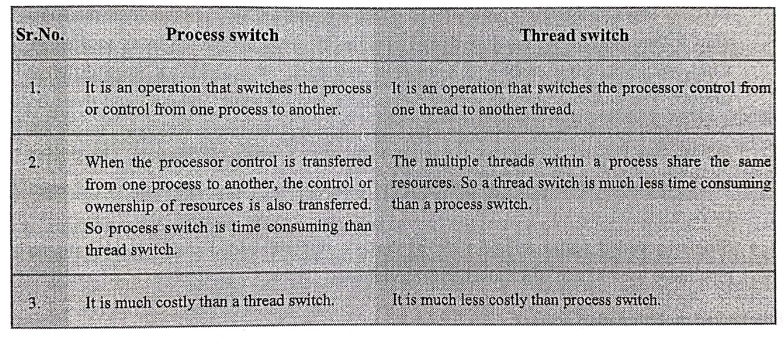
Process switch
1.
It is an operation that switches the process or control from one process to
another.
2.
When the processor control is transferred from one process to another, the
control or ownership of resources is also transferred. So process switch is
time consuming than thread switch.
3.
It is much costly than a thread switch.
Thread switch
1.
It is an operation that switches the processor control from one thread to another
thread.
2.
The multiple threads within a process share the same resources. So a thread
switch is much less time consuming than a process switch.
3.
It is much less costly than process switch.
Explicit Threads
■
User level threads which are visible to the application program and kernel‒level
threads which are visible only to operating system, both are referred to as
explicit threads.
Implicit and Explicit Multithreading
■
Implicit multithreading refers to the concurrent execution of multiple threads
extracted from a single sequential program.
■
Explicit multithreading refers to the concurrent execution of instructions from
different explicit threads, either by interleaving instructions from different
threads on shared pipelines or by parallel execution on parallel pipelines.
Approaches to Explicit Multithreading
■
Interleaved or fine‒grained
multithreading : The processor executes two or more threads at a time. It
switches from one thread to another at each clock cycle. During execution, if a
thread is blocked because of data dependencies or memory latencies, that thread
is skipped and a ready thread is executed.
■
Blocked or coarse‒grained multithreading
: The processor executes instructions of a thread sequentially and if an
event (e.g. cache miss) that causes any delay occurs, it switches to another
thread.
■ Simultaneous
MultiThreading (SMT) : The wide superscalar instruction
is executed by executing multiple threads simultaneously using multiple
execution units of a superscalar processor.
■
Chip multiprocessing : The processor
is replicated on a single chip and each processor executes separate threads.
This approach effectively utilizes the available logic data on a chip without
increasing pipeline design complexity. This is referred to as multicore. Chip multiprocessing enables
simultaneous execution of instructions from different threads. The possible
pipeline architectures those involve multithreading and those do not use
multithreading are shown in Fig. 5.10.1. The instructions in different threads
are indicated as I1,I2,I3, ... and so on. Each
row indicates a single clock cycle. The shaded block represents an unused
execution slot in one pipeline. A no‒operation is indicated by X.
■
Single‒threaded scalar : Fig 5.10.1
(a) shows a single‒threaded scalar. Here a simple pipeline is used like in RISC
and CISC machines.
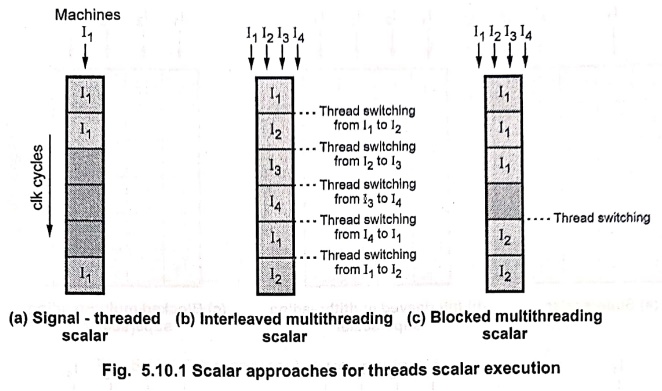
Interleaved multithreaded scalar :
■
As shown in Fig. 5.10.1 (b), the pipeline stages are kept fully occupied (or
close to it) by switching from one thread to another at each clock cycle. The
hardware should support this switching operation.
Blocked multithreaded scalar :
■
As shown in Fig. 5.10.1 (c), the instructions of a single thread are executed
successively until an event occurs that may cause delay such as cache miss.
When such an event occurs, the processor switches to execute an another thread.
■ It is to be noted that in interleaved multithreading (Fig. 5.10.1 (b)), thread switching takes no time since there are no control or data dependancies between threads which simplifies pipeline design. However in block multithreading (Fig. 5.10.1 (c)), thread switching needs one clock cycle.
Fig.
5.10.1 (a) and Fig. 5.10.1 (b) and Fig. 5.10.1 (c) show variations among
processors that have hardware capable for issuing four instructions per cycle.
The instructions from a single thread are executed in single cycle in each
case. All these cases are discussed here.
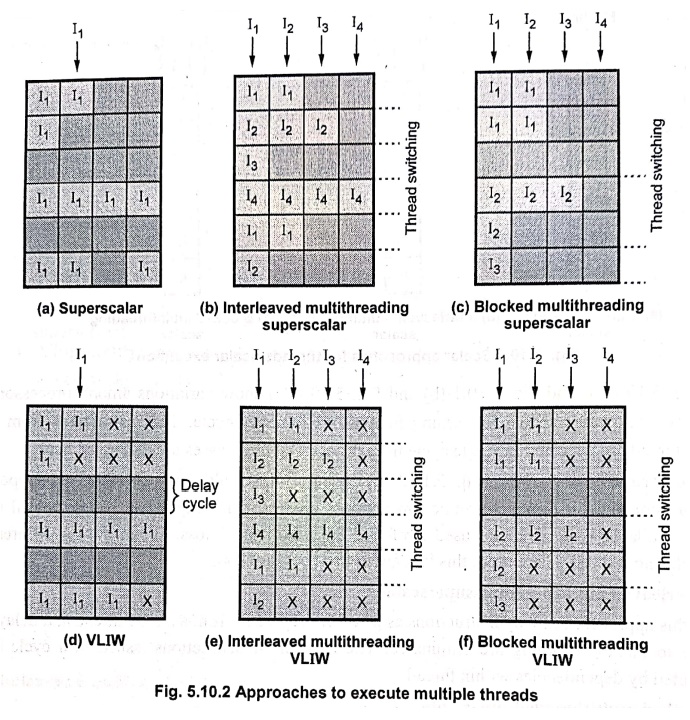
• Superscalar :
As shown in Fig. 5.10.2 (a), the basic superscalar approach does not support
multithreading. It provides parallelism within a processor. During some cycles,
not all of the available issue slots are used; referred to as horizontal loss.
When during different cycles no issue slots are used, this is referred to as
vertical loss.
•
Interleaved multithreading superscalar
In
this approach, as many instructions as possible are issued from a single thread
and delays due to thread switching are eliminated. The number of instructions
issued in a cycle is limited by dependencies within thread.
• Blocked multithreaded
superscalar
In
this technique, instructions from only one thread are issued during a cycle and
block multithreading is used.
• Very Long Instruction
Word (VLIW)
The
example of VLIW architecture is IA‒64. It places multiple instructions in a
single word. The operations which may be executed in parallel are placed in the
same word. If it is not possible to completely fill the word with instructions
those are to be issued in parallel, those slots are filled with no‒operation
(X).
• Interleaved
multithreading VLIW
This approach provides similar efficiencies as that of interleaved multithreading on a superscalar architecture.
• Blocked
multithreading VLIW
This
approach provides similar efficiencies as that of blocked multithreading on a
superscalar architecture.
Fig. 5.10.3 shows two more approaches to execute multiple threads.
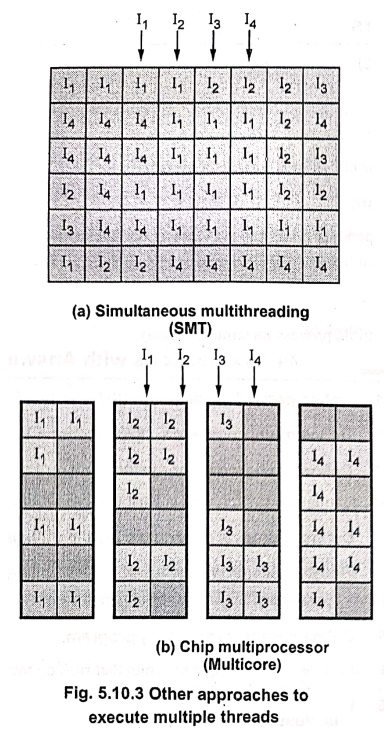
• Simultaneous
multithreading
A high degree of efficiency can be achieved using system capable of issuing number instructions at a time. Fig. 5.10.3 (a) shows a system capable of issuing 8 instructions simultaneously. All horizontal slots can be filled by a single instruction if the thread has a high degree of instruction‒level parallelism. Also, instructions from two or more threads may be issued during some cycles. Thus, the maximum number of instructions can be issued during each cycle.
• Chip multiprocessor
(Multicore)
As
shown in Fig. 5.10.3 (b), a chip contains four processors and each has a
two-issue superscalar processor.
Review Questions
1. What is
multithreading?
2. Define process,
resource ownership, process switch, thread and thread switch related to
multithreading?
3. Give comparison between
process switch and thread switch.
4. What do you mean by
implicit and explicit multithreading.
5. Discuss various
approaches to explicit multithreading.
6. What is multicore?
7. Write a note on
chip multiprocessing.
8. Explain the term:
Hardware multithreading.
9. What is hardware
multithreading? Compare and contrast Fine grained Multi-Threading and Coarse
grained Multi Threading.
10. Explain in detail
about hardware multithreading.
11. Explain the four
principle approaches to multithreading with necessary diagrams.
12. Explain any three
types of hardware multithreading.
Computer Organization and Architecture: Chapter 5: Advanced ILP and Parallel Processing : Tag: Computer : - Multithreading
Computer Organization and Architecture: Chapter 5: Advanced ILP and Parallel Processing
Under Subject
Computer Organization and Architecture
CW25201 3rd Semester IT department. | 2025 Regulation | 3rd Semester 2025 Regulation
Related Subjects
Discrete Mathematics
MA25C14 3rd Semester CSE,IT,CY,AIDS departments. | 2025 Regulation | 3rd Semester 2025 Regulation
Data Structures
CS25C08 3rd Semester CSE,IT,CY,AIDS departments. | 2025 Regulation | 3rd Semester 2025 Regulation
Computer Organization and Architecture
CW25201 3rd Semester IT department. | 2025 Regulation | 3rd Semester 2025 Regulation
Object Oriented Programming
CS25C07 3rd Semester IT department. | 2025 Regulation | 3rd Semester 2025 Regulation
Web Technologies
IT25301 3rd Semester IT department. | 2025 Regulation | 3rd Semester 2025 Regulation
English Communication Skills Laboratory I
EN25C03 3rd Semester all department. | 2025 Regulation | 3rd Semester 2025 Regulation
Skill Development Course I
3rd Semester all department. | 2025 Regulation | 3rd Semester 2025 Regulation