Applied Physics I: Chapter 8: Applied Optics - Interference
Application of Air Wedge - Thickness of a Thin Sheet of Paper
Principle, Description, Working
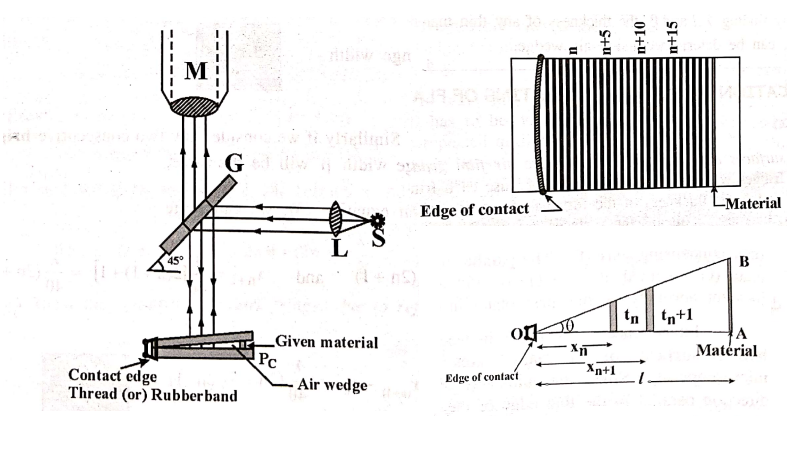
Using the principle of airwedge, we can find the thickness of any thin materials, like paper, wire, hair etc.
APPLICATION OF AIR
WEDGE ‒ THICKNESS OF A THIN SHEET OF PAPER
Using
the principle of airwedge, we can find the thickness of any thin materials,
like paper, wire, hair etc.
Principle
Two
plane glass plates are inclined at an angle (θ) by introducing a thin material
(e.g. hair), forming a wedge shaped air film. This film is illuminated by
sodium light. Interference occurs between the two rays, one reflected from the
front surface and the other by internal reflection at the back surface.
Therefore straight line fringes parallel to the edge of the wedge are obtained.
Using the theory of airwedge the thickness of the material can be determined.
Description
Two
optically plane glass plates are placed one over the other and tied by means of
a rubber band at one end. The given material of wire (or) paper is introduced
on the other end, so that an air‒wedge is formed between the plates as shown in
Fig. 8.3.
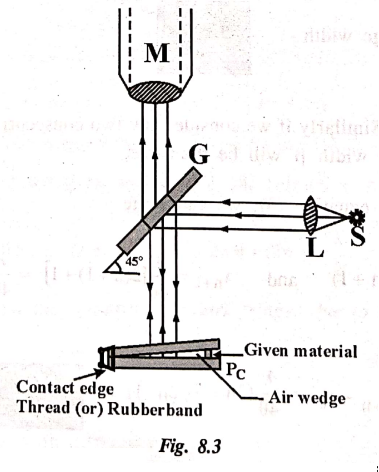
This set up is placed on the horizontal bed plate of the travelling microscope. Light from the source 'S' can be made to fall on the Air wedge setup with the help of a condensing lens(L) and 45° angled glass plate(G).
Working
Light
from the sodium vapour lamp (S) is rendered parallel by means of a condensing
lens (L). The parallel beam of light is incident on a plane glass plate (G)
inclined at an angle of 450 and gets reflected. The reflected light
is incident normally on the glass plates in contact Pc.
Interference
takes place between the light reflected from the top and bottom surfaces of the
glass plates and is viewed through the travelling microscope (M). Since the
thickness of the material remains constant in the direction parallel to the
thin edge of the wedge, a large number of equally spaced dark and bright
straight line fringes are formed parallel to the edge of contact as a shown in
Fig. 8.4.

The
microscope is adjusted so that the bright (or) dark fringe near the edge of
contact is made to coincide with the vertical cross wire and this is taken as
the nth fringe. The reading from the horizontal scale of the
travelling microscope is noted.
The
microscope is moved across the fringes transverse screw and the readings are
taken when the vertical cross wire coincides with every successive 5 fringes
(5, 10, 15, 20...). The width of every 20 fringes is calculated and the width
of one fringe is calculated. The mean of this gives the fringe width (β).
We
know from the theory of Airwedge, the fringe width β = λ/2θ ....(1)
If
‘l’ is the distance between the edge
of contact and the material (say the distance of the last fringe) and 't' is the thickness of the material,
then
For
θ being very small, from Fig. 8.5, we can write θ = t/l. ………..(2)
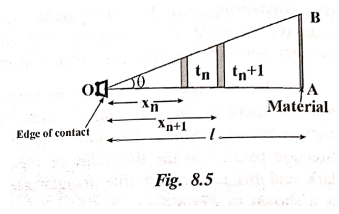
Substituting
equation (2) in (1), we get
Fringe
width β = λl / 2t
Thickness
of the material (t)
= λl / 2β
Thus,
by finding λ,l and β the thickness of
any thin material like, papers, wire, hair, etc., can be determined using air
wedge.
Applied Physics I: Chapter 8: Applied Optics - Interference : Tag: Applied Physics : Principle, Description, Working - Application of Air Wedge - Thickness of a Thin Sheet of Paper
Applied Physics I: Chapter 8: Applied Optics - Interference
Under Subject
Applied Physics I
PH25C01 1st Semester | 2025 Regulation | 1st Semester 2025 Regulation
Related Subjects

English Essentials I
EN25C01 1st Semester | 2025 Regulation | 1st Semester 2025 Regulation

தமிழர் மரபு - Heritage of Tamils
UC25H01 1st Semester | 2025 Regulation | 1st Semester 2025 Regulation

Applied Calculus
MA25C01 Maths 1 M1 - 1st Semester | 2025 Regulation | 1st Semester 2025 Regulation
Applied Physics I
PH25C01 1st Semester | 2025 Regulation | 1st Semester 2025 Regulation

Applied Chemistry I
CY25C01 1st Semester | 2025 Regulation | 1st Semester 2025 Regulation

Makerspace
ME25C04 1st Semester | 2025 Regulation | 1st Semester 2025 Regulation
Computer Programming C
CS25C01 1st Semester | 2025 Regulation | 1st Semester 2025 Regulation

Computer Programming Python
CS25C02 1st Semester | 2025 Regulation | 1st Semester 2025 Regulation
Fundamentals of Electrical and Electronics Engineering
EE25C03 1st Semester | 2025 Regulation | 1st Semester 2025 Regulation

Introduction to Mechanical Engineering
ME25C03 1st Semester | 2025 Regulation | 1st Semester 2025 Regulation

Introduction to Civil Engineering
CE25C01 1st Semester Civil Department | 2025 Regulation | 1st Semester 2025 Regulation
Essentials of Computing
CS25C03 1st Semester - AID CSE IT Department | 2025 Regulation | 1st Semester 2025 Regulation

Applied Physics I Laboratory
PH25C01 1st Semester practical Laboratory Manual | 2025 Regulation | 1st Semester Laboratory 2025 Regulation

Applied Chemistry I Laboratory
CY25C01 1st Semester practical Laboratory Manual | 2025 Regulation | 1st Semester Laboratory 2025 Regulation

Computer Programming C Laboratory
CS25C01 1st Semester practical Laboratory Manual | 2025 Regulation | 1st Semester Laboratory 2025 Regulation

Computer Programming Python Laboratory
CS25C02 1st Semester practical Laboratory Manual | 2025 Regulation | 1st Semester Laboratory 2025 Regulation
Engineering Drawing
ME25C01 EEE Mech Dept | 2025 Regulation | 2nd Semester 2025 Regulation

Basic Electronics and Electrical Engineering
EE25C04 1st Semester ECE Dept | 2025 Regulation | 2nd Semester 2025 Regulation