Applied Physics I: Chapter 8: Applied Optics - Interference
Optics Interference: Important part-A 2 marks Short Questions and Answers
Applied Physics I: Chapter 8: Applied Optics - Interference : Important part-A 2 marks Short Questions and Answers
ANNA UNIVERSITY PART‒A
QUESTIONS & ANSWERS
1. Explain why colours
are seen over a thin film of petrol on roads.
When
white light, (sunlight) falls on a thin film of petrol on roads, interference
takes place between the reflected light from the top and bottom layer of the
petrol film and thus it appear coloured.
NOTE:
The same principle is applicable for the formation of colours in soap bubbles.
2.
How is optical flatness of a surface
checked using interference phenomena?
(Or)
What is the principle
of using air wedge method to test the planeness of a glass plate?
The
material (OB) whose flatness has to be tested is kept over a glass plate (OA)
and tied at one end (O). Thus an airwedge is formed between the two glass
plates. Now, light is made to fall over the setup and the interference pattern
is viewed through a microscope.
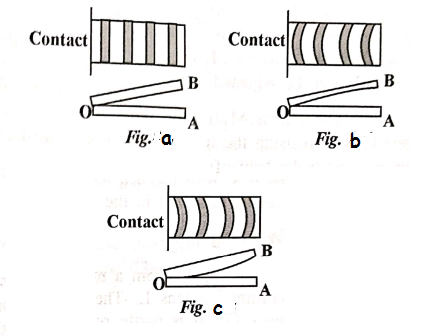
i)
If the bands appear regularly spaced, the surface is flat (Fig. 8a)
ii)
If the bands are curved towards the contact edge, the surface is concave (Fig.
8b)
iii)
If the bands are curved away from the contact edge, the surface is convex (Fig.
8c)
ADDITIONAL PART‒A
QUESTIONS AND ANSWERS
1. What is meant by
interference of light?
When
two light waves from the sources moves in the same direction, then the light
wave trains from these superimpose on each other, which results in the
modification of distribution of intensity. This modification of light energy
due to the superposition to two waves is known as interference.
It
the amplitudes of the two waves increase the intensity of the resultant, then
it is called as constructive interference. If there is decrease in intensity of
the resultant, then it is called as destructive interference.
2. State Superposition
Principle.
It
states that, the resultant displacement of the particle of a medium acted upon
by two or more waves simultaneously is equal to the algebraic sum of the
displacement of the particle due to the individual waves.
3. What are conditions
to be satisfied for interference to occur.
1.
There must be atleast two coherent sources.
2.
The distance between the sources must be very less.
4.
The distance between the source and the screen should be made as large as
possible.
5.
For constructive interference, the path difference should be equal to nλ and
for destructive interference, it should be (2n+1)λ/2 .
4. What is meant by
fringe width?
The
distance between any two consecutive bright or dark fringes is known as fringe
width β. It is constant for both bright and dark fringe. It is given by
β = λD / d
5. What is meant by an
Air wedge? Give its usage.
When
two plane glass plates of equal thickness and diameter is tied at one end, then
the two plane surfaces is inclined at an angle θ. Thus a wedge shaped air film
is formed between the two glass places and hence called as an Air wedge. It is
used to find the thickness of very thin materials like our hair, paper etc.,
6. What is the use of
compensating plate in the Michelson interferometer?
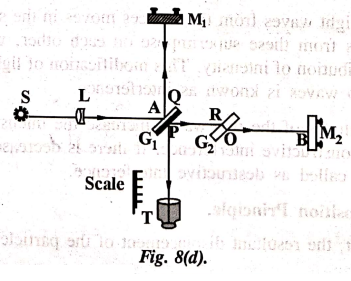
In
Michelson interferometer, the ray from the source and the ray which suffers
reflection from mirror M1 is passed through the glass plate G1
twice whereas the ray reflected from mirror M2 does not even passes once
through the glass plate G1. So to compensate the path a second glass
plate G2 is introduced between the glass plate G1 and the
mirror M2 as shown in Fig. 8(d).
7. What are the uses of
Michelson interferometer ?
It
is used to determine the
(i)
wavelength of a given monochromatic source
(ii)
the difference between the two neighbouring wavelengths or resolution of the
spectral lines
(iii)
refractive index and thickness of various thin transparent materials and
(iv)
for the measurement of the standard metre in terms of the wavelength of light.
Applied Physics I: Chapter 8: Applied Optics - Interference : Tag: Applied Physics : - Optics Interference: Important part-A 2 marks Short Questions and Answers
Applied Physics I: Chapter 8: Applied Optics - Interference
Under Subject
Applied Physics I
PH25C01 1st Semester | 2025 Regulation | 1st Semester 2025 Regulation
Related Subjects

English Essentials I
EN25C01 1st Semester | 2025 Regulation | 1st Semester 2025 Regulation

தமிழர் மரபு - Heritage of Tamils
UC25H01 1st Semester | 2025 Regulation | 1st Semester 2025 Regulation
Applied Calculus
MA25C01 Maths 1 M1 - 1st Semester | 2025 Regulation | 1st Semester 2025 Regulation
Applied Physics I
PH25C01 1st Semester | 2025 Regulation | 1st Semester 2025 Regulation

Applied Chemistry I
CY25C01 1st Semester | 2025 Regulation | 1st Semester 2025 Regulation
Makerspace
ME25C04 1st Semester | 2025 Regulation | 1st Semester 2025 Regulation
Computer Programming C
CS25C01 1st Semester | 2025 Regulation | 1st Semester 2025 Regulation
Computer Programming Python
CS25C02 1st Semester | 2025 Regulation | 1st Semester 2025 Regulation
Fundamentals of Electrical and Electronics Engineering
EE25C03 1st Semester | 2025 Regulation | 1st Semester 2025 Regulation
Introduction to Mechanical Engineering
ME25C03 1st Semester | 2025 Regulation | 1st Semester 2025 Regulation

Introduction to Civil Engineering
CE25C01 1st Semester Civil Department | 2025 Regulation | 1st Semester 2025 Regulation
Essentials of Computing
CS25C03 1st Semester - AID CSE IT Department | 2025 Regulation | 1st Semester 2025 Regulation

Applied Physics I Laboratory
PH25C01 1st Semester practical Laboratory Manual | 2025 Regulation | 1st Semester Laboratory 2025 Regulation

Applied Chemistry I Laboratory
CY25C01 1st Semester practical Laboratory Manual | 2025 Regulation | 1st Semester Laboratory 2025 Regulation

Computer Programming C Laboratory
CS25C01 1st Semester practical Laboratory Manual | 2025 Regulation | 1st Semester Laboratory 2025 Regulation

Computer Programming Python Laboratory
CS25C02 1st Semester practical Laboratory Manual | 2025 Regulation | 1st Semester Laboratory 2025 Regulation
Engineering Drawing
ME25C01 EEE Mech Dept | 2025 Regulation | 2nd Semester 2025 Regulation

Basic Electronics and Electrical Engineering
EE25C04 1st Semester ECE Dept | 2025 Regulation | 2nd Semester 2025 Regulation