Applied Physics CSIE II: UNIT II: Logic Gates
Base Conversions for Number Systems

Electronic and digital systems work with different number systems such as Decimal, Binary, Octal and Hexadecimal. These number systems are important in computing and digital electronics.
BASE CONVERSIONS FOR
NUMBER SYSTEMS
Electronic
and digital systems work with different number systems such as Decimal, Binary, Octal and Hexadecimal.
These number systems are important in computing and digital electronics.
• Decimal (base‒10)
is the number system we use in everyday life for counting and calculations.
• Binary (base‒2)
is the main number system used in digital circuits and the computers work using
0s and 1s.
• Octal (base‒8)
and Hexadecimal (base‒16) are used
to make long binary numbers easier to read and write.
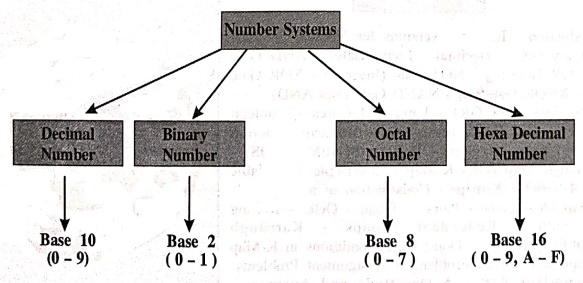
Number Systems:
Decimal Number: Base 10 (0‒9)
Binary Number: Base 2 (0‒1)
Octal Number: Base 8 (0‒7)
Hexa Decimal Number: Base 16 (0‒9, A‒F)
Decimal Number System (Base‒10)
The
decimal system has a base of 10.
It
uses ten digits: 0, 1, 2, 3, 4, 5, 6, 7, 8, 9.
Each
digit's position is based on powers of 10 (100,101,102,...).
For
Example, the Decimal Number 4315.7 can be expanded according to the place value
of each digit, as follows:
4000 + 300 + 10 + 5 + 0.7 = 4315.7
This
can also be written using powers of 10, as follows:
4×10³
+ 3×10² + 1×101 + 5×100 + 7×10‒1
The
same number may also be written as (4315.7)10, where the subscript
10 indicates that the number is in the decimal (base‒10) system.
Binary Number System (Base‒2)
The
binary system has a base of 2.
It
uses only two digits: 0 and 1.
Each
digit's position is based on powers of 2 (20, 21, 22,
... ).
For
example, the binary number 1101.101 shall be represented in powers of 2 and its
decimal value shall be computed as follows.
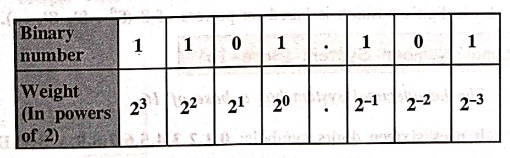
Computation
of decimal value shall be done using the following steps, viz.,
Step 1:
The number can be expanded as:
N = (1×23)+(1×22)+(0×21)+(1×20)+(1×2‒1)+(0×2‒2)+(1×2‒3)
Step 2:
Now calculate each term:
1
× 23 = 8
1
× 22 = 4
0
× 21 = 0
1
× 20 = 1
1
× 2‒1 = 0.5
0
× 2‒2 = 0
1
× 2‒3 = 0.125
Step 3:
Add
them all: 8+4+0+1+0.5+0+0.125 = 13.625
The
decimal equivalent is N = (13.625)10
Octal Number System (Base‒8)
The
octal system has a base of 8.
It
uses eight digits: 0, 1, 2, 3, 4, 5, 6, 7.
Each
digit's position is based on powers of 8 (80, 81, 82,
...).
Hexadecimal Number System (Base‒16)
The
hexadecimal system has a base of 16.
It
uses sixteen digits symbols: 0,1,2,3,4,5,6,7,8,9,A,B,C,D,E,F.
Each
digit's position is based on powers of 16 (160,161,162,
...).
Example 1: Convert decimal (68)10
to binary number.
Solution
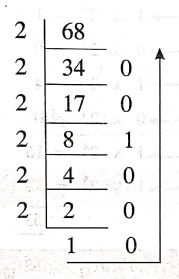
(68)10
= (1 0 0 0 1 0 0)2
Example 2: Convert decimal (13.125)10
to binary number.
Solution
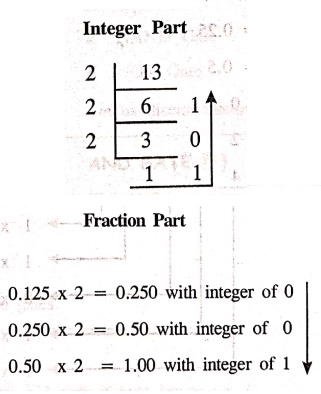
(13.125)10 = (1101. 001)2
Example 3: Convert binary 110101 to decimal.
Solution
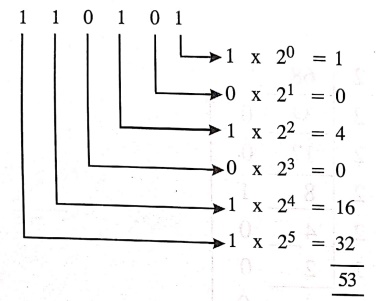
(110101)2
= (53)10
Example 4:
Convert 110.112
into decimal.
Solution
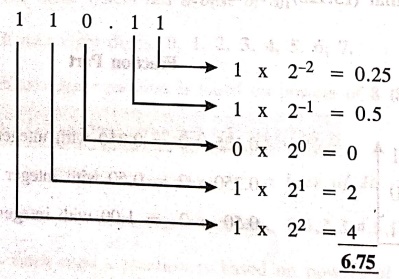
(110.11)2 = (6.75)10
Applied Physics CSIE II: UNIT II: Logic Gates : Tag: Applied Physics : - Base Conversions for Number Systems
Applied Physics CSIE II: UNIT II: Logic Gates
Under Subject
Applied Physics (CSIE) II
PH25C03 2nd Semester AIDS, CSE, IT, CSE(CY) Dept | 2025 Regulation | 2nd Semester 2025 Regulation
Related Subjects

English Essentials II
EN25C02 2nd Semester | 2025 Regulation | 2nd Semester 2025 Regulation

Tamils and Technology தமிழர்களும் தொழில்நுட்பமும்
UC25H02 2nd Semester | 2025 Regulation | 2nd Semester 2025 Regulation
Linear Algebra
MA25C02 2nd Semester | 2025 Regulation
Applied Physics (CSIE) II
PH25C03 2nd Semester AIDS, CSE, IT, CSE(CY) Dept | 2025 Regulation | 2nd Semester 2025 Regulation
Digital Principles and Computer Organization
CS25C06 2nd Semester AIDS, CSE, IT, CSE(CY) Dept | 2025 Regulation | 2nd Semester 2025 Regulation

Basic Electrical and Electronics Engineering
EE25C01 2nd Semester | 2025 Regulation | 2nd Semester 2025 Regulation
Python for Data Science
AD25201 2nd Semester AIDS Dept | 2025 Regulation | 2nd Semester 2025 Regulation

Re-Engineering for Innovation
ME25C05 2nd Semester | 2025 Regulation | 2nd Semester 2025 Regulation
Python for Data Science - Laboratory
AD25201 2nd Semester AIDS Dept | 2025 Regulation | 2nd Semester 2025 Regulation