Applied Physics CSIE II: UNIT II: Logic Gates
Boolean theorems and Boolean Algebra
Boolean Algebra is used to analyse and simplify digital circuits.
BOOLEAN THEOREMS AND
BOOLEAN ALGEBRA
Boolean
Algebra is used to analyse and simplify digital circuits.
Three
basic laws of Boolean algebra are similar to the laws used in ordinary algebra.
These
laws are:
1.
Commutative Law
2.
Associative Law
3.
Distributive Law
BASIC BOOLEAN LAWS
Logical
operations can be expressed and minimized mathematically using the rules, laws
and theorems of boolean algebra.
Boolean Addition:
Boolean
addition involves variables having values of either a binary 1 or 0. The basic
rule for addition are given below
0+0=0
0+1=1
1+0=1
1+1=1
Boolean
addition is same as the logical OR operation Boolean multiplication. Boolean
multiplication involves logical AND operation.
0.0
= 0
0.1
= 0
1.0
= 0
1.1
= 1
The
most common postulates used to formulate various algebraic structures are
1. Closure:
A
set S is closed with respect to a binary operates if, for every pair of
elements of S, the binary operator specifies a rule for obtaining a unique
element of S.
For
example, the set of natural numbers N = {1, 2, 3, 4 ...} is closed with respect
to the binary operator plus (+) by the rules of arithmetic addition, since for
any a, b, EN we obtain a unique C ∈
N by the operation a + b = c.
2. Associative low:
The
associative property for addition is given by
A+
(B+C) = (A+B) + C
The
OR operation of several variables results in the same, regardless of the
grouping of the variables.
The
associative law of multiplication is given by
A.(B.C)
= (A.B).C
According
to this law, it makes no difference in what order the variables are grouped
during the AND operation of several variables.
Example:
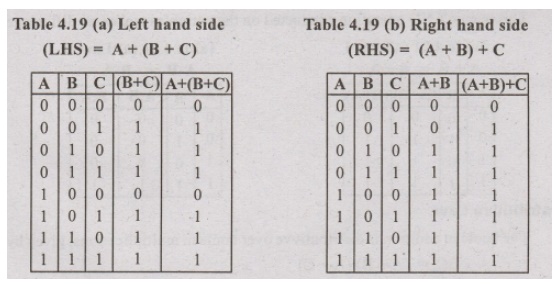
Law I→ A+ (B+ C) =
(A+B) + C
From
the above example grouping of the variable regardless of the grouped output is
same Left hand side A+ (B+ C) equal to Right hand side (A + B) + C.
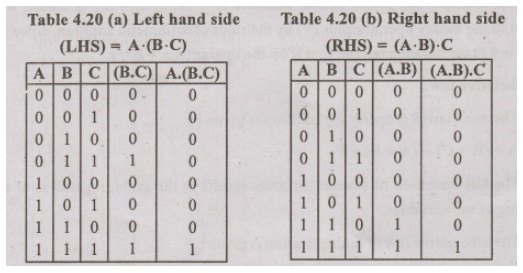
Law II → A.(B-C) =
(A.B).C
From
the above example A (B.C) = (A.B). C are same
Commutative Law
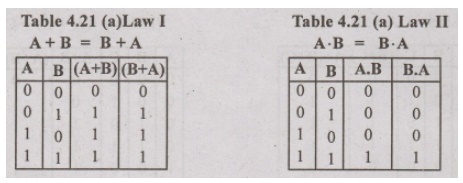
According
to this law, the Boolean addition is commutative is given by ComputerScience
A+
B = B+ A
The
OR operation conducted on the variables makes no difference.
A.B
= B.A
This
means AND operation conducted on the variables makes no difference.
Distributive Law
The
boolean addition is distributive over boolean multiplications, given by
ComputerScience
A+
BC = (A + B) (A + C)
This
law states that the AND operation of several variables and then the OR
operation of the result with a single variable is equivalent to the OR
operation of single variable with each of the several variables and then the
AND operation of the sums.
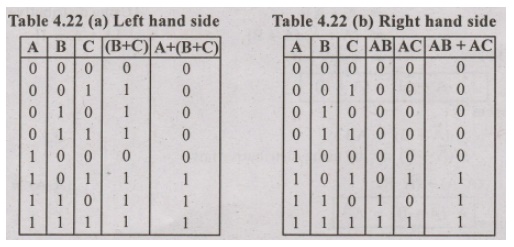
Example
A(B
+ C) = AB+ AC
Theorem 2: A+1 = 1
Proof: A + 1= (A + 1)
• 1
But
in Boolean algebra, A+ 1 = 1, because adding 1 always gives 1.
Therefore,
A+1=1
Theorem 3: A
• 0 = 0
A
multiplied by 0 always results in 0.
Therefore,
A•0=0
Theorem 4: Absorption
Laws
1.
A+AB = A
2.
A(A+B) = A
3.
A( + B) = AB
4.
(A+B)(A+ C) = A + BC
Proof 1: A+AB = A
• 1 + AB
Step 1: A+AB=A•1
+ AB = A • (1+B)
But
(1+B) =1
Step 2: →
A×1 = A Hence Proved
Proof 2: A(A+B) = A
Step 1:
A(A+B) = A•A+AB=A + AB
But
from theorem (1): A+AB=A
Therefore,
Step 2:
A(A+B) = A
Hence
Proved
Proof 3: A(A+B) = AB
Step 1:
A(+B)
Step 2:
= A•+ AB
But
A⚫=0
So
expression becomes:
Step
3: 0+ AB = AB
Hence
Proved
Proof 4: (A+B)(A+ C) =
A+ BC
LHS
= (A+B)(A+C)
Step 1:
=
A•A + A•C + B•A + B•C
=
A + AC + AB + BC
A+AB+BC
[Since
A+AC=A]
Now,
the expresion
A+AB+BC
becomes
A+BC
[since A+AB=A]
Thus,
(A+B) (A+AC) = A+BC
Hence,
proved
Step 2: We
know that
A+AC=A
So
expression becomes:
A+AB+BC
∴ A+BC
Step 3:
A+AB
= A
∴ Expression becomes
Thus,
(A+B) (A+C) = A + BC
Hence
Proved
Theorem 5: A + B
= A + B
R.H.S.
A+B = A=B•1
=
A+B•[A+]
=
A + BA+B
=
A[1+B]+B
=
A+B = LHS
Hence,
proved
Applied Physics CSIE II: UNIT II: Logic Gates : Tag: Applied Physics : - Boolean theorems and Boolean Algebra
Applied Physics CSIE II: UNIT II: Logic Gates
Under Subject
Applied Physics (CSIE) II
PH25C03 2nd Semester AIDS, CSE, IT, CSE(CY) Dept | 2025 Regulation | 2nd Semester 2025 Regulation
Related Subjects

English Essentials II
EN25C02 2nd Semester | 2025 Regulation | 2nd Semester 2025 Regulation

Tamils and Technology தமிழர்களும் தொழில்நுட்பமும்
UC25H02 2nd Semester | 2025 Regulation | 2nd Semester 2025 Regulation
Linear Algebra
MA25C02 2nd Semester | 2025 Regulation
Applied Physics (CSIE) II
PH25C03 2nd Semester AIDS, CSE, IT, CSE(CY) Dept | 2025 Regulation | 2nd Semester 2025 Regulation
Digital Principles and Computer Organization
CS25C06 2nd Semester AIDS, CSE, IT, CSE(CY) Dept | 2025 Regulation | 2nd Semester 2025 Regulation

Basic Electrical and Electronics Engineering
EE25C01 2nd Semester | 2025 Regulation | 2nd Semester 2025 Regulation
Python for Data Science
AD25201 2nd Semester AIDS Dept | 2025 Regulation | 2nd Semester 2025 Regulation

Re-Engineering for Innovation
ME25C05 2nd Semester | 2025 Regulation | 2nd Semester 2025 Regulation
Python for Data Science - Laboratory
AD25201 2nd Semester AIDS Dept | 2025 Regulation | 2nd Semester 2025 Regulation