Applied Physics I: Chapter 5: Oscillations and Waves - Ultrasonics
Determination of velocity of ultrasonic waves in liquid - Acoustic Grating Method
Principle, Construction, Working
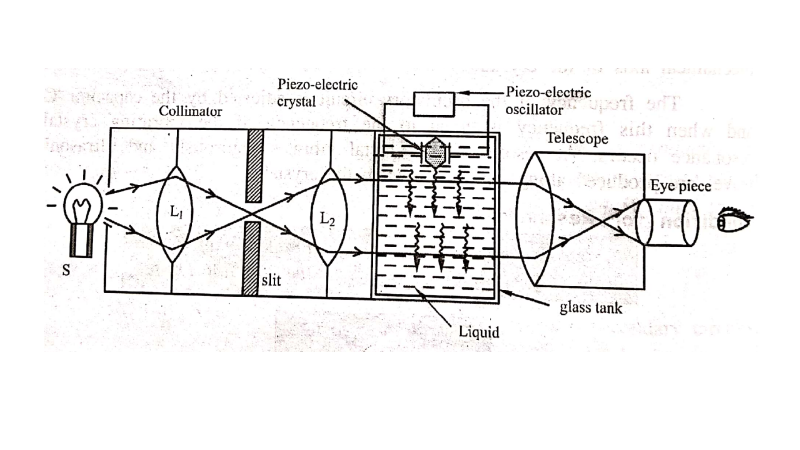
When ultrasonic waves are passed through a liquid, the density of the liquid varies layer by layer due to the variation in pressure and hence the liquid will act as a diffraction grating, so called acoustical grating.
DETERMINATION OF
VELOCITY OF ULTRASONIC WAVES IN LIQUID ‒ ACOUSTIC GRATING METHOD
Principle
When
ultrasonic waves are passed through a liquid, the density of the liquid varies
layer by layer due to the variation in pressure and hence the liquid will act
as a diffraction grating, so called acoustical
grating. Under this condition when a monochromatic source of light is
passed through the acoustical grating, the light gets diffracted. Then by using
the condition for diffraction, the velocity of ultrasonic waves can be
determined.
Construction
It
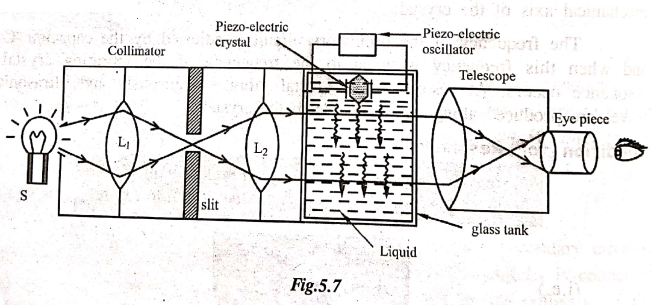
consists of a glass tank, filled with the liquid (say kerosene). A piezo‒
electric crystal (Quartz) is fixed at the top of the glass tank and is
connected to a piezo‒electric oscillatory circuit as shown in Fig.5.7.
An
incandescent lamp is used as a monochromatic source of light(S) and a telescope
arrangement is made to view the diffraction pattern. A collimator consisting of
two lens L1 and L2 is used to focus the light effectively
onto the glass tank.
Working
i) When the piezo‒electric crystal is at rest
Initially
the piezo‒electric crystal is kept at rest and the monochromatic source of
light is switched ON. When the light is focused onto the glass tank filled with
the liquid, a single image (or) a vertical peak is observed on the telescope,
which shows that there is no diffraction.
ii) When the piezo‒electric crystal is set into vibration
The
piezo‒electric crystal (quartz) is set into vibrations using piezo‒electric
oscillatory circuit. At resonance, ultrasonic waves are produced and is passed
through the liquid.
These
ultrasonic waves are reflected by the walls of the glass tank and forms a
stationary wave pattern with nodes and antinodes, in the liquid.
At
nodes the density of the liquid becomes more and at the antinodes the density
of the liquid becomes less. Thus the liquid behaves as a diffracting element
called acoustical grating element.
Now
when the monochromatic source of light is passed through the acoustical
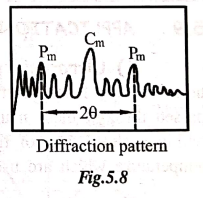
grating, the light gets diffracted and a diffraction pattern consisting of
central maximum (Cm) and principle maxima (Pm) on either
side is viewed through the telescope as shown in Fig. 5.8.
The
velocity of ultrasonic waves can be found using the diffraction condition
i.e.,
2d sin θ = nλ ………………(1)
Where
'd' is the distance between successive nodes (or) antinodes.
θ
is the angle of diffraction.
n
on is the order of spectrum.
λ
is the wavelength of the monochromatic source of light.
If
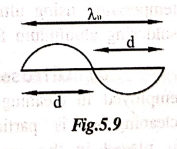
λu is the wavelength of ultrasonics, then
we
can write from Fig.5.9 as λu = 2d ......(2)
Equation
(1) becomes λu sin θ = nλ
(or) Wavelength of ultrasonics λu =
nλ / sin θ
We
know,
Velocity
of ultrasonics = (Frequency of ultrasonics) × (Wavelength of ultrasonics)
Frequency
of ultrasonics produced by piezo‒electric oscillator will be the same as that
of the frequency of the oscillatory circuit. So if vu is the frequency of the ultrasonics produced using
piezo‒electric oscillator then,
Velocity
of Ultrasonics (v) = Vuλu
……………….(4)
Substituting
equation (3) in (4), we get
Velocity
of ultrasonics v = vunλ / sin θ
Thus
the velocity (or) wavelength of the ultrasonics can be determined using
acoustical grating.
NOTE:
Using this method we can determine the velocity of any liquids (or) gases, even
at various temperatures.
Applied Physics I: Chapter 5: Oscillations and Waves - Ultrasonics : Tag: Applied Physics : Principle, Construction, Working - Determination of velocity of ultrasonic waves in liquid - Acoustic Grating Method
Applied Physics I: Chapter 5: Oscillations and Waves - Ultrasonics
Under Subject
Applied Physics I
PH25C01 1st Semester | 2025 Regulation | 1st Semester 2025 Regulation
Related Subjects

English Essentials I
EN25C01 1st Semester | 2025 Regulation | 1st Semester 2025 Regulation

தமிழர் மரபு - Heritage of Tamils
UC25H01 1st Semester | 2025 Regulation | 1st Semester 2025 Regulation

Applied Calculus
MA25C01 Maths 1 M1 - 1st Semester | 2025 Regulation | 1st Semester 2025 Regulation
Applied Physics I
PH25C01 1st Semester | 2025 Regulation | 1st Semester 2025 Regulation

Applied Chemistry I
CY25C01 1st Semester | 2025 Regulation | 1st Semester 2025 Regulation
Makerspace
ME25C04 1st Semester | 2025 Regulation | 1st Semester 2025 Regulation

Computer Programming C
CS25C01 1st Semester | 2025 Regulation | 1st Semester 2025 Regulation

Computer Programming Python
CS25C02 1st Semester | 2025 Regulation | 1st Semester 2025 Regulation

Fundamentals of Electrical and Electronics Engineering
EE25C03 1st Semester | 2025 Regulation | 1st Semester 2025 Regulation

Introduction to Mechanical Engineering
ME25C03 1st Semester | 2025 Regulation | 1st Semester 2025 Regulation

Introduction to Civil Engineering
CE25C01 1st Semester Civil Department | 2025 Regulation | 1st Semester 2025 Regulation
Essentials of Computing
CS25C03 1st Semester - AID CSE IT Department | 2025 Regulation | 1st Semester 2025 Regulation

Applied Physics I Laboratory
PH25C01 1st Semester practical Laboratory Manual | 2025 Regulation | 1st Semester Laboratory 2025 Regulation

Applied Chemistry I Laboratory
CY25C01 1st Semester practical Laboratory Manual | 2025 Regulation | 1st Semester Laboratory 2025 Regulation

Computer Programming C Laboratory
CS25C01 1st Semester practical Laboratory Manual | 2025 Regulation | 1st Semester Laboratory 2025 Regulation

Computer Programming Python Laboratory
CS25C02 1st Semester practical Laboratory Manual | 2025 Regulation | 1st Semester Laboratory 2025 Regulation
Engineering Drawing
ME25C01 EEE Mech Dept | 2025 Regulation | 2nd Semester 2025 Regulation

Basic Electronics and Electrical Engineering
EE25C04 1st Semester ECE Dept | 2025 Regulation | 2nd Semester 2025 Regulation