Applied Physics I: Chapter 5: Oscillations and Waves - Ultrasonics
Ultrasonics: Important Solved Problems
Anna University Solved Problems, Additional Solved Problems, Assignment Problems - Questions with solved Solution and Answer - Applied Physics I: Chapter 5: Oscillations and Waves - Ultrasonics
ANNA UNIVERSITY SOLVED
PROBLEMS
1. Calculate the
frequency to which a piezo electric oscillator circuit should be tuned so that
a Piezo‒electric crystal of thickness 0.1cm vibrates in its fundamental mode to
general ultrasonic waves. (Young's Modulus and density of material of crystal
are 80 Gpa and 2654 kgm‒3?
Solution
The
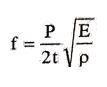
frequency of vibration is given by f
= P/2t . √(E/ρ)
For
fundamental mode P = 1.
f
= 1/2t . √(E/ρ)
f
= 1/(2×0.1×10−2) . √( 80×109 / 2654 )
f
= 2.7451×10⁶ Hz
The frequency of the oscillator circuit = 2.7451×10⁶
Hz.
2. A quartz crystal of
thickness 0.001 metre vibrates in its fundamental frequency. Calculate its
frequency. Given that E=7.9×10¹⁰ N/m2 and ρ =2650 kg/m3
for quartz.
Given
data
t = 1×10‒3 m,
E=7.9×10¹⁰
N/m2;
ρ=2650
kg/m3
Solution
Formula
The
frequency of vibration f = P/2t .
√(E/ρ)
For
fundamental mode of frequency P = 1
f=
1/(2×1×10‒3) . √[7.9×10¹⁰ /2650]
f=
500 × 29.811 × 106
f=
500 × 5459.945
f=
2.7299 × 10⁶ Hz
Frequency of vibrating crystal = 2.729 MHz
3.
A quartz crystal in an ultrasonic interferometer produces stationary waves of
frequency 1.5 MHz. If the distance between 6 consecutive nodes is 2.75 mm, find
the velocity of the ultrasonic wave.
Solution
Given
data
(i)
Frequency of ultrasonics (vu) = 1.5 MHz. = 1.5 × 10⁶ Hz.
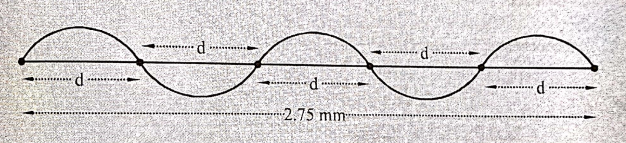
(ii) Distance between 6 consecutive nodes =
2.75 mm
i.e.,
5d = 2.75 mm
d
= (2.75/5) × 10‒3 m
d
= 5.5 x 10‒4 m
From
the above figure, we can write wavelength λu = 2d
λu= 2 × 5.5 × 10‒4 m
(or)
λu=
1.1 × 10‒3 m
Velocity
of ultrasonics = Frequency × Wavelength
v
= vuλu
v
= 1.5 × 106 × 1.1 × 10‒3 m
v
= 1650 m/sec.
Velocity of ultrasonics (v) = 1650 m/sec.
4. A ultrasonic
generator consists of a quartz plate of thickness 0.7 mm and density 2800 kg/m3.
Find the fundamental frequency of ultrasonic waves if the Young's modulus of
quartz is 8.8 × 10¹⁰ N/m2.
Given
Data:
l
= 0.7 mm = 0.7 × 10‒3m
ρ = 2800 kg/m3
P
= 1
E
= 8.8 × 10¹⁰ Nm‒2
Formula:
Fundamental
frequency (f) = P/2l . √(E/ρ)

f = 1/(2×0.7×10‒3)
. √(8.8×10¹⁰ / 2800)
f = 4.004 × 10⁶
Hz
(or)
f=4.004 MHz
The fundamental frequency of Ultrasonic waves = 4.004 MHz
5. A quartz crystal of
thickness 0.001 m is vibrating at resonance. Calculate the fundamental
frequency. Density of quartz = 2.650 × 10³ kg/m3 and
Young's modulus for quartz = 7.9 × 10¹⁰ Nm‒2.
Given
Data:
l=0.001m
p=2.650×10³
kg/m3
E=7.9×10¹⁰
Nm‒2
P=1
Formula:
Fundamental
frequency (f) = P/2l
. √(E/ρ)
=
1/(2 × 0.001) . √ [7.9×10¹⁰ /
2.650×10³]
f=2.7299×10⁶
Hz
The fundamental frequency = 2.7299 MHz
6. Longitudinal
standing waves are set up in a quartz plate with antinodes at opposite faces.
The fundamental frequency of vibration is given by the relation f = 2.87×10³/t where f is in Hz and t is in metre.
Compute (i) Young's
modulus of quartz plate
(ii) The thickness of
the plate required for a frequency of 1300 KHz. The density of quartz is 2660
kg m‒3.
Solution
(i)
The frequency of vibration is given by f = P/2t . √(E/ρ)
For
fundamental frequency P = 1
f = 1/2t . √(E/ρ)
Substituting
the value of 'f', we have
2.87×10³
/ t =
1/2t . √(E/2660)
E
= 4 × 2660 × (2.87×103)2
=
8.76406×10¹⁰ Nm‒2
The Young modulus of the quartz plate = 8.76406×10¹⁰
Nm‒2
(ii)
The frequency of vibration = 1300 KHz
we
know that f = 1/2t . √(E/ρ)
(or)
Thickness
(t) = 1/2f . √(E/ρ)
=
1 / (2x1300x103) . √(8.76406×10¹⁰ / 2660)
=
2.2076 × 10‒3 m
The thickness of the crystal = 2.2076×10‒3 m.
7. An ultrasound pulse
sent by a source in sea is reflected by a submerged target at a distance
597.50m and reaches the source after 0.83 seconds. Find the velocity of sound
in sea water.
Given
Data:
d
= 597.50m
t
= 0.83 sec
Formula:
Velocity
(v) = 2d / t
Velocity
(v) = 2×597.5 / 0.83
Velocity
(v) = 1439.75 m/s
Velocity of sound in sea water = 1439.75 m/s
8. A quartz crystal
with a thickness of 0.5 mm and a density of 2650 kg.m‒3 vibrates
longitudinally producing ultrasonic waves. Find the fundamental frequency of
vibration if the Young's modulus of quartz is 7.9×10¹⁰ Nm‒2.
Given
data:
t
= 0.5 × 10‒3 m
ρ
= 2650 kgm‒3
E
= 7.9 × 10¹⁰ Nm‒2
Formulae:
f = P/2t . √(E/ρ)
for
fundamental mode P=1
f = 1/2t . √(E/ρ)
(or)
f =
1/(2 × 0.5 × 10‒3) . √(7.9 × 10¹⁰ / 2650)
f = [1× (5459.97) ] / [ 1× 10‒3 ]
f
= 5.45997 × 10⁶ Hz
The fundamental frequency=
5.45997 MHz
9. Calculate the
fundamental frequency of a quartz crystal of thickness 1.5mm which is vibrating
at resonance. Given Young's modulus for quartz 7.9×10¹⁰Nm‒2
and density of quartz = 2650 kg m‒3.
Solution
The
frequency of vibration f = P/2t . √(E/ρ)
Where
P=1,2,3 etc for fundamental, first overtone, second overtone respectively,
Here
P= 1
f =
1/[2×1.5×10‒3] . √(7.9×10¹⁰ / 2650)
f =
1.8199 × 10⁶ Hz
The fundamental frequency of the quartz crystal = 1.8199×10⁶
Hz or 1.8199 MHz
ADDITIONAL
SOLVED PROBLEMS
1. The velocity of
ultrasonics in steel is 5000m/s. An ultrasonic beam is used to determine the
thickness of a steel plate. It is noticed that the difference between two
adjacent harmonic frequencies is 60 KHz. Determine the thickness of the steel
plate.
Solution
The
frequency of ultrasonics f = v / 2d
Let
fn and fn‒1 be the two adjacent
harmonic frequencies.
fn
‒ fn‒1 = v / 2d
d
= v / 2(fn ‒ fn‒1)
The
difference between the two harmonic frequency = fn ‒ fn‒1
=
60 KHz
=
60 × 103 Hz
d
= 5000 / 2×60×103
= 0.04166 m
The thickness of the steel plate is 0.04166 m.
2. Find the depth of a
submerged submarine if an ultrasonic wave is received after 0.33 sec. from the
time of transmission.
Given:
The
velocity of ultrasonic waves in sea water = 1440 m/s.
Solution
Velocity
of ultrasonics in sea water, v = 1440 m/s.
Time
taken between transmitted and received ultrasonic waves t=0.33 sec.
We
know velocity (v) = Distance (d) / Time (t)
Total
distance travelled by ultrasonics = v × t
Distance
(d) = 1440 × 0.33
Distance
(d) = 475.2 m
Here,
the total distance travelled by ultrasonics waves refers to the distance
travelled (i) From source to the submarine and (ii) From the submarine to the
source i.e., equal to twice the depth of the submarine from the transmitting end.
Depth
of submerged submarine = 475.2 / 2
=
237.6 metres
Depth of the submerged submarine = 237.6 metres.
3. An ultrasonic
interferometer used to measure the velocity in sea water. If the distance
between two constructive antinodes is 0.55mm. Compute the velocity of the waves
in the sea water. The frequency of the crystal is 1.5 MHz.
Solution
Distance
between two antinodes = λ/2
=
0.55 mm.
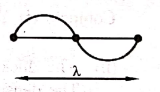
λ/2
= 0.55 × 10‒3 m
λ
= 1.1 × 10‒3 m
Velocity
of ultrasonics = Frequency × wavelength
=
1.5 × 106 × 1.1 × 10‒3
=
1650 m/s
Velocity of ultrasonics in sea water = 1650 m/s.
ASSIGNMENT PROBLEMS
1.
Calculate the fundamental frequency of 3 mm thick x‒cut quartz crystal. Given
Young's modulus for quartz is 7.9 ×10¹⁰ Nm‒2 and ρ for
quartz is 2650 kg m3. (Ans: 9.09×10⁵ Hz)
2.
An ultrasonic beam is used to determine the thickness of a steel plate. The
velocity of ultrasonics in steel is 5000 m/s. It is noticed that the difference
between the two adjacent harmonic frequencies is 56 KHz. Determine the
thickness of the given steel plate. (Ans:
0.0446 m)
3.
Calculate the frequency of the fundamental note and the first overtone emitted
by a piezoelectric crystal using the following data. Vibrating length is 4 mm. Young's
modulus of quartz = 7.9 × 10¹⁰Nm‒2 and density of crystal
= 2650 kgm‒3.
(Ans: Fundamental note
6.824 ×10⁵Hz, First overtone = 1.364 ×10⁶Hz)
4.
Longitudinal standing waves are set up in a quartz plate with antinodes at
opposite faces. The fundamental frequency of vibration is given by the
relation, f = 2.5 × 10³ / t,
where t is the thickness of the plate in metre.
Compute
(i) Young's modulus of the quartz plate
(ii)
The thickness of the plate required for a frequency of 1400 KHz. The density of
quartz is 2,660 kgm‒3 (E=6.65 ×10¹⁰ Nm‒2;
t=1.785×10‒3m)
Applied Physics I: Chapter 5: Oscillations and Waves - Ultrasonics : Tag: Applied Physics : - Ultrasonics: Important Solved Problems
Applied Physics I: Chapter 5: Oscillations and Waves - Ultrasonics
Under Subject
Applied Physics I
PH25C01 1st Semester | 2025 Regulation | 1st Semester 2025 Regulation
Related Subjects

English Essentials I
EN25C01 1st Semester | 2025 Regulation | 1st Semester 2025 Regulation

தமிழர் மரபு - Heritage of Tamils
UC25H01 1st Semester | 2025 Regulation | 1st Semester 2025 Regulation

Applied Calculus
MA25C01 Maths 1 M1 - 1st Semester | 2025 Regulation | 1st Semester 2025 Regulation
Applied Physics I
PH25C01 1st Semester | 2025 Regulation | 1st Semester 2025 Regulation

Applied Chemistry I
CY25C01 1st Semester | 2025 Regulation | 1st Semester 2025 Regulation

Makerspace
ME25C04 1st Semester | 2025 Regulation | 1st Semester 2025 Regulation

Computer Programming C
CS25C01 1st Semester | 2025 Regulation | 1st Semester 2025 Regulation

Computer Programming Python
CS25C02 1st Semester | 2025 Regulation | 1st Semester 2025 Regulation

Fundamentals of Electrical and Electronics Engineering
EE25C03 1st Semester | 2025 Regulation | 1st Semester 2025 Regulation

Introduction to Mechanical Engineering
ME25C03 1st Semester | 2025 Regulation | 1st Semester 2025 Regulation

Introduction to Civil Engineering
CE25C01 1st Semester Civil Department | 2025 Regulation | 1st Semester 2025 Regulation

Essentials of Computing
CS25C03 1st Semester - AID CSE IT Department | 2025 Regulation | 1st Semester 2025 Regulation

Applied Physics I Laboratory
PH25C01 1st Semester practical Laboratory Manual | 2025 Regulation | 1st Semester Laboratory 2025 Regulation

Applied Chemistry I Laboratory
CY25C01 1st Semester practical Laboratory Manual | 2025 Regulation | 1st Semester Laboratory 2025 Regulation

Computer Programming C Laboratory
CS25C01 1st Semester practical Laboratory Manual | 2025 Regulation | 1st Semester Laboratory 2025 Regulation

Computer Programming Python Laboratory
CS25C02 1st Semester practical Laboratory Manual | 2025 Regulation | 1st Semester Laboratory 2025 Regulation
Engineering Drawing
ME25C01 EEE Mech Dept | 2025 Regulation | 2nd Semester 2025 Regulation

Basic Electronics and Electrical Engineering
EE25C04 1st Semester ECE Dept | 2025 Regulation | 2nd Semester 2025 Regulation