Applied Physics I: Chapter 5: Oscillations and Waves - Ultrasonics
Applications of Ultrasonics
Applications of Ultrasonics
APPLICATIONS
OF ULTRASONICS
1) Ultrasonic drilling
and cutting:
Ultrasonics
are used for making holes in very hard materials such as glass, diamond etc.,
When ultrasonics are passed through these materials it creates air bubbles.
This air bubbles collapses within a short span of time, thereby releasing a
large amount of pressure and temperature which are used for cutting and
drilling.
2) Ultrasonic welding
and soldering:
Some
materials cannot be welded at high temperature. In such cases the welding can
be done at room temperature using ultrasonics and is called as cold welding. It
is also used for soldering aluminium foil condensers, aluminium wires etc.,
without any flux.
3) Ultrasonic cleaning
and drying:
Ultrasonics
can also be employed in cleaning motors, aeroplanes, electronic assemblies
etc., Here the cleaning tank is partially filled with detergent solutions. The
article to be cleaned is placed in this tank. The ultrasonics are imparted to
the solution, which accelerates the molecules in the liquid to move with high
kinetic energy. This particles strikes the dirt particles and clean it. Further
it can also be dried using acoustic drier.
4) Coagulation:
They
are used in coagulation (changing from liquid phase to a semi solid phase) and
crystallisation, hence can be used in the manufacturing of paints, polishes
etc.
5) In industries:
ultrasonics
are used to remove air bubbles in the liquid metals and convert them into fused
metals. Low frequency ultrasonics are used in sorting paper fibers from the
paper pulp. They are also used to increase the sensitivity of colour in
photographs by dispersion of dye in the emulsion.
6) Sound Signalling:
High
frequency ultrasonics can be sent out in the form of beams, which spreads in
all directions as spherical wavefronts and passes the signals from one place to
another. Thus the signals can be used as an identification for landing the
ships. In military field the method of sound signalling can used to identify
our warships.
7) Depth sounding:
Echo
sounding is the principle used to find the depth of the sea. A beam of
ultrasonics is directed towards the bottom of the sea and the reflected signal
is received as shown in Fig. 5.10.
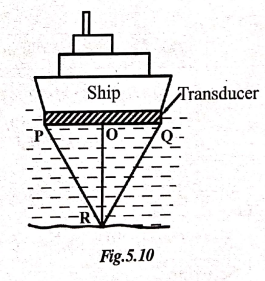
The
time interval between the transmitted and received signal is noted and let it
be 't'. If 'v' is the velocity of the ultrasonics, then
Velocity
= Distance travelled / Time taken
From
Fig.5.12, we can write
v = [PR+
RQ] / t = 2RO (approx) / t
RO
= Depth of sea = vt / 2
The
depth of the sea can be directly calibrated using the instrument called as
Fathometer (or) Echometer.
NOTE:
Using the same principle, ultrasonics are also used in sound navigation purpose
(SONAR).
Applied Physics I: Chapter 5: Oscillations and Waves - Ultrasonics : Tag: Applied Physics : - Applications of Ultrasonics
Applied Physics I: Chapter 5: Oscillations and Waves - Ultrasonics
Under Subject
Applied Physics I
PH25C01 1st Semester | 2025 Regulation | 1st Semester 2025 Regulation
Related Subjects

English Essentials I
EN25C01 1st Semester | 2025 Regulation | 1st Semester 2025 Regulation

தமிழர் மரபு - Heritage of Tamils
UC25H01 1st Semester | 2025 Regulation | 1st Semester 2025 Regulation
Applied Calculus
MA25C01 Maths 1 M1 - 1st Semester | 2025 Regulation | 1st Semester 2025 Regulation
Applied Physics I
PH25C01 1st Semester | 2025 Regulation | 1st Semester 2025 Regulation

Applied Chemistry I
CY25C01 1st Semester | 2025 Regulation | 1st Semester 2025 Regulation
Makerspace
ME25C04 1st Semester | 2025 Regulation | 1st Semester 2025 Regulation
Computer Programming C
CS25C01 1st Semester | 2025 Regulation | 1st Semester 2025 Regulation
Computer Programming Python
CS25C02 1st Semester | 2025 Regulation | 1st Semester 2025 Regulation
Fundamentals of Electrical and Electronics Engineering
EE25C03 1st Semester | 2025 Regulation | 1st Semester 2025 Regulation
Introduction to Mechanical Engineering
ME25C03 1st Semester | 2025 Regulation | 1st Semester 2025 Regulation

Introduction to Civil Engineering
CE25C01 1st Semester Civil Department | 2025 Regulation | 1st Semester 2025 Regulation
Essentials of Computing
CS25C03 1st Semester - AID CSE IT Department | 2025 Regulation | 1st Semester 2025 Regulation

Applied Physics I Laboratory
PH25C01 1st Semester practical Laboratory Manual | 2025 Regulation | 1st Semester Laboratory 2025 Regulation

Applied Chemistry I Laboratory
CY25C01 1st Semester practical Laboratory Manual | 2025 Regulation | 1st Semester Laboratory 2025 Regulation

Computer Programming C Laboratory
CS25C01 1st Semester practical Laboratory Manual | 2025 Regulation | 1st Semester Laboratory 2025 Regulation

Computer Programming Python Laboratory
CS25C02 1st Semester practical Laboratory Manual | 2025 Regulation | 1st Semester Laboratory 2025 Regulation
Engineering Drawing
ME25C01 EEE Mech Dept | 2025 Regulation | 2nd Semester 2025 Regulation

Basic Electronics and Electrical Engineering
EE25C04 1st Semester ECE Dept | 2025 Regulation | 2nd Semester 2025 Regulation