Digital Principles and Computer Organization: Chapter 8: Instruction Set Architecture and Control Unit Design
Instruction Set Architecture (ISA)
Questions: 1. Write a note on Instruction Set Architecture (ISA). 2. What is the importance of ISA?
Digital
Principles and Computer Organization:
Chapter 8: Instruction
Set Architecture and Control Unit Design
Instruction Set
Architecture (ISA)
•
The Instruction Set Architecture (ISA),
or processor architecture, serves as the interface between software and
hardware, defining the set of instructions a CPU can execute, their encoding
formats and the behaviour they produce.
•
It provides a standardized framework that allows programs written for a
specific ISA to run on different CPUs implementing the same architecture,
ensuring compatibility and portability.
• ISAs guide both software development–by specifying instruction types, addressing
modes and registers–and hardware design,
by defining registers, memory models, control units, and execution pipelines.
•
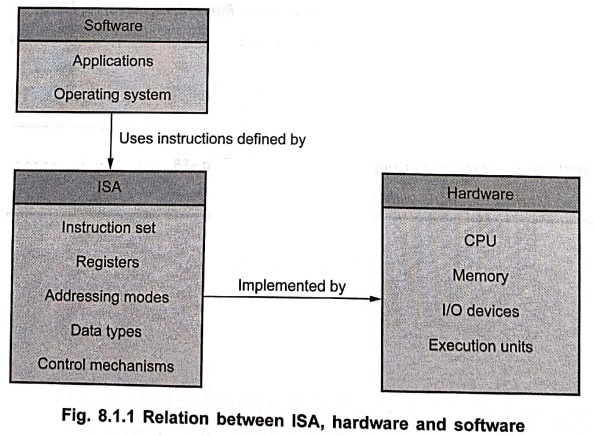
Fig. 8.1.1 shows the relation between ISA, hardware and software.
■ Software
uses the ISA to write and execute programs.
■
ISA acts as the bridge, defining
instructions, registers, data types, addressing modes and control mechanisms.
■ Hardware implements
the ISA in physical components like CPU, memory and I/O devices, enabling
program execution.
Key components of ISA :
1. Instruction set : Includes
arithmetic (add, subtract, multiply, divide), logical (AND, OR, XOR), data
transfer (load, store), control flow (branch, jump) and specialized instructions
(multimedia, cryptography, AI acceleration).
2. Instruction format :
Specifies opcode, operand fields, immediate values and control bits,
influencing instruction length, encoding efficiency and fetch/decode
complexity.
3. Data types :
Defines the supported data types, including integers, floating–point numbers
and characters, along with their size and memory representation.
4. Registers :
High–speed storage within the CPU, used for quick data access and intermediate
computations. ISA defines the number, size and purpose of registers.
5. Memory model and
addressing modes : Specifies how instructions access
memory, including direct, indirect, immediate and indexed modes. Endianness
(big–endian vs. little–endian) is also defined.
6. Input/Output mechanisms
: Instructions
or dedicated I/O processors enable the CPU to interact with external devices.
7. Interrupts and
exceptions : Provide mechanisms for handling
asynchronous events (interrupts) and synchronous errors (exceptions).
8. Privilege levels :
Support multiple operating modes (user, kernel) to enforce security and system
protection.
9. Parallelism support :
Some ISAs include vector, SIMD, or multithreading instructions to enable high–performance
computing.
10. Microarchitecture
independence : The same ISA can be implemented with
different pipelines, cache structures and execution units, allowing hardware
innovation without affecting software.
Importance of ISA :
• Compatibility and
portability : Programs run across different CPUs with
the same ISA.
•
Software development : Provides a
clear instruction framework, enabling efficient coding, compilation and
optimization.
• Hardware design :
Informs CPU design, including control units, memory access and execution
pipelines.
• Performance
optimization : Instruction selection, encoding and
parallelism influence speed and efficiency.
• Security and
reliability : Privilege levels, memory protection and
exception handling ensure safe operation.
•
Specialization : Different ISAs can
be optimized for specific tasks, such as graphics, scientific computing, or AI.
Review Questions
1. Write a note on
Instruction Set Architecture (ISA).
2. What is the
importance of ISA?
Digital Principles and Computer Organization: Chapter 8: Instruction Set Architecture and Control Unit Design : Tag: : - Instruction Set Architecture (ISA)
Digital Principles and Computer Organization: Chapter 8: Instruction Set Architecture and Control Unit Design
Under Subject
Digital Principles and Computer Organization
CS25C06 2nd Semester AIDS, CSE, IT, CSE(CY) Dept | 2025 Regulation | 2nd Semester 2025 Regulation
Related Subjects

English Essentials II
EN25C02 2nd Semester | 2025 Regulation | 2nd Semester 2025 Regulation

Tamils and Technology தமிழர்களும் தொழில்நுட்பமும்
UC25H02 2nd Semester | 2025 Regulation | 2nd Semester 2025 Regulation
Linear Algebra
MA25C02 2nd Semester | 2025 Regulation
Applied Physics (CSIE) II
PH25C03 2nd Semester AIDS, CSE, IT, CSE(CY) Dept | 2025 Regulation | 2nd Semester 2025 Regulation
Digital Principles and Computer Organization
CS25C06 2nd Semester AIDS, CSE, IT, CSE(CY) Dept | 2025 Regulation | 2nd Semester 2025 Regulation

Basic Electrical and Electronics Engineering
EE25C01 2nd Semester | 2025 Regulation | 2nd Semester 2025 Regulation
Python for Data Science
AD25201 2nd Semester AIDS Dept | 2025 Regulation | 2nd Semester 2025 Regulation

Re-Engineering for Innovation
ME25C05 2nd Semester | 2025 Regulation | 2nd Semester 2025 Regulation
Python for Data Science - Laboratory
AD25201 2nd Semester AIDS Dept | 2025 Regulation | 2nd Semester 2025 Regulation